Death is the Last Frontier

Characters dying at 0 hit points and disappearing is great for raising the stakes, having a grim world, and encouraging certain play styles.

It is not the only way to create an interesting adventure, be it OSR or not.

Let's look at a few video games and pieces of fiction where death is just the beginning of a greater adventure, or where constant death is a reality.

The Soul of Cinder, an amalgamation of undead champions in Dark Souls 3

Soulsborne Games - This is Demon's Souls, all three Dark Souls games, and Bloodborne. In these games, your character is essentially immortal; they die, respawn, and try again, losing a little bit more of themselves along the way. In world, you can see various would-be characters that don't have the same strength your character does. Hollows in Dark Souls, or Demons in Demon's Souls, or Beasts in Bloodborne. Essentially, the mechanic is, you can use death to make risky plays and to learn things and to keep moving forward up till a certain point, changing with every death.

Sekiro: Shadow's Die Twice - Made by the same company as the above, the difference here is that when your character in Sekiro dies, you have a limited number of times where you can respawn automatically. This allows you to take enemies by surprise and set up some very interesting ways to achieve your goals. If you exceed that number, you are returned to a shrine that you've prayed too.

Bleach - A manga made by Tite Kubo, here death allows for most mortals to achieve the greater powers and poetry of their souls, essentially becoming greater beings and refining themselves through what might as well be a poetic representation of reincarnation. Here, death serves as a gateway to getting strong, though dying again leads to actual death, making it a one time thing that isn't always beneficial either.

Death Parade - An anime where, after dying, the characters go to a bar and have to gamble for their soul in order to move on deeper into the afterlife. In this case, death serves as an entirely new adventure laden with all kinds of theme about sin vs virtue, dying with regrets, moving on past grief, etc. This set up is less game mechanic and more "what do when death has come for me."

Princess Mononoke - This is a strange one, where actual death doesn't become a thing until the very end in true. Throughout the movie, protagonist Prince Ashitaka is dying from a curse given to him by a dying demon-god. He ventures to a mythical forest where the Forest God there has power of life and death, and rebirths him--healing a fatal wound but not his injury. The god, when it dies later, baptizes him as thanks for returning to it a decapitated head. Here we have a situation where one thing in particular in killing the characters, but other things can/will not, leading them into a series of adventures to get rid of the actual death curse on them.
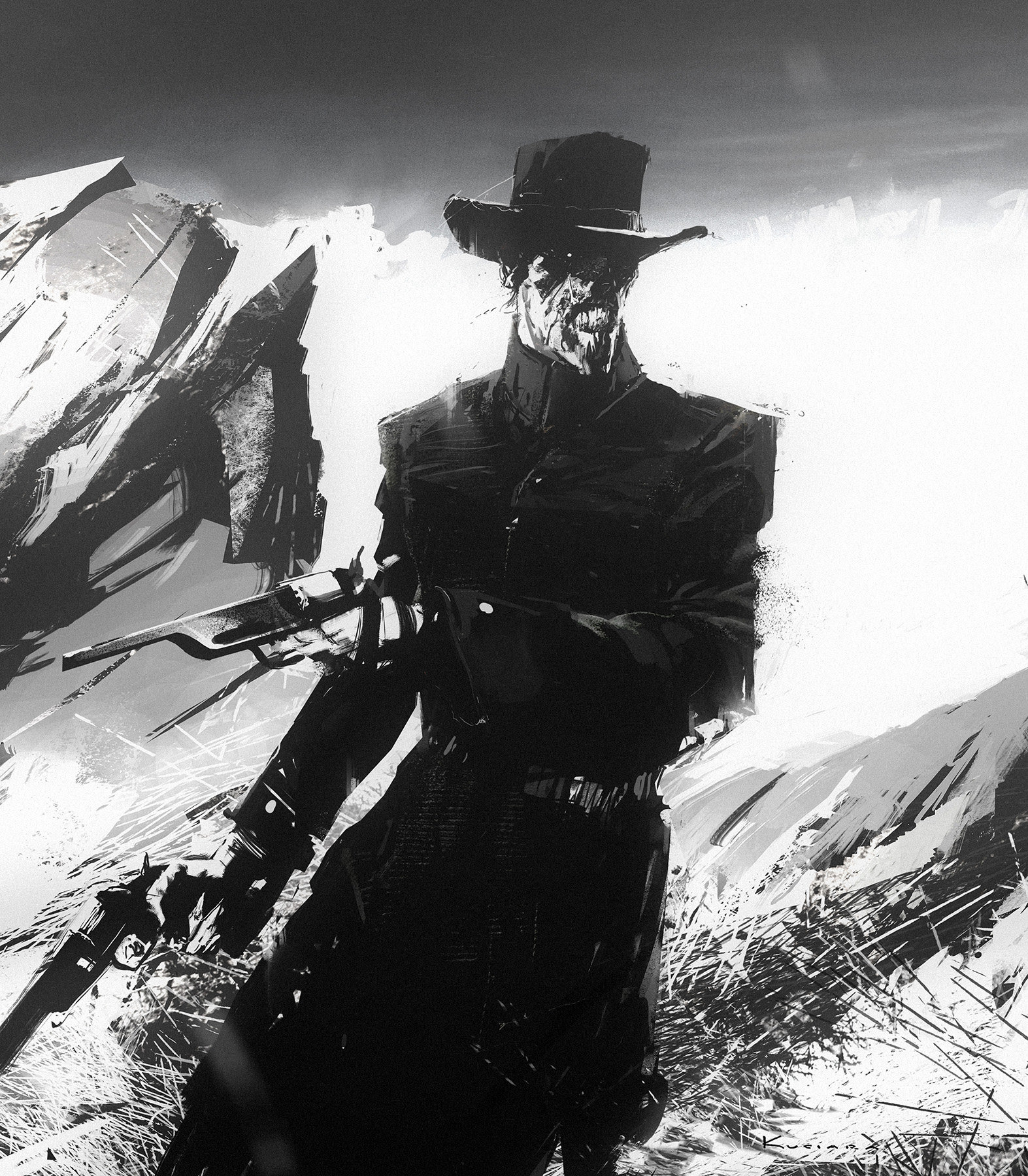
Undead Gunslinger by Kuciara.

All of the above say one thing to me: death is an avenue for adventure.

It can be used to:

  1. Learn more about the world, it's challenges, and how to overcome them.
  2. Be used as a tool to gain advantages.
  3. Be a requirement to gaining power to achieve more difficult goals.
  4. Serve as a compelling post-death adventure.
  5. Be used to create an interesting, unique set-up for adventures.
Now then, translating this to game mechanics.

The system I've been working on for the past week or so has been building to this. These "death mechanics" and the themes/ideas surrounding them are exactly what I want my RPG to capture. I guess, in truth, what I'm writing isn't a true OSR adventure--it isn't designed in a way to achieve interesting dungeon crawls or as a full call back to older editions of the game. The point of the RPG is to introduce new ways to adventure/play games that are fantasy in nature. BUT, that being said, these death mechanics can and probably should be applied to OSR since death is so frequent. Imagine playing Frostbitten & Mutilated, dying, and then encountering an amazon tribe that exists only in this weird death-space, frozen and hateful?

Possibilities abound.

Let's start with a simple Dark Souls inspired death-mechanic.

Hit Dice as Treasure
You do not gain hit dice (HD) from leveling up in a class, or from rolling on a Class Advancement Table (CAT). Instead, you gain HD from discovering strange graves, hidden away corpses, killing monsters, or buried inside of obscure dungeons. When you discover a new HD, roll 1d12 and add the number rolled to your maximum and current hit points (HP).

When your hit points are reduced to 0, you die. You reincarnate with all your equipment, no wounds, and at your maximum HP within 1d10 miles of your place of death. When you reincarnate this way, half of your HD (rounded up) are left in place of your corpse. If you ever run out of HD upon death, you leave behind a corpse suspect to the whims of whoever or whatever killed you.

What does this do? HD are a form of treasure separate from magical items or coins that can and should be sought out if the players want to become powerful. Losing your HD sucks, but you have incentive to go and find them, creating an emerging story of revenge or retrieval. It has interesting world-building implications as well. What is an HD? Is it a Dark Souls-esque soul-flame? Are they vials of blood? Are they roses that must be made into tea and drank? Are they drugs that must be imbibed? This leads to things like kings hiring adventures to go bring them back hordes of HD, leading to new adventure dynamics, new enemy goals, etc.

In short, this small mechanical change completely changes how a game is played and adds a lot of unique spice to a game.
Image result for dark souls death art
Bonfires from Dark Souls, or something similar, can be used instead of the 1d10 miles concept.

I'll be making a lot of death mechanics like this for the game I'm making, and they'll become a feature in the games I run as well. Death is the last frontier for living creatures--might as well explore it!

Exploring Characters pt. 4: Removing Levels + Dealing with Combat / AC + Hirelings Without Charisma

Going back over the rules I've been sketching for my own games and how I want to run OSR (and, tbh, modern stuff too), I've realized I don't need levels anymore. This came off to me as heretical at first but I quickly realized that the style of game I run and the direction I want my material to go made levels largely pointless.

Two Keywords: Knight + Calm & Collected.

There is still advancement in what I'm crafting . I'm a strong believer that a setting or campaign should have it's own method of dolling out XP. Below are some methods common:

  • Treasure as XP
  • Killing as XP
  • Finding resources as XP
  • Discovering/clearing hexes or dungeon rooms as XP
  • Narrative milestones for XP
Instead of giving people fat ass numbers (TM) for XP, I want to go this route:

When you complete X task for experience, you receive 1 experience point. You can spend this experience point at the beginning or end of a session to roll on your Class Advancement table (CAT) or to buy a new keyword.

With the above, you get ye olde' advancement (either generic or with a cool new class button feature) or a new keyword to further expand what your character is narratively. Well, I guess both expand them narratively, but the latter is more focused on what you can do beyond your class constraints.

Below is a slightly amended class advancement table detailing the generic half for all characters.

1-20: HD increases by 1. Roll again and add 20 to the roll unless you choose this option from #50.21-30: Add +1 to all saving throws.31-40: 1+your level of hirelings are attracted to you by reputation alone.41-49: Expand the success range on one of your keywords from 5-6 to 4-6. Continue expanding to a maximum of 2-6 every time you roll this option.50: Choose any of the below options, then roll again, adding +50 to your roll if it's 50 or below.

SO now that there is no leveling up, what does that mean for adventures that detail levels? Use this conversion:

For every even level needed, roll once on the CAT. For every odd level, take a new keyword. So if the adventure requires level 5 characters, that's 2 bonus rolls on the CAT, and two bonus keywords.

At level 1, you take 2 keywords and roll once on the Class Advancement Table.

Because of this system, characters will have different amounts of HD, saves, hirelings, success rolls, and unique class abilities. This is intended; the party is diverse, and one's niche in a party forms overtime from their rolls on the CAT. Some people will be able to take more damage and can play to these strengths, while others will be better at avoiding shit all together, and others will just have a very unique toolset of abilities to pull out. I like this, as it adds a total of three ways to make your character different from others: Generic Differences, Class Unique Differences, and Keyword Differences.

After rolling on the CAT like 8 times.

Now, using this system, let's establish some conversions: 
  • Treasure are now treasure hordes. A Referee should know how much treasure is inside of the dungeon they're about to run. If the party successfully absconds with 50% of it, they are awarded 1 XP. If they get 90% or more, they get 2 XP.
  • Combat yields 1 XP for every 10 monsters killed, requiring 10 more the next time. So if you kill 10 monsters, you have to kill 20 for the next 1 XP. If you kill a one-of-a-kind monster or antagonist, like Strahd or Acerak or the Anti-Pheonix, you gain 1 XP automatically.
  • Resources that can last the entire party 1 week earn 1 XP.
  • For every 5 hexes or 10 dungeon rooms cleared he party earns 1 XP. If a dungeon or area has less than this amount, once it's cleared, the party still gains 1 XP.
  • Milestones are 1 XP each.
I suggest taking 1-2 of these above items, and then creating a special 3rd one, and having those three be your methods of gaining XP. This gives a given campaign some breadth in what can be done, and also makes things personal for your table/setting/world.


Running out of AC is bad.

For those paying attention to this series, they'll notice hitting stuff is now a to-hit roll under your Athletics attribute. So, what about AC/Armor?

AC still exists, but not in the same way it used too. Your AC (calculated from armor bonus + every point of Athletics above 10) is a pool you can use to reduce damage. It works as thus:

When you would take damage from an attack, you can choose to instead subtract from your AC pool. You reduce the pool by 1, 5, or 10 depending on what the amount of HD the attacker has. At the beginning of your next turn, can forgo an attack to instead regain +3 AC that cannot exceed your maximum AC amount.

HD to AC Subtraction Chart
  • 1-3 HD=subtract 1 AC
  • 4-10 HD=subtract 5 AC
  • 11+ HD=subtract 10 AC

This is simple to me. I choose this instead of subtracting exact damage because I don't want a bunch of fiddly math. Monsters do not roll to hit; you either take the damage or subtract from your AC. This creates a system where combat is dangerous, you have protection, and where attacking creatures requires weighing the risk vs reward of losing AC vs doing damage. 

The reason you add your Athletics is for the obvious reason that the more athletic you are, the better you are at getting hit. Some class features may change this to Savvy or Weird or something else, but default is athletics.

100% uses Weird for AC.

Armors that reduce dex bonuses reduce Atheltics bonuses for the same amount. So a heavy ass chain coat that gives you AC 14 + dex (max 2) now gives you AC 4 + athletics (max 2). This creates a game where thief-like characters can avoid damage suitably well, but they can also take a few precautions to make sure they don't get fucked when caught.

That leaves hirelings. Without Charisma as an attribute or levels, how do we judge this?

Loyalty checks are weighed against whatever attribute you used to attract your hirelings. If you attracted them through force of arms (Athletics), you do that. If you attracted them through barganing, good prices, favors, etc (Savvy), you do that. Weird is for those attracted to your magical prowess, or how in tune you are with the supernatural, etc. If you use the Reputation attribute in your game, that's even better. This applies to morale checks and reaction checks as well.

Getting hirelings through Weird.

How many hirelings you can have is gated purely by how much money you have to pay them. If their loyalty is ever rendered questionable through PC abuse, or frequent death, or bad circumstances, it's just another check against the attribute that the PC uses. If the PC has used multiple attributes, focus only on their biggest attribute for keeping them. The Barbarian Chieftain may have beaten some people into submission and talked others into it, but it's his power over ancestral spirits that keeps people there.

After pt. 5, which will be a huge list of keywords + a sample fully completed class, I'll move on to basic game mechanics. Eventually I'll name this system and make it into a nice little PDF or booklet or something.

Exploring Characters pt. 3: Replacing Attributes and Rolling Under

Attributes are a sacred cow, which means for me they're good beef to eat.

That's Athletics alright.

First off, I'm a big believer that only 4 attributes are needed for a character and that one of these four should always be setting dependent. This means I have a standard 3 + 1 special. I'm a bit afraid that this might make things seem super rules-lite or straight forward, but to be honest, 6 attributes causes confusion both from # and how much overlap they have amongst each other.

In most OSR games, well, all OSR games, attributes are used as slight modifiers and no great focus is put on them. This is both good and bad. A big attribute focus implies character sheet and rolls are more important than choice; however, attributes can be a fantastic tool for both building a character narratively, as well as worldbuilding too (basically through that special stat).

I think roll under attributes takes the best of both worlds. Attributes can be a bit more important, but you only roll dice when you haven't taken enough precautions to really impact the chance of failure. This also allows for tinkering with attributes. 

The three standard attributes are:

Athletic - This replaces strength, dexterity, and constitution. In a real world situation, most people who are strong are fit, and are usually good with their hands, especially athletics, etc. Gymnasts, basketball players, samurai, jousters--none of these people are clumsy by nature, weak, or of frail constitution (usually; exceptions can be handled with keyword conditions).

Athletics governs three things: Encumbrance, To-Hit Accuracy, and Damage. You have a # of encumbrance slots equal to your Athletics attribute; you roll under your Athletics to hit things with any type of non-magic attack; deal the # of damage dealt + the weapon die, so long as you roll under your attribute (so if your athletics is 18 and you roll a 4 to hit, you're doing 12 extra damage).

Savvy - This replace Intellect, Wisdom, and Charisma. Essentially, the more savvy you are, the craftier and more skilled you are, both signs of intellect. If you are really good at sleight-at-hand and pulling off heists, you probably learn things quickly and are good at picking up things on the fly.

Savvy governs three things as well: Delicate Matters, Knowledge, and Languages. You roll under your Savvy attribute whenever doing something like being sneaky, sleight-of-hand, or lying; roll when you enter an new hex and learn that many rumors, details, or events as long as it's under the attribute  (so if I make it to Vornheim and I have a Savvy of 12 and I roll a 5, I know 7 rumors, details, or important pieces of info); roll a d20 and you know that many of languages under your savvy score.

Weird - This doesn't replace anything specifically. This is what you use both for dealing with anything supernatural. Essentially the higher your Weird attribute, the more in touch you are with things spiritual and divine, or arcane and eldritch, or just plane fucking strange.

Weird covers a single thing: your knowledge of Esoteries. When you make your character, roll a d20 under weird and gain that many Esoteries. Whenever you spend an XP, you roll under Weird again to learn an additional +1 Esotery in addition to whatever you roll on your Class Advancement table.

Low Savvy & Weird.


To determine your stats roll 2d6+6 for one of your choice, and then 3d6 for the other three. Alternatively, put a 15 in one of your choice, and then a 10, 9, and 8 in the other three. These are low on purpose, given the power of keywords.

So then, on to the special 4th stat. Again, this depends on setting, but I'll give some archetypal ones.

Corruption/Taint/Radiance - Roll under this whenever you would suffer any of the above. On a success, you only suffer 1 point. On a fail, you suffer however many points are being given. If you have more points than your score, you lose your character or get a mutation or something.

Honor/Glory/Reputation - Roll under this whenever you enter into a scene with NPCs or monsters. On a success, they are awed or cowed by you without you having to do anything. The higher this is, the more well-known you are, the more doors open up for you in terms of exploring a world. Can be increased as rewards for clearing dungeons or helping kings or something.

Alignment [Ambition vs. Harmony/Chaos vs. Order/Light vs. Shadow] - Divide this attribute into 2, but choose one to be higher than the other (so a 12 in Alignment can be a 8 in Chaos and a 4 in order). Refer to this otherwise, though I might update this for the new method.

High Weird, probably high Reputation too.

I guess some examples might help.

Conan, the Barbarian - High Athletics and Savvy, low Weird, Reputation changes every story.

Alice from Alice in Wonderland - Low Athletics, middling Savvy, High Weird, special stat is something like Determination or Willpower or Acceptance, in which she is high.

Princess Mononoke - High Athletics, middling Savvy, low-middling Weird, middling Alignment with a lean towards Harmony.

Geralt of Rivia - High Athletics, high Savvy, high Weird, high Taint (from Witcher potion shit). 

Odysseus - Middling Atheltics, High Savvy, middling Weird, middling-high Reputation.

Aragorn - High Athletics, high Savvy, low-middling Weird, high Alignment focused on Light.

Luke Skywalker - Middling-high Athletics, low-middling Savvy, high Weird, high Alignment focused on Order.