Showing posts with label 5e. Show all posts

Factions of the Eden Under Eventide

 The dreampunks have, over the course of the strange, relentlessly passing eons they’ve survived, formed tribes, and from tribes they made juntas, blocs, and sects. Though there are many of these scattered throughout the Eden Under Eventide, those listed below hold the most sway, and each has their seat in Xibalba, where sits the empty Rorschach Throne.

Alena Kuzminykh


Monarch’s Mask’d Mercy

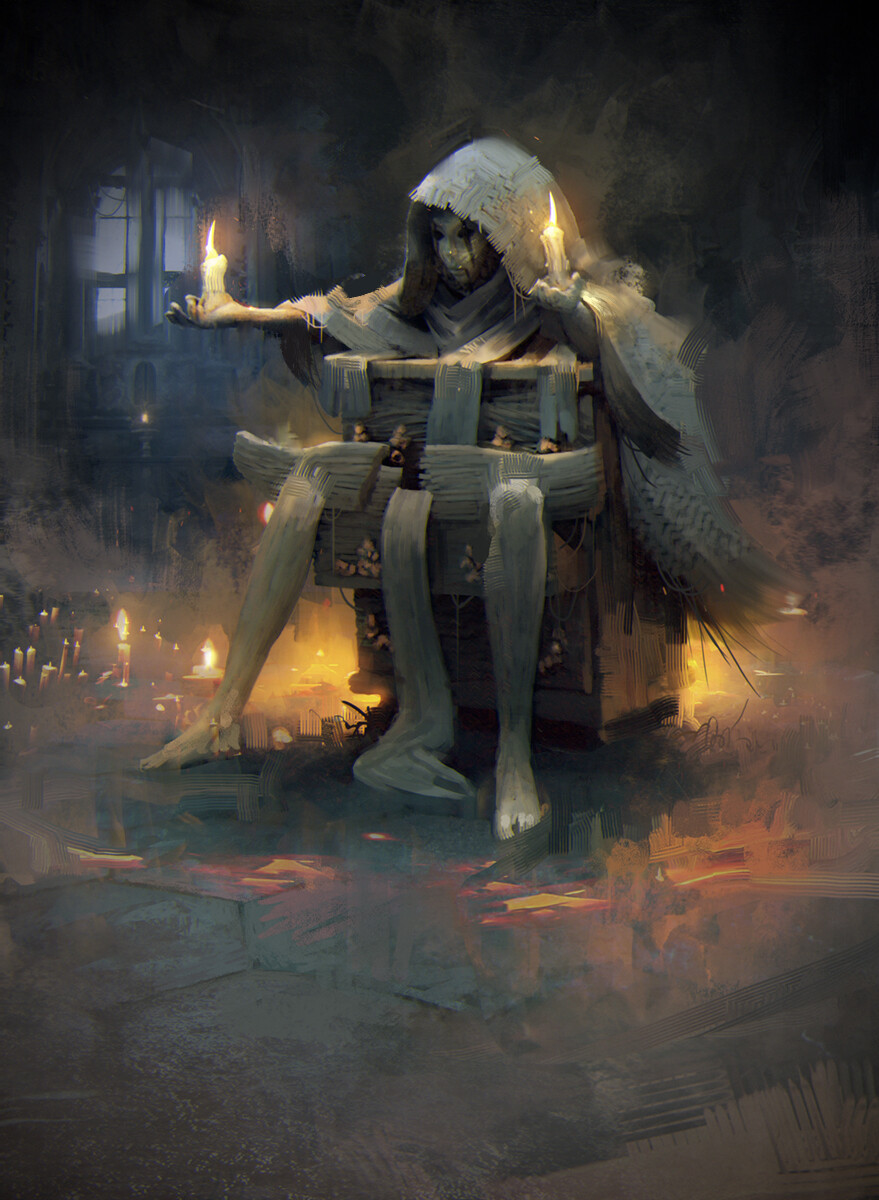
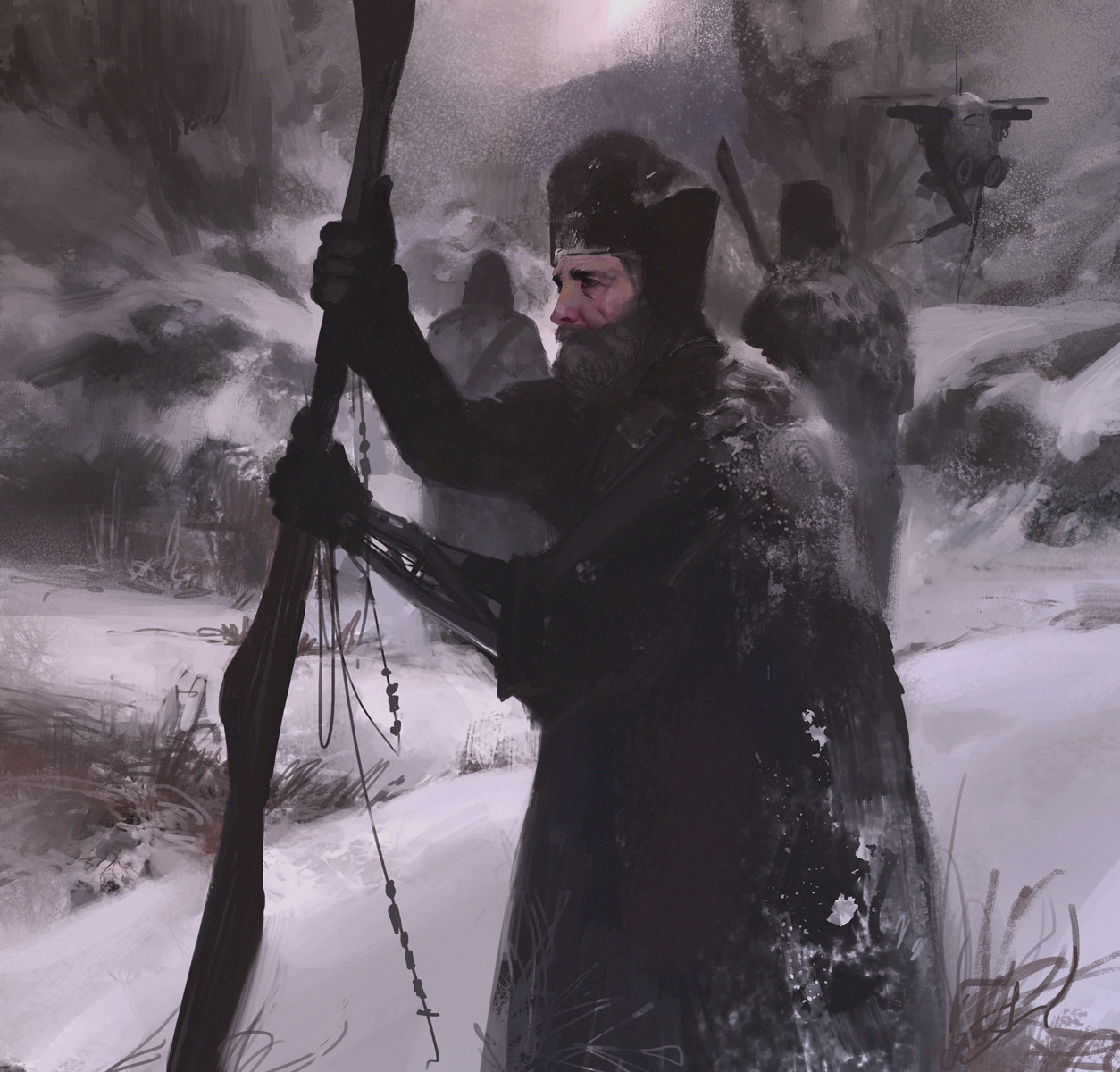
Shadows glide gently across the Eden Under Eventide. They wear white masks modeled after their queen, hooded robes too, vantablack, thick enough to keep out the ever-approaching winter and the prying eyes of the ego-blind. They say their hands are the hands of the Monarch. The left is merciful. With it, these masked shadows strip from the dreampunks their ailments and pains. The right is less kind. Still gingerly, filled with love, the Right Hand of the Monarch is a conduit for mortality. Death is imposed upon the still living flesh of the cruel, of nightmare things, reserved for when realities go too far.


To join the Monarch’s Mask’d Mercy is to give up living as you are. Your name is now the number of a verse and the book in which it is found. Your purpose in life is to heal, and, if needed, to harm. From an early age, an acolyte is trained in the Mortal’s Monastery. It is a black, crooked building wherein those secreted within are taught the Enlightenment of Love—a teaching found nowhere else.  Dreampunks learn that their lives are born from the Monarch’s kindness, and her stern, death-dyeing touch. They are sent to the far reaches of the Eden Under Eventide on a pilgrimage of suffering where they do what they were taught to do for neither gold nor favor but instead only for a moment of shared prayer. 


Leading the Monarch’s Mask’d Mercy is Cessations 3:14. Never do they speak. What goals they have for the Eden Under Eventide are known to none but the shadar-kai, who in turn say nothing and merely watch.


Igor Kieryluk


The Dreameating Syndicate

They speak in a code that no others know. They carry with them an amber coin that they flip between their fingers, chew absentmindedly on, spin on a countertop, leave it spinning, stop it with the flat of their hand when murder is due. If dreampunks are alive, than they are life-eaters, just like everything else in the multiverse. That means it is the job of dreampunks who are savvy to this bit of selfish wisdom to steal, take, and control whatever they want. Criminals, the lot of them, spoken of as a neverending threat, or in the way people do terrorists during times of discord. Sometimes this syndicate instead uses its influence to help out its fellow dreampunks. After all, if they were to all die, there would be no more dreams to eat, and thus no life left to live.


Find the Dreameaters throughout the Eden Under Eventide. You won’t know them at first, and they won’t care to tell you what they are. They’re abnormally skilled, more than a little bit clever. Many of them are soulknives who never leave any evidence behind, or Phantoms trained by the shadar-kai for purposes kept secret since the earliest times. Yuan-Ti who become disillusioned with the progress of Xibalba’s civilization fall easily into the syndicate’s plans. Tortles jaded during their long lives, ghostwises separated from their kin—these stories are common for Dreameaters too. Some of them still care for their fellow dreampunks. But because they care, they know they have to do these kinds of things, to protect that which keeps them real, that is, their loved ones, their passions, their own dreams of the future.


All this utilitarianism doesn’t bleach deep enough to remove the Dreameating Syndicate’s sins. They still run rackets, organize crime, or get up to debaucheries and cruel magics and infernal rituals. They’ll trade the souls of the dead for promises and deals and never let regret stop them from doing it again. Beware these, trust them not, lest you know what you offer is more than what your life is worth. Leading the Dreameating Syndicate is the mythical Les Neuf Vies, a rumored dreampunk of no discernable race who has lived and died nine times over.


Igor Kieryluk


The Aberrant Bloc

It is no secret that the Eden Under Eventide is haunted still by the echoes of immortal minds long since gifted death. Those echoes call to things from the Far Realm, whom flood alien and warped through the eclipse to terrorize dreampunks. The Aberrant Bloc, born from these events, captures, shatters, and harnesses the minds of the Far Realm aberrations that litter the world. They are hunters, sorcerers, abjurers all, each one constantly training to fully harness their psionics into not just weapons, but roads to enlightenment. These beliefs make the Aberrant Bloc one of the few factions who does not wholly bow to the Raven Queen, nor her Half-Light Diaconate. Instead, they believe that it is them who should rule the Eden Under Eventide, for they are the future of the dreampunks, and they alone offer a path to ascending beyond their half-lives into a greater, more divine thing. 


This has led to no civil war, nor will it ever. The Aberrant Bloc and the Half-Light Diaconate are kept in peace by clerics of the latter. Likewise, the Aberrant Bloc is just as focused on political power as they are protecting the Eden Under Eventide from Far Realm incursions. Thus, the Aberrant Bloc has been forced to resort to more indirect methods for their influence wars. They use their protective services to garner influence, convert dreampunks to their beliefs, and therefore increase the power of their bloc. At the same time, they put on demonstrations, parades, and tours throughout the Eden Under Eventide to further preach their superiority. Never does the Half-Light Diaconate respond negatively to these events; the shadar-kai pay relatively little attention to the Aberrant Bloc.


Aberrantcists wear proudly their deformities, attained from their experiments with their captured aberrant prey. Third eyes, slime, cloaks of astral wind—these things mark them wherever they go and they take no effort to hide this. The bloc leaders, called the Mysterions, are said to be so horrifically changed that they no longer appear like their original selves. For this reason, or so the rumor goes, the Aberrant Bloc uses liaisons to communicate the wills of its leaders. 


Lius Lasahido


Sect of Scriptures

As the shadar-kai teach, dreampunks first learned to write from giants, who used tortle shells for their runestones. With that arcane writing studied and learned, wizardry was born,  which in turn led to the dreampunks establishing order throughout the heart of the Eden Under Eventide. Those original scribes game together to make the Sect of Scriptures. With scrolls, grimoires, and holy books in hand, the members of this occult sect explore the Eden Under Eventide, recording, learning, and further establishing order through this chaotic plane. Scribing Wizards are protected by Rune Knights trained either from birth or those who were once criminals and now wish to pay off their sins. Others, such as those who make pacts with Outsiders, or who rely on the clockwork order stolen from Mechanus, find themselves joining the Sect of Scriptures as well, if for nothing else beyond learning the secrets of their magic.


Often told, the story of a sect member stumbling into a fatal yet fated doom. Curiosity is considered both sin and virtue by the dreampunks, and the scribes embody both aspects. Though their developments, always applied to a special branch called the Borromean Rings—small studio-organizations who seek to turn scribed knowledge into artifice—go far in the mission of bringing everlasting peace to the Eden Under Eventide, they also lead to slumbering monstrosities, horrible curses, and the terrifying half-nightmares that hide in those places where twilight cannot reach. Still, the allure of adventure, and to learning deeper truth, sees the Sect of Scriptures replenishing its members every Ecliptic Year.


Eight wizards stand united as the Eight Edenic Roads, whom lead the Sect of Scriptures. They unanimously agree that the Witch Queen planeswalker Iggwilv is their ninth member out of gratitude for the vast majority of knowledge she’s shared with the Sect over the last several centuries. Each of the Roads represents another school of magic, as well as another aspect of the rune writing that was stolen from the now-mad giants. Only through scholarly inheritance can this position be earned. Rare is it that this happens, and rarer is it that the Roads put their collective minds together in the Fifth-Plane Tower to solve any of the Eden Under Eventide’s numerous problems. Their own magical ventures take them far away from where their powers are most needed.


Bonhotal William

Knights of Eden

O’ great Knights of Eden, fabled are you, heralded with the dream-joy of those who venture not into the Deep Night or the Haunted Day. Only through valor, glory, skill, or heritage may one be accepted into this most supreme and chivalrous order. Once initiated, a badge, land deed, and stipend are given to the newfound knight by the Xibalban state. The ser or dame is sent off to some remote region of the Eden Under Eventide. Sometimes they are sent alongside different factions. Sometimes they are sent alone. Always are they sent with a mission to protect, slay, and purify, to abjure any wretched reality or cruel aberration, to hunt down the fey courts and free their victims and smash their glass mazes, to expand the Sublime Light that is twilight into those disturbed places where the Weave unravels into threadbare annihilations destitute just as they are absolute.


The Knights of Eden are not always treated like heroes. Many of them cause just as many problems as they solve and for this their reputations are forever besmirched. A knight may have saved some distant outpost, only to sacrifice half the population to do so. Never is this done with malicious intent. The Knights of Eden have no doom-wishes for their fellow dreampunks, nor do they view life as cheap. They simply cannot save every life, and though they try too, their failures become nooses ‘round their necks that keeps their spirits in ache, their resolve ever-sharp.


Shadar-kai from the Half-Light Diaconate appoint a Grand Cross to lead the organization, who inturn appoints ranks as needed to the rest of the knights. Xi Xa Wa is a Yuan-Ti so thoroughly invested in the survival of the Eden Under Eventide that they have sworn a sacred oath to watch over the plane until even their soul turns to dust. So far, they have lived for over five hundred years as a lingering revenant fueled by the Sublime Light.


Danil Golovkin


The Everlasting Troupe

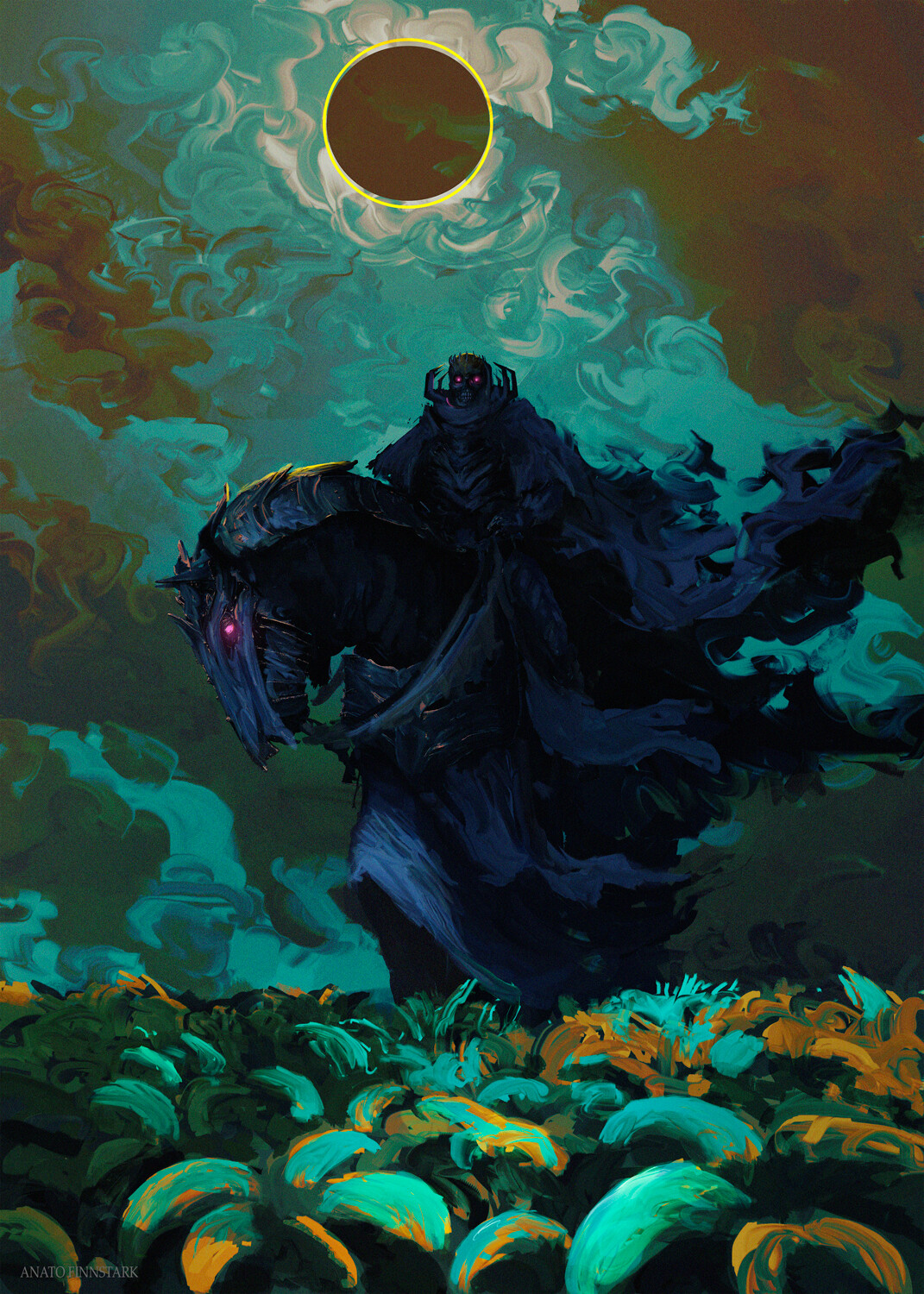
They never sleep and they’ll never die because they’ll never need to stop dreaming nor creating nor living from now until the Eclipse breaks apart and the sun does shine for an eon that stretches from now to the end of time. Every member of the troupe has given themselves wholly to the art of creation. They have realized a deeper truth about the Eden Under Eventide, one that so many others hear but do not believe because they cannot experience it themselves. You see, all things are an illusion, and here, all things are half-dream, and thus, they are the architects of not only their own future but their very world.


Others join the Everlasting Troupe too, addicted either to their performances or their philosophies. Some become monks who change their shape or summon forth the astral self locked within all things. Wildpunks tap into the lingering traces of the immortals whom birthed them, shifting into bestial guises or unleashing souls suffused with enchantment. A ghostwise with a silver tongue will warp the thoughts with every word. A mountain dwarf with a clockwork heart will make impossible odds into absolute destinies. Splintered throughout the Ender Under Eventide this Everlasting Troupe into Everlasting Troupes each with their own ringleaders and their own rules. They tour from outpost to Xibalba and back to outposts, Unearthly Roads rolling lazily before them, trailed by their own strange musics or proceeded by the weird things they’ll let loose in the Weave to announce their arrivals.


All members of the Everlasting Troupe dress like rococopunks. Their make-up is wild. Their outfits are strange. Color splashes them in haphazard patterns that name each performer as something unique. These appearances change with the tour as the performers themselves grow ever closer to revealing their True Self.


Anato Finnstark

The Half-Light Diaconate

Mobeds—priests—gloomy, pale and cloaked in feathered black who watch and advise, teach, educate, guidance of a billion year old hand that’s set the stage for tragedy after tragedy after tragedy in the tear-dappled loop that is all time. Every mobed is either a shadar-kai or a dreampunk who has been directly educated by a shadar-kai. Devout and pious to the Half-Light Trinity these clerics, each of whom deeply embodies one gloaming aspect of the Raven Queen. Those inspired by the Monarch are educators and judges both in Xibalba and in the wider Eden Under Eventide. Mobeds forever Soothed embody peace. With a hand enshadowed by twilight they bridge the disparate yet soulbound dreampunk races. And those who radiate the Sublime Light wander far and wide like echoes rebuffed along a canyon’s walls into the outer dark where the most wretched of things are rooted out for the good of all.


Trained by the Diaconate are the bladesingers. It is an art stolen from the Glass Court by dreampunks who use it against their master’s enemies. Each bladesinger is knighted by a mobed or hadur, given two blades of forged silver, taught the secrets of elven wizardry. Set loose they are like secret police, unmarked and unknown save to those with influence or the shadar-kai. Though they are servants of the Raven Queen, they are no more privy to her attentions than any other dreampunk. Thus, only through faith in the Half-Light Trinity can a bladesinger ever hope to one day meet their goddess.


The Half-Light Diaconate is the de facto ruling force of the Eden Under Eventide. They keep the Rorschach Throne empty. They balance the countless factions, listen to the lobbying of all interests, and use strictly democratic vote to determine the directions Xibalba will grow. In this way, they maintain the balance of powers, the supremacy of the Raven Queen, and the Eden Under Eventide’s unique existence as a grand stage for tragedies, revelations, and apotheoses.


Eight Edenic Truths of Eventide

By Oliver Ryan


  1. DREAMPUNKS ARE HALF-DREAM, HALF-REALITY PEOPLES DIFFERENT FROM THEIR COUNTERPARTS. Though they bleed, eat, and die like everyone else, dreampunks are different at a spiritual level. Half-dream and half-reality means they weren’t evolved or created like other races throughout the cosmos. Likewise, the rules that govern many dreampunk races—like Yuan-Ti being evil—do not apply to this surreal Eden. That being said, dreampunks do have one core difference compared to other races: they do not dream when they sleep, and no one knows what happens to their souls when they die. Necromancy doesn’t work to bring dreampunks back to life either, nor do spells like speak with dead ever reach them.
  2. THE EDEN UNDER EVENTIDE IS ECLIPSED BY A PORTAL TO DIFFERENT PLANES. Yet another of this world’s mysteries is its constant eclipse. No magic nor device has ever disturbed its path, and it never fails to at least partially eclipse the Eden’s sun. This eclipse is also the source of most of the world’s life. The immortals of antiquity fell through, and now the Realities enter the plane through this same entrance. While attempts have been made to block this hole, never have they succeeded, and it is a fear for many dreampunks that eventually something will invade that will spell their end.
  3. FEY COURTS PLAGUE THE DREAMPUNKS WITH CRUEL TRICKS OUT OF A NEED FOR SUPERIORITY AND LOVE. Before the dreampunks were born, the Glass Court haunted the half-asleep immortals. Though they’ve long since lost their precious toys, they continue their games with the dreampunks, kidnapping them, trapping them, and torturing them until their prey either loves them or is killed for entertainment. A second fey court, the Court of Wine, does much the same to the dreampunks, but also wages a fairy tale war with the Glass Court. The debaucheries of these Outsiders is the source for many of the dreampunks’ collective woes.
  4. THE WEAVE IS WARPED BY THE HALF-DREAMS OF DEAD IMMORTALS, MAKING MAGIC STRANGE. So great was the combined magical force of the dying immortals that their pent-up dreams disturbed this plane’s Weave. Mutations in magic are frequent. Non-traditional forms of spellcasting, magic manifests most often such as psionics are disturbingly common—and extraplanar influences, particularly from the entreated Mechanus, leaking Far Realm, and the courts of both fey and genie alike, all of whom are attracted to this plane’s wyrd magic, has led to unique understanding of how the Weave works. Should this power ever be mastered by the dreampunks, the potential they have to affect both their world and the wider multiverse is nearly beyond compare.
  5. LITTERING THE EDEN UNDER EVENTIDE ARE SOMNOLENT SUPERNATURAL DANGERS LEFT OVER FROM A NIGHTMARE WAR. The warped Weave has littered the Eden Under Eventide with countless supernatural regions and unearthly roads. Many dreampunks throw themselves into these places hoping to learn more about their shared experience, while others stick to the arcane pathways which bind all outposts to the central City. Much of dreampunk society is based on trying to control, live with, or gain mastery over these supernatural regions—an impossible task for a likewise impossible people. Also known to the dreampunks is the reason for the violent themes shared by many of these supernatural regions. The shadar-kai call it a Nightmare War, which played out early in the evolution of the Eden Under Eventide. What this Nightmare War exactly was it never fully detailed, though rumor speaks that this is the reason shadar-kai teach the Half-Light Trinity as they do.
  6. THEOLOGY KEEPS THE DREAMPUNKS BOUND TOGETHER JUST AS WELL AS IT KEEPS THEM IN CONFLICT. It is well known that the Raven Queen, under her many occult names, is what led to the genesis of the Eden Under Eventide. It is also known that she is not present in the world, having left behind only Her feathers—the shadar-kai themselves. These shadar-kai have made the central City of the world a theocracy, binding together the many dreampunks with faith in the Half-Light Trinity. Though this religion promotes a feeling of shared community and experience, the looseness of it creates wildly varied interpretations. Driven by their own beliefs in the Monarch, the Soothed, and the Sublime Light, dreampunks sometimes find themselves on evil paths or (literally) becoming monsters themselves. If this bothers the shadar-kai, they show it not; and a few rumors tell that these diametric and warped understandings of the Half-Light Trinity are subtly encouraged.
  7. BLUE-SKY COAL IS WHAT KEEPS THE DREAMPUNKS SAFE IN THEIR TWILIT CITIES. When mortality washed throughout the glooming forests of the Eden Under Eventide, the elements themselves became a churning, chaotic swirl. Water broke apart stone, wind blew down forests, avalanches crushed all manner’s of budding flower. And, for the first time, ancient trees were burned, and across half-dreamed eons all that was left behind was deep-reaching veins of phantasmal, blue-sky coal. Burning this coal has led to a mystical and industrial revolution. The central city has grown gargantuan, the power of coal-fueled light beating back the darkness and giving the dreampunks agency over the night-sworn reaches of their world. As technology continues to grow side-by-side with magic’s warping, the dreampunks stand poised on the cliff’s edge, preparing to hurdle themselves into the void that is a future built from their dreams and not those of their ancestors.
  8. TRAGEDY IS COMMON, BUT ALWAYS LEADS TO PEACE. The most common stories in the Eden Under Eventide are tragedies in all their many forms. A somber mood is one held by most dreampunks, even if it is sometimes buried under a hoard of wanderlust or hope. The shadar-kai teach this as good, for it means that the dreampunks lives have meaning—for themselves, their descendents, and for the Raven Queen too. Mayhaps, they say, if the dreampunks can find a way through all the tragedy, they too will become divine and join the Sublime Light. Though this teaching is considered by the dreampunks to be foolish, it has created a special mindset: one that seeks to turn all woes into future weal.
By L-E-N-T-E- S-C-U-R-A


EDEN UNDER EVENTIDE - Building a Fantasy World Relying on the Magic of Tasha's Cauldron to Everything

 This world began from an idea: what if a setting was designed around the magic of the new Tasha's Cauldron to Everything subclasses. So, what would a setting look like filled with psionic powers, rune knights, reality-is-an-illusion principles, and other weirdness? The result is this Eden Under Eventide. 

By Adrián Ibarra Lugo


EDEN UNDER EVENTIDE is a high fantasy world of surreal, mystical magic wherein a diverse society of half-dreamed races must navigate a world of alien danger, chaotic fey, and shadow-birthed nightmares.

There are ten available races in Eden Under Eventide. These races are split into two groups of five: the DREAMPUNKS and the REALITIES.

DREAMPUNKS (the half-dreamed peoples, born from the divine deaths of insomniac immortals)

  • Loxodons
  • Tortles
  • Yuan-Ti
  • Ghostwise Halflings
  • Mountain Dwarves

REALITIES (Outsiders from other worlds)

  • Shadar-Kai
  • Githyanki
  • Githzerai
  • Eladrin (DMG variant)
  • Humans (including Tiefling and Aasimar).

Realities are often seen by Dreampunks as dangerous individuals who add another chaotic variable to their lives. However, due to shared elements in the Dreampunks cultures, attempts at peace are often made; but the Knighthood of the Owl’s Eye keeps a strict watch over all Realities, abjuring them from Eventide if needed without a second thought.

The default races allowed to be played are the five Dreampunks and Shadar-Kai. Gith of both forms normally arrive in arms (as they are hunting down some Far Realm thing), thus making them unlikely to remain in Eventide for long. Eladrin hail from the fey courts and are seldom accepted without great suspicion. Humans are reserved for Outsider characters—rarities to the extreme, usually only one or two in the world at a time.

EDEN UNDER EVENTIDE is a sprawling forest of supermassive trees, at times stabbed with mountains or gouged out with fathomless lakes that brood underneath a permanently twilit sky in which sits a total solar eclipse. At times the thing eclipsing the sun will move, allowing more light; however, the eclipse itself never ends. Littering the world are isolated strangities built from the Dreampunks magic (or that of the fey or something else); lone clocktowers rising gargantuan into the sky where sorcerers create miracles; the dens and burrows of immortal beasts who accepted not the Raven Queen’s gift of mortality; vast and labyrinthine mazes of glass where the fey trap Dreampunks in hells of endless trickery.

The Dreampunks of Eventide, despite their different natures, have a rather unified culture. This culture has its variations, splits into subcultures and so on, and is scattered across the plane and connected by Unearthly Roads that shorten the impossible distances. Some groups of Dreampunks choose to remain isolated, with wandering monkish loxodon moving seismically through the dim forest valleys, or circles of wildfire-worshipping dwarves hidden in the hearts of immense coal engines, whose light lines brass-forged streets of furtive, half-dreamed cities.

Binding this all together is the Half-Light Trinity - the default religion that is interpreted again and again in ever more different ways throughout the Eden Under Eventide. Below is the genesis myth of this strange faith.


By Zuzzana Wuzyk


THE GENESIS OF THE EDEN UNDER EVENTIDE

As told by the shadar-kai, and their Gloom Weaving Mobeds

“From out the darkness she waltzed, our Gloaming Queen, dance partners too, death and memory. We followed Her into this twilit world, flew down as ravens from the abyss of its eclipse born on beams of dusk and dawn. You were not here yet. Nothing but a dream in the heads of immortal things that neither slept nor could wake. To each of those immortals our Queen did visit. She washed their matted hair, cleaned their bedsores, infected as they were by the curses that only lives lived too long could throng. With us, she shoo’d away the fairies, their Court of Glass, who dance in plague of all us still.

“Then, she answered the immortals’ prayers.

“Each one was given the gift of true sleep. Mortality was pressed upon their souls with raven feathers. As they died, their heads split open, and out flowed their endless half-dreams, hallucinations, weirdling sleep paralyses. They flooded this immortal world in a great chaotic press, horizon to horizon, fading and dying and breaking apart, warping the world into this.

“Our Queen watched. Then she left. She departed with no commands for us, no task but to experience what was destined to be our suffering. We who were left are we who watch. Though queenless, we have shaped this eventide garden with what wisdoms she left behind—the Half-Light Trinity.

“First there is the Monarch, the predominant aspect of the Goddess and Creator. It has no memory of the past, only the thing needed to reach the future. Through the Monarch inside all of us, we impose order upon Eventide, soothe the chaos, create a stable ground for life to thrive. Know this as our Mother.

“Then there is the Soothed, the heart of our God-Queen, and all hearts of Eventide too. Death and sleep, a concord among the dreamed. The Soothed is our peace, our destiny to maybe wake again—to sit under shaded boughs of primeval trees in succulent, sublime silence. Know this as our Sister.

“And lastly, there is the Sublime Light, the artha of all us in this Eden Under Eventide who must wander under the gated eclipse, the hollowed sun, protected in our immortal mortality, knowing that sleep will come from which we will never wake. Know this as our Soul.

“Through the Half-Light Trinity, embodying it, worshipping it, becoming it, dreams transformed into something else. You became peoples, scattered but now gathered, few and than many.

“Legacy to the Queen, in Her name only, swilah.”

Rules for playing D&D 5E in an Avatar Universe

So, I'm a huge Avatar fan. Reading the books now (about Kiyoshi), watched the show, love the comics, etc. Been thinking about how to do D&D Avatar. Came to a different conclusion than what most would expect (which would be a sub-class or new classes etc).


azula gifs | Tumblr


RULES FOR AVATAR-THEMED D&D GAMES

LEVEL CAP

The max level you may reach is 10th-level.

Note: This is basically because 6th-level+ spells don't really work in Avatar. Most games end around 10th-level anyway.


ELEMENTAL BENDING

You are a human who comes from one of four cultural backgrounds: the Fire Nation, Air Nomads, Water Tribes, or the Earth Kingdom. Your choice impacts the following:

  • Supernatural abilities that you have (Barbarian rage, Ranger's Primeval Awareness, Spellcasting) have their fluff dictated by your culture. A Water Tribe Warlock's eldritch blast could be an icicle; an Earth Kingdom Paladin's Smite is an overwhelming amount of Earth striking the target.
  • Corresponding with the list of cultures above, you know one of the following cantrips: Control Flames, Gust, Shape Water, Mold Earth.
  • You can change the damage type of non-weapon damage to the element corresponding to your culture: Fire, Thunder, Cold, or Force.

Note: This may seem difficult with more esoteric spells, but its possible! If you're from the Earth Kingdom and you learn hypnotic pattern, take inspiration from the Dai Li and their hypnosis!


ADVANCED BENDING FEATS

At 8th level, you can choose one of the following feats so long as you meet the prerequisites.

LIGHTNING GENERATION

Prerequisite: Born to the Fire Nation

You gain the following benefits:

  • You can cast lightning bolt a number of times per long rest equal to your proficiency bonus. Charisma is your spellcasting ability modifier for this spell. This spell only requires somatic components.
  • You can change the damage type of non-weapon damage you roll to lightning.
  • You are resistant to lightning damage.

SPIRIT BENDING

Prerequisite: Born to the Air Nomads

You gain the following benefits:

  • You can cast counterspell a number of times per long rest equal to your proficiency bonus. This spell only requires somatic components.
  • When you roll a critical hit with a melee weapon attack, your target creature must make a Constitution saving throw with a DC = 8 + your Wisdom modifier + your Proficiency bonus. On a failure, the target creature cannot cast spells or use magical abilities for 1 minute. At the end of each turn, the creature can make another Constitution saving throw, ending this effect immediately on a success.

BLOOD BENDING

Prerequisite: Born to the Water Kingdom

You gain the following benefits:

  • You can cast the spell dominate person once per long rest. Wisdom is your spellcasting ability modifier for this spell. This spell only requires somatic components.
  • You can cast the spell crown of madness a number of times per long rest equal to your proficiency score bonus. Wisdom is your spellcasting ability modifier for this spell. This spell only requires somatic components.

METAL BENDING

Prerequisite: Born to the Earth Kingdom

You gain the following benefits:

  • When in physical contact with a non-magical object made out of metal, you can freely change the object's shape so long as the object does not increase in size.
  • Weapon attacks using metal weapons deal an additional amount of damage equal to your Wisdom ability modifier.
  • When wearing metal armor, your AC increases by your Wisdom ability modifier.
The Last Airbender GIFs - Get the best GIF on GIPHY


BENDING GIFTS

When you create your character, choose one of the Bending Gifts below. These represent something special about your character that makes them unique in the world. In order to choose a gift, you must meet its prerequisite.

AVATAR

You are the avatar, and thus have the capability of learning all four elements. You gain the following benefits:

  • You can change the damage of non-magical weapon attacks to: Fire, Thunder, Cold, or Force.
  • You can learn any culture's Advanced Bending Feat.
  • When you fall to 0 hit points, you enter into the Avatar State - a powerful state of being where you channel the cosmic energy of the entire universe. For a number of turns equal to your Proficiency bonus you are not unconscious, do not make death saving throws, and add your Wisdom ability modifier to all damage rolls you make.

BLIND BENDER

Prerequisite: Born to Earth Kingdom

You permanently suffer the blind condition. However, you have blindsense up to 60 feet, increasing to 120 feet at level 5.

BLUE FLAMES

Prerequisite: Born to Fire Nation

You produce rich, blue flames when you firebend. When rolling fire damage, you can reroll any 1s or 2s, but you must keep the rerolled number.

CLOUD MANIPULATION

Prerequisite: Born to Air Nomads

You have learned to manipulate clouds. You can cast the spell fog cloud a number of times per day equal to your proficiency bonus. Additionally, you can stand on clouds, vapor, and air as if it were solid ground.

COMBUSTION BENDING

Prerequisite: Born to the Fire Nation

Through years of training, you have learned to combust objects with a ray of heat produced from your forehead. As an action, you can make a spell attack with Wisdom as your spellcasting modifier. This attack has a range of 60 feet and deals 1d12 + your Wisdom ability modifier fire damage. This damage increases by 1d12 at 5th and 9th levels.

MINERAL IMMORTALITY

Prerequisite: Born to Earth Kingdom

Through years of training, you have learned to bend the minerals in your own body, decreasing your rate of aging. You age x10 slower than a normal human being. Additionally, your hit points increase by an additional +1 when you gain more hitpoints, and you have advantage on saving throws against paralysis, petrification, and stuns.


Toph Bei Fong GIFs - Get the best GIF on GIPHY
My favorite character btw

PLANT BENDING

Prerequisite: Born to Water Tribe

You can manipulate the water in plants for the purposes of your waterbending. As a bonus action, you can gather nearby plant life towards you for one of three uses:

  • Arm Vines - Your reach for melee attacks and grapples increases from 5 to 30 feet.
  • Swamp Giant - You gather plants around you, creating a giant for you to pilot. Your size increases to large, gain proficiency in unarmed strikes, and your unarmed strikes do 2d10 + your Wisdom modifier in damage.

SUBTLE WIND

Prerequisite: Born to Air Nomads

You have a high level of sensitivity with to changes in air currents. Your passive Perception increases by +5 and you do not suffer disadvantage when fighting or tracking invisible or hidden creatures.

WATER HEALING LEGEND

Prerequisites: Born to Water Tribe

Your ability to heal with water far surpasses anyone elses. When you cast a spell or use an affect that would restore someone else's hit points, add double your Wisdom modifier to the total number of hit points rolled.


5E Sublime - Ideas, Construction

Runehammer released a hack of D&D lately called 5E: HARDCORE MODE. Its very interesting, bridging old school ideas with the more new school styles of play, but still firmly in something brutal, realistic, and traditional. Much of what it does adds a lot of difficulty back into D&D out of hopes that games will lean towards quests to overcome challenges instead of always resorting to raw combat. I won't go into deep detail about how, though some methods of how it does this is: capping players at 10, keeping HP low, streamlining CR, and expecting players to confront things hyper-lethal to them without preparation/research done.

I want to use this as a model to create my own version of D&D (as everyone else has) using some of my work on Rising Legends while also moving in a completely new direction. I also want to draw on my old Saga Style stuff too. The main thing I want, however, is to keep 5E's sub-classes. Sub-classes are, for me, the thing that honestly keeps me playing 5E; I like ever more precise, specific character concepts - which, I know, is kind of heretical to people who usually "trim the fat" from D&D. On top of this, I want to use my own created spellbooks (which I plan to make more of soon) for this. Magic is the reason I play Fantasy; watching how the Weird changes the Normal is the kind of art I'm usually interested in making.

So with those steps outlined, let's look at what I am thinking so far.
Candle
Piotr Foksowicz

5E Sublme is the working name I'm going for. The sublime, in a literary sense, is used to described scenes, characters, events, or stories that are greater than human in a way difficult to understand or comprehend. One never fully notices when they slip into the sublime, but they are always aware that something is sublime around them. Because something is sublime, they cannot escape or look away from it. Instead, they must work with it, enter it, or be destroyed by it.

The sublime is the core of what I like in RPGs. It doesn't have to be magical, it can just be intense humanity, crazy sci-fi concepts, etc. I'd like to think that something like Dungeon Crawl Classics is a pretty sublime game, or Troika!

I've mentioned that I'm using 5E HARDCORE MODE as my model for building this, so there's a few things I want to lift from it to keep. Those are:
  • How hit die + rests work.
  • How monsters + CR now works.
  • How initiative + skill/off skill works.
  • Respawning methods.
  • Level 10 cap.
  • Zones/Movement.
With that in mind, the following are concepts I plan to change/use for 5E Sublime.
  • Class features almost exclusively being sub-class features.
  • Different way of gaining experience.
  • Different way of casting spells.
  • Adding in an Explorer procedure.
  • Making use of 5E's Exhaustion system as a consequence system.
  • Additional survival tool (indomitable). 
Everything not covered by one of these two sets of changes is in the D&D Basic Rules (if you need it).

Saeed Farhangian

Classes are defined in 5E Sublime as methods in which you (the players) enter the world of the sublime. These are the things that make you something greater than human.

Each class comes as a duo-package. There is a version of it more focused on "tricks" and a version more focused on "combat." At 1st level, you gain a class feature. At every even level afterwards, you gain sub-class features. For your sub-class, find your favorite sub-class from that class in your 5E books and use it. If a sub-class grants multiple features at the same level, then you gain all of those features when you learn one of them. For example, if your Sorcerer sub-class learns two features at 6th level in core 5E, you would learn both of these at 4th level in 5E Sublime. If your sub-class wouldn't grant you 5 different levels of features in 5E Sublime, you would instead learn that classes 20th level capstone in core D&D at 10th level.

The Classes Are:
  • Cleric/Paladin - Entering the sublime through faith in a religion, power, creed, or oath.
  • Monk/Disciple - Entering the sublime through internal ki or psionic mutation.
  • Sorcerer/Artificer - Entering the sublime through being born afflicted with magic or knowing how to forge magic into tools.
  • Warlock/Hexer - Entering the sublime through strange pacts or drastic modifications of the self.
Note that all classes are mystical in some way, and that I don't add a thief class. Any of these can be thieves, and 5E Sublime is a game about exploring strange magics and how they effect people, societies, etc. As you progress, you'll get weirder and weirder, more and more sublime, until eventually you hit level 10 or otherwise die for good.

The Hexer uses Matt Mercer's Blood Hunter 2020 for its sub-class options. I changed the name to fit an aesthetic I prefer.

In the above class list, classes on the left side are considered Mystics, while those on the right side are considered Warlords. This is important to remember just for keeping up with stuff below.

Class progression is as thus:
  1. First class feature. Mystics start with 3 spells of a tradition. Warlords have a fighting style + 2 attacks.
  2. Sub-class feature(s).
  3. Mystics automatically learn 3 more spell of a known tradition. Warlords gain 1 Indomitable use.
  4. Sub-class feature(s).
  5. Mystics +3 spell of a tradition. Warlords +1 Indomitable use.
  6. Sub-class feature(s).
  7. M +3 spell of a tradition. W +1 Indomitable use.
  8. Sub-class feature(s).
  9. M +3 spell of a tradition. W +1 Indomitable use.
  10. Sub-class feature(s) OR (if not viable) class capstone feature.
A tradition is a tradition of spellcasting. This is the broad term given to spellbooks I've developed and have used so far. An example is my recent blogpost on the Plane of Lightning and the magical tradition that stems from it. Keep in note that Mystics can learn spells by finding them/being taught in addition to leveling up. Warlords can learn spells through the same means. Adventuring to learn new magic is one of the core reasons to adventure in 5E Sublime.

Indomitable is a feature taken from the core Fighter class . Once per rest, a Warlord class can dig deep into themselves to overcome a failed saving throw. I choose this as their special gain as I like the aesthetic of these kinds of characters somehow, through a method no one else can, just shaking off the effects of some supernatural hazard or other doom.

You gain a level through earning experience. Experience is earned by taking on sublime challenges. All things, from monsters to traps to riddles and puzzles, should have a CR attached to them. Using 5E HARDCORE's math, you get experience from something equal to CR x 200. All other 5E HARDCORE CR guidelines are in use, streamlining the numbers needed to overcome these challenges.

Mystics require the following experience to gain levels:
  1. 0
  2. 300
  3. 900
  4. 2300
  5. 6500
  6. 14,000
  7. 23,000
  8. 31,000
  9. 37,000
  10. 40,000
Warlords require the following experience to gain levels:
  1. 0
  2. 200
  3. 600
  4. 1800
  5. 4200
  6. 6000
  7. 11,000
  8. 18,000
  9. 24,000
  10. 30,000
As it takes longer to level, your Proficiency bonus increases a bit faster. Starting at +2, it increases by 1 every three levels after, to a maximum of +5.


White Woods
Irina Nordsol Kuzmina
Spells and magic items and weird shit are the core of the game. Finding this stuff is the real reward. Experience is for you to get more tools to find cooler stuff so that you can dig deeper into the sublime on your adventures.

All classes have spellcasting as an inherent feature. Manifesting a spell is rough on the body; thus, you can only cast as many spells as you have HD. Once you run out, you must finish a long rest to regain all uses. If you have a feature that uses spellslots, it instead uses one of your spell castings for the day. If you are out of spell slots, you can risk your life to cast a spell instead. Roll 2d6 + your Proficiency bonus. On a 10 or higher, you cast a spell. On a 9 or lower, you cast the spell but lose hit points = to the amount under 10. So, if you cast a spell with no castings left and roll a 5, you lose 5 hit points. The spell will cast, even if this kills you.

You can learn additional spells on an adventure through a number of ways. If you find a master, you can buy an education from them (either through favors, wealth, or magical items). If you find scrolls, you can decipher them and try to teach yourself (though if you ever use the scroll, note that it is destroyed in the casting!). Every tradition has its own guidelines for how long it takes to learn a spell through it. Once that time has passed, you have to make a check. The DC for the check is 15 + the Spell's level. The roll made is d20 + Proficiency bonus + Int or Wis or Cha modifier (determined by class). If you fail, something about you changes internally; you cannot attempt to relearn the spell for a year and a day after failing. 

Pilgrim
Tomas Osang Muir

Exhaustion is key! Exhaustion is my favorite mechanic in 5E and it has gone underutilized for too long!

Primarily, exhaustion is inflicted in 5E Sublime through new ways to add challenges to exploration.
  1. When a saving throw is failed against a trap or hazard, a player can elect to take 1 level of exhaustion instead of suffering damage.
  2. When a player fails their check to cast a spell without having any spellcastings left, they can elect to take 1 level of exhaustion instead of suffering damage.
  3. When a player suffers more than 10 damage from a single attack or effect, they can elect to take 1 level of exhaustion and halve the incoming damage.
  4. Some traps or hazards or other effects may simply just inflict exhaustion instead of other banes.
Exhaustion is removed in the standard ways; however, if a player rests for 20-24 hours at once (essentially a full day), they can remove all levels of exhaustion. This should be difficult to achieve! A player having a full day of rest is subject to the danger of being discovered, of dungeons or areas resetting, or of losing an opportunity to gain something important!

Thomas Scholes
Exploration feels bad to me in 5E. It took me a long time to finally say this but after years of playing the game, I absolutely hate exploration in it. This is because, unironically, time is so fluid normally that I'm not sure how to go about it in a standard game of 5E core. Below is my solution to this (after trying many, many, many different methods...)
  • Decide if you are either Crawling (IE in a dungeon or similar area) or Ranging (IE in open wilderness or a ship).
  • If Crawling, a round is 10 minutes. If Ranging, a round is 1 day.
  • When a round starts, explain everything they see. If a player's passive Perception beats the DC for finding something, they should automatically find that thing.
  • On every player's turn, ask them what they are doing. Do not resolve these actions yet. This should be stuff that achieves a single task, like finding clean water, hunting, preparing food, searching for possible places to camp, investigating, etc.
  • At the end of the round, have all players roll any ability checks needed and introduce any hazards, complications, or dangers. Everything happens at once for tension and adding weight to decisions.
  • If a hazard/complication/danger has appeared, resolve it before beginning the next Crawling/Ranging round.
  • When a new round starts, ask the players where they've moved (to a new hex or point, to a new dungeon room, a new zone, etc) and start the process over.
Keeping track of time lets me keep track of all the basic stuff like dehydration etc. I can apply exhaustion for penalties more easily, add more nuance to traveling, and so on. This is basic stuff, just stripped down in a way to use with 5E.

Encumbrance is mentioned too, but not in 5E's atomic detail. Your Constitution ability score + your Intelligence modifier = how many slots you have. This is because your body's constitution determines how much you can load it with, and your intelligence is how smartly you pack your stuff. You need a bag to carry; if you don't have a bag, chest, etc, you can only carry stuff in your hands or wear it.
  • Armors and large things use 5 slots if not worn.
  • Weapons + shields use 2 slots if not held.
  • Meals, gallons of liquid, coin purses, and all other things are 1 slot (within reason).

Anato Finnstark
So what's next? 

Next blogpost in this series, I'll go over the 8 classes, their 1st level abilities, their saving throws, and talk about how I wanna do races. After that, its a matter of playtesting this stuff and making more spellbooks and challenges. I'm not sure if I'll ever publish this ruleset, but at the very least I'll condense it one day for ease of giving to my players. 

Spell Slots as Hit Point Abstractions

Spell slots are limited. This is primarily for game reasons; the wizard cannot cast fireball more than X times a day, because if they could, people with swords would cease to matter, and that's not good for the game. But let's pretend that isn't the main reason and come up with a narrative reason, and thus maybe a new mechanic, for why Spell Slots exist.

By Seb McKinnon.

The Force of Magic

What laymen call magic - that is, the casting of spells, the working of rituals, and other such supernatural powers - is a deeply personal thing. Not just on the mental level, but on the physical as well. To cast a spell is to turn one's body into a channel for something utterly paranormal; to let something leave you and rearrange the world before you. This is an idea that many have discussed in a philosophy called the River & the Rain. 

The River is the actual force flowing through the spellcaster. It is that eldritch momentum that ignites a fireball in a perfect vacuum or that polymorphs a griffon's body into a comatose mouse.

The Rain is the greater force that the spellcaster is calling on. It is a metaphysical concept, an energy that permeates everything, the stuff that keeps the universe expanding, the noosphere too, and that ideas generate when conjured forth.

Together, the River & the Rain make up the force of magic. The more of the rain you can call upon to flow into your river, the more force the river has, or in other words, the spell you are casting becomes all the more powerful. This is a tangible thing. It can and has been measured by cabals of arcane workers, by congregations of divine priests, by circles of druids hidden in the hill and mist. This is, mechanically, what a spell level is. Call it a Spell of the 1st Circle if you want, or a Miracle of the 1st Order, or whatever name you can conjure forth. It all means the same thing: spell level.

And if a spell's level is tangible to the amount of force that the spell produces, and if this force is a river flowing through the spellcaster, then it is only natural that there are many limitations to spells - as many as their are limitations of the physical form.

For example, a human's max recorded jump height is 63.5 inches - a little over 5 ft or 161 cm. It stands to reason that, with little variation, a human cannot possibly jump higher than that; their biology will not allow it. So then is it true that a human can only cast spells so strong due to their own biological limit. It is a limit that can be raised with training, yes, but it is a limit nonetheless. And just as a human cannot jump their max height an infinite number of times, neither can the spellcaster cast their spells an infinite number either. Thus, spell slots.

Let's first translate this to some more interesting narrative concepts, and then see what it leads too mechanically.

Machina Arcana - Sabina illustration
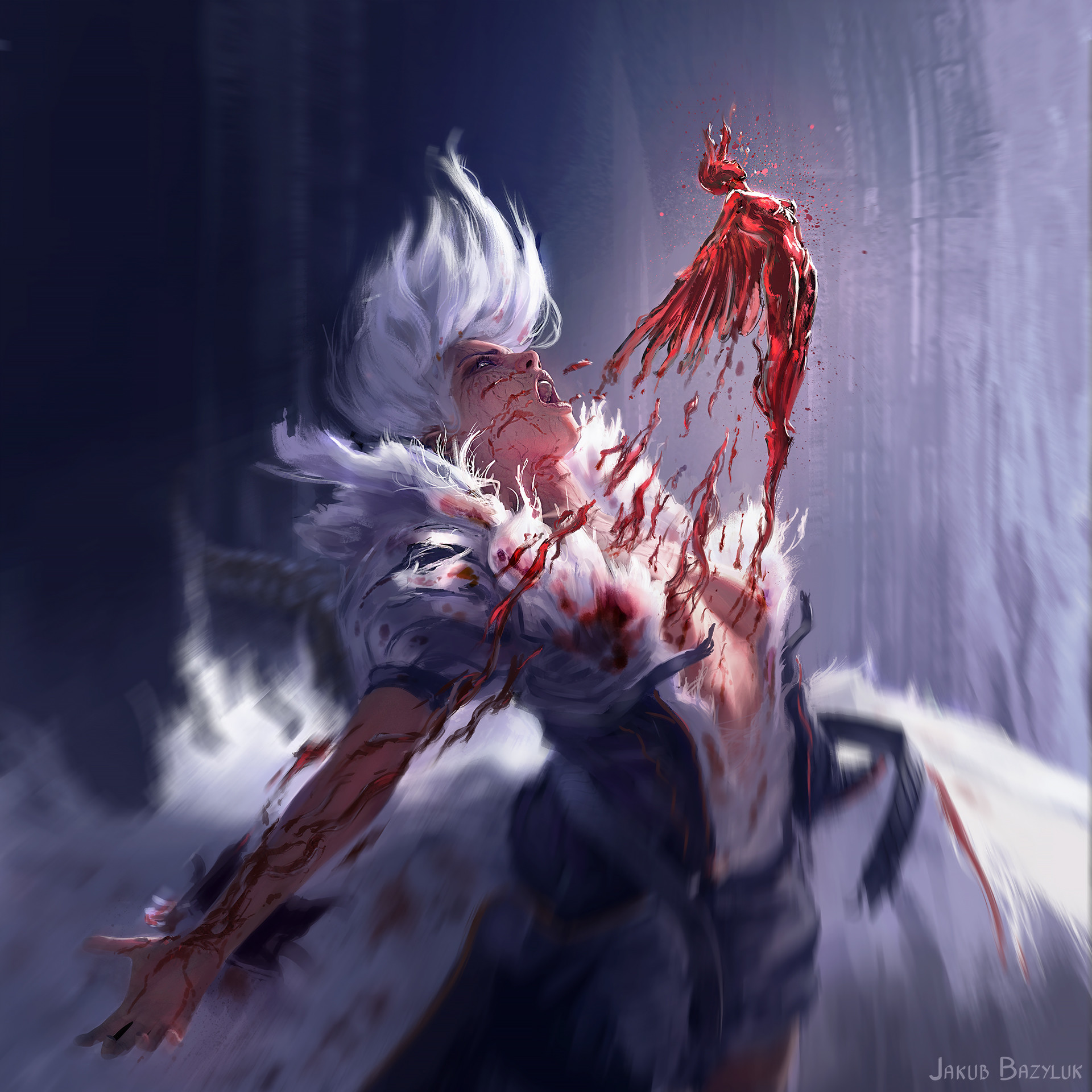
By Jakub Bazyluk. A spellcaster violently letting the River flow for a spell.

Magical Exhaustion

As the River flows so too does the spellcaster's body suffer wear and tear. Their neurons, during the casting of a spell, are firing on every possible cylinder. The complex network of bacteria, fungi, and cells that makes up a living being are all, for that moment, uniting their potential to one specific purpose. Such effort does not go unpunished. Eventually, a spell caster will expend all of their spell slots and be left with just their own, natural, mortal selves.

What does this look like? It is different, yet always the same. A feeling that one's heart is beating slower - that their blood is thinner than it was before - that their stomach cannot digest food or liquid. Thinking is done through a haze as memories are rebuilt and personality traits reestablished by the previously overloaded mind. It will feel like your nails are loose in their cuticles; like your bones are only barely attached to their joints.

In other words, it is not a pleasant feeling. Not like being exhausted, but similar, thus its simple term of being magically exhausted. No spellcaster likes it. Many avoid casting their last spell so that they can avoid this state. In games where they only get one or two spells a day at early levels, it is a state frequent. In exchange for being able to blow a door open or warp someone's perception of you, you just feel like abject shit.

Below, a d12 table. Roll on it when you spend your last spell slot. This effect is lost when you regain any spell slots. These effects are in addition to the above description.
  1. Your eyes are weakened; you see low detail versions of everything around you.
  2. You lose all sense of temperature except for a spreading, extreme heat inside of you.
  3. You vomit immediately, and can keep no food or liquid down for long.
  4. Memories of specific things, such as people's names, your favorite color, or the name of where you are disappear.
  5. Your personality is eroded, leaving you bland, neutral, and unimpressed with things around you.
  6. Natural instincts like fear, pain, and anger are gone, significantly mellowing your reactions.
  7. When others look at you, they forget what you look like, sound like, or act like the moment they look away.
  8. Your name is damaged; others can only remember and refer to you as either the first or last letter of your name.
  9. Non-magical things that you touch sometimes slip through your fingers as if they were never there.
  10. Your thoughts leak out of your head and into others around you.
  11. A magical, aurora-glowing sweat drips off of you and rises as steam too. Whatever it touches - clothing, grass, other's skin - it steals away its color.
  12. You continuously cry, though these tears you shed are more akin to blood than anything else.
A night's rest, a week's rest, whatever your rest is allows your body to heal, and thus the magical exhaustion ends.

Exhaustion serves as a way to note that you are growing stronger. Magical exhaustion is no different. Eventually, your ability to let flow greater rivers for longer duration will mean that magical exhaustion is harder and harder to come by. And just as muscles grow visibly larger, a spellcaster grows a greater presence the more powerful they become.

By Seb McKinnon.
Magical Exhaustion is similar to feeling as if you are fading away, mist in the sun.

Eldritch Presence

Eldritch Presence is the concept coined that shows how powerful a spellcaster is. It is an aura about them - a non-visible force that is felt in the minds of those close. The higher the spell level that the caster can cast, the more powerful their Eldritch Presence is.

It feels like looking at a sky where stormclouds are just creeping on the horizon. Like looking around and seeing a gentle wind pick at the trees and grass as the grey above grows ever darker. A gravity that does not pull you inwards,and a force that does not push you away but that threatens almost innocently. It sets your hairs on fire, waves of goosebumps racing from shoulder to hand. Cats will bristle if this force is malignant. Your hair will stick to your head, as if you are sweating. Glass fogs, blades become sharper, colors more vivid. Most noticeably of all, your thoughts will race. Faster and faster will you think as if something was empowering your mind in ways never before felt. Like an adderall drop, a hit of speed.

These effects are slight for neophytes. Even for those well-versed, able to cast magics entering into the third, fourth, fifth levels can they be written off by the ignorants who know not what Eldritch Presence is. But beyond that, it is tangible. It is a pressure. It makes the commons bow to the wizard, the king sit more rightly in their throne, the guards ever more guarded.

Hard it is to put a range on such an effect. The range is your sight. If you can see a powerful spellcaster, you can feel their Eldritch Presence. If they are close enough to you that you can hear their voice then you are close enough to feel their strength.

This is why dragons, demons, angels, and all other manner of superior creatures can confidently stare down a battalion of soldiers and not be harmed. So great is their Eldritch Presence that it halves the force of sword swings, makes arrows miss wide. Force field of Rain. Armor of Power.

And if this is how it feels to hold magic, and if magic protects you from certain death, then so too can magic be seen similar at hit points - abstraction of life as it is.

Guild Wars concept art.
Strong Eldritch Presence can even make others perceive you as something beyond mortal.

Spell Slots as HP

Spellcasting characters no longer have hit points. They instead have spell slots. If they are a half-caster (ranger, paladin) they are uniquely equipped, as now they have their starting hit points and their spell slots to protect them.

When a creature/character (hereafter referred too just as a creature) would suffer damage while having at least 1 unspent spell slot, they instead take no damage unless the damage die rolls either its max number or is above 6 + the amount of spell slots unspent, whichever is higher.

Example: if a 1d8 longsword attack is made against a wizard with 1 spell slot, the longsword needs a 7 (6 + 1) or 8 (max number) to hit. If the wizard has 2 spell slots, only an 8 will hit. If a 3, only a 9, thus requiring a modifier of some sort to deal damage.

If the damage meets one of these two criteria, the spell slot is lost.

If a creature is Magically Exhausted (no spell slots), any damage die rolled against it knocks the spellcaster out and either kills them or leaves them dying, depending on your exact ruleset. If they have hit points, then those instead are effected until the same situation occurs.

This makes magic-users more difficult to kill if they are completely fresh, but essentially makes them nothing better than dead meat if they are out of spell slots. Resource management is all the more difficult now, as you are spending hit points. It will become important for a spellcaster to find a way to regain spell slots more quickly, if not at least temporarily, in order to stave off death for just a while longer. But it also empowers spellcasters when fresh to take on big risks. They can match the great warrior in a duel so long as they allow the River to flow free and to flow hard.

By Seb McKinnon.
Even a little girl, enriched with magic, is mighty as the armored soldier.

Temporary Spell Slots

The following methods can be used to regain temporary spell slots; that is, spell slots that disappear when your normal spell slots are regained. You cannot have more temporary spell slots then you have maximum spell slots.

Places of Power, such as shrines, altars, magical lairs, old arcane battlefields, moonless nights with the right constellations, etc etc, can be meditated in for 10 minutes, regaining 1d4 spell slots. 

Rituals & Sacrifices if you are a divine/miracle caster can be done in the name of your Power/Divinity, allowing you to regain 1 temporary spell slot per miracle you know.

Eldritch Cannibalism can be done on a creature with Eldritch Presence. Drinking a dragon's blood or eating a captured pixie will give you 1 temporary spell slot per HD the creature has.

Contracts & Pacts & Deals can be made with a creature with Eldritch Presence. In exchange for a favor, they lose 1 spell slot and you gain 1 temporary spell slot. They cannot regain their spell slot until you lose your temporary one. Temporary spell slots gained this way are added on top of your maximum spell slots and do not disappear when you regain spell slots, instead only disappearing when the favor is completed or you die.

Various esoteries, like blue goldstones, opals with polished fire, or the tears of a heartbroken siren can be used similar to health potions, granting 1 temporary spell slot.

Related image
By Seb McKinnon.
The River can flow from one to another in pacts and rituals.

Cantrips & Other Outliers

In some games and traditions, spellcasters have access to cantrips - low level magicks that require little effort to use. If you can cast cantrips, you are using your Eldritch Presence to shape reality in a minor way around you. Even when Magically Exhausted does a spellcaster have at least a little presence, and thus can cast cantrips. Cantrips have no bearing on a spellcaster's hit point abstractions.

In some games and traditions, spellcasters eventually can learn to cast a low level spell as if it were a cantrip. This is a feat of great power. If you can only cast a single spell like this, treat it as if it were a cantrip. But, if you are, say, a demon with multiple at will spells, your Eldritch Presence is never truly diminished. The only thing that can kill you is a magical weapon of some sort or a spell being used to destroy you when your limited spell slots are spent. Mortal forces cannot.

By Seb McKinnon.
No steel nor arrow will kill that with Presence Eldritch as This.