Showing posts with label Sorceries. Show all posts

The Sphinx - Class, Race, Hireling, NPC, Enemy

The Sphinx is, along with the Angel and Medusa, my favorite fantasy creature. They are one of my principle OD&D races, featured heavily in COMMANDMENT, and are aesthetically one of my touchstones for Fantasy as a whole. So, have a blog dedicated to fleshing out the Sphinx in OD&D, 5E, and general fantasy games.

by Casimir Lee
The Universe, and, in fact, every universe is a spell in the process of being cast. This spell is sentient. This spell wishes to understand itself, its purpose, where it is going, where it came from. Thus life is born. Stardust makes complex compounds, the universe's magic is sheaved off to form a soul, and evolution begins. Across every universe, life of all kinds abounds. The Sphinx is but one of many, but one special nonetheless.

A riddle, personified. The Sphinx was born wholecloth from the divinity that is the universe, created from eons of watching life evolve and still not finding the answer to the Question of Questions. The Sphinx knows this. It is born wise, adult, knowing of many things and many languages. But the Sphinx is young in soul, lonely amidst the stars, the cosmos. It knows why it was born, but not why all was born, and it sets to work. The work: become wiser still, through any and all means, so that one day the Question of Questions can be answered.

This makes them great adventurers. They happen upon a strange land and seek to know all there is to know. If you're looking for treasure, or weapons, or secrets, and you happen upon a man or woman or them wing'd and gold-swathed, a man or woman or them who is a master of a thousand and one riddles, you'd be a fool not to ask them to ally with you. And, of course, the Sphinx will. You are but one of many vectors towards wisdom in the future. By knowing you, watching you, fighting with you, and even killing you, the Sphinx grows more.

Not all Sphinx are so kind. Some, especially those that are older, are cruel. They seek wisdom in violence, death, suffering, annihilation. Their kin do not judge them for this. There is wisdom to be found in all things. There in lies the biggest difference between you and they. You have morality guiding you forward. The Sphinx has a quest, eternal and known, and any means needed to complete it is thus Righteous. Some are chaotic. Some are lawful. Some choose to be good. Some choose to be evil. Some choose to be both, or neither. All, though, are Righteous, and they can be convinced no different.
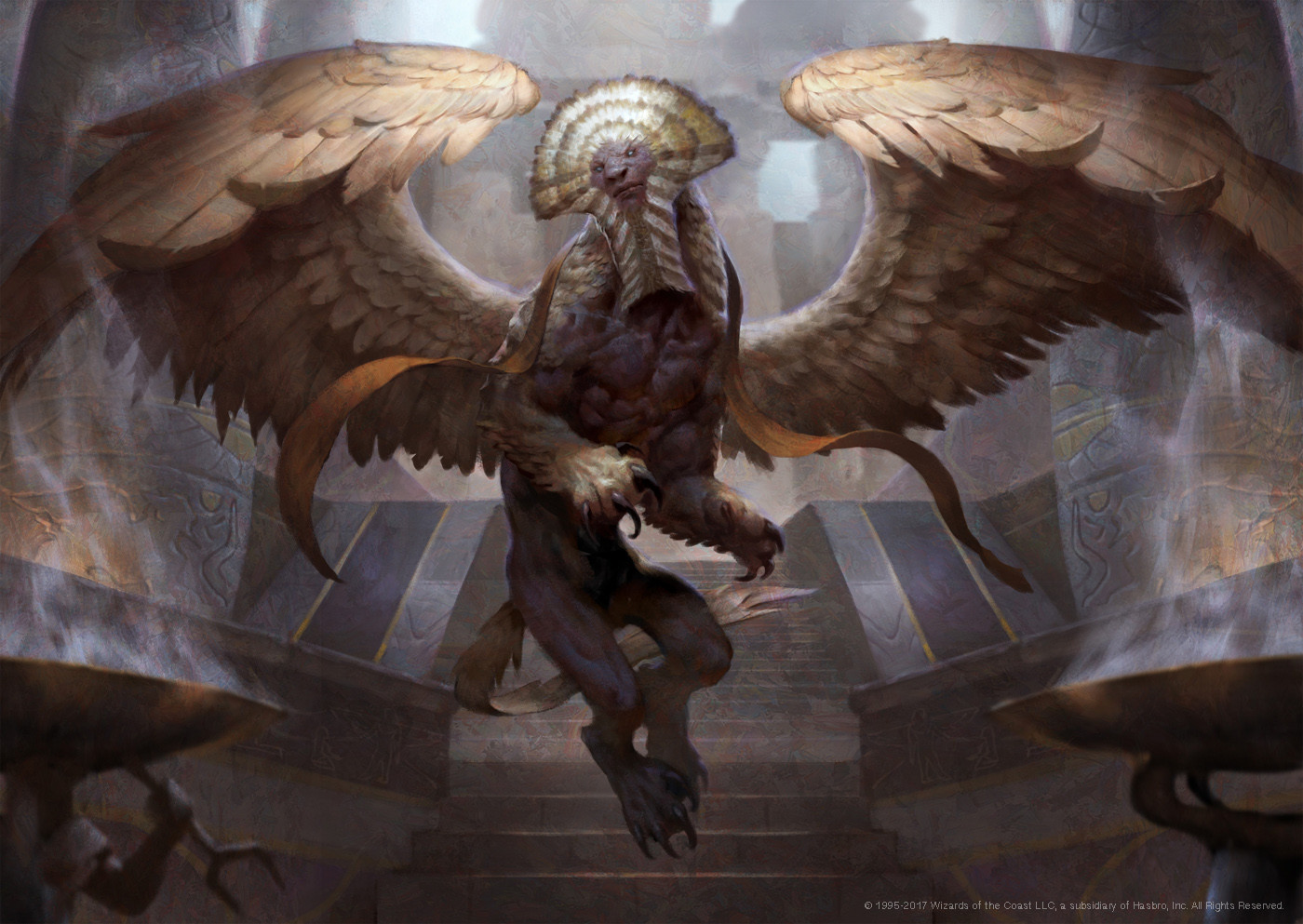
Consecrated Sphinx
Lius Lasahido
The form of the Sphinx is a bit different then what you're used to imagining. This is because they are creatures of two forms.

They are born as adults, in the shape of humans, for it is that shape that is most common throughout all universes for those seek answers. They are wing'd, to better traverse the world. Gold adorns them, for gold is the metal of greed, and they are greedy for wisdom in all of its forms. Their skin is of a color olive, or mahogany, or porcelain. Their eyes are hazel or green and star-flecked.

But wisdom is the domain of lions as well, who know much of the universe instinctively. Thus, the sphinx has the ability to take on this majestic, powerful form. The older they are, the larger their shape. They retain their wings, too. A Sphinx who no longer wishes to adventure will usually retain this shape, for reasons many.

Fur sapphire-rich or jet-deep. Manes wild as burning plains or regal as the king's crown. Eyes slitted, glowing in the dark, burning pieces of gold worth more than any coin. Claws and fangs sickle'd and sharp, blades enchanted by long learning years.

The Sphinx is not born, it is made. All are infertile. When a Sphinx is truly wise, it will have answered the riddle of how to create a child and will do so. Some will choose to parent, but most do not; after all, their child is an adult already, ready to fly into the world and have its own questions answered. Know that this means that it is rare that Sphinx congregate. There are no Sphinx towns or Sphinx cities. The only time they gather is in death, when their souls fly into the great beyond, ruminating at the Horizon together before going to explore some distant afterlife.

Know too that a Sphinx cannot die of old age, unless it wills away its immortality. Thus, many live for epochs, recording what they know on stone tablets or in omen and song.
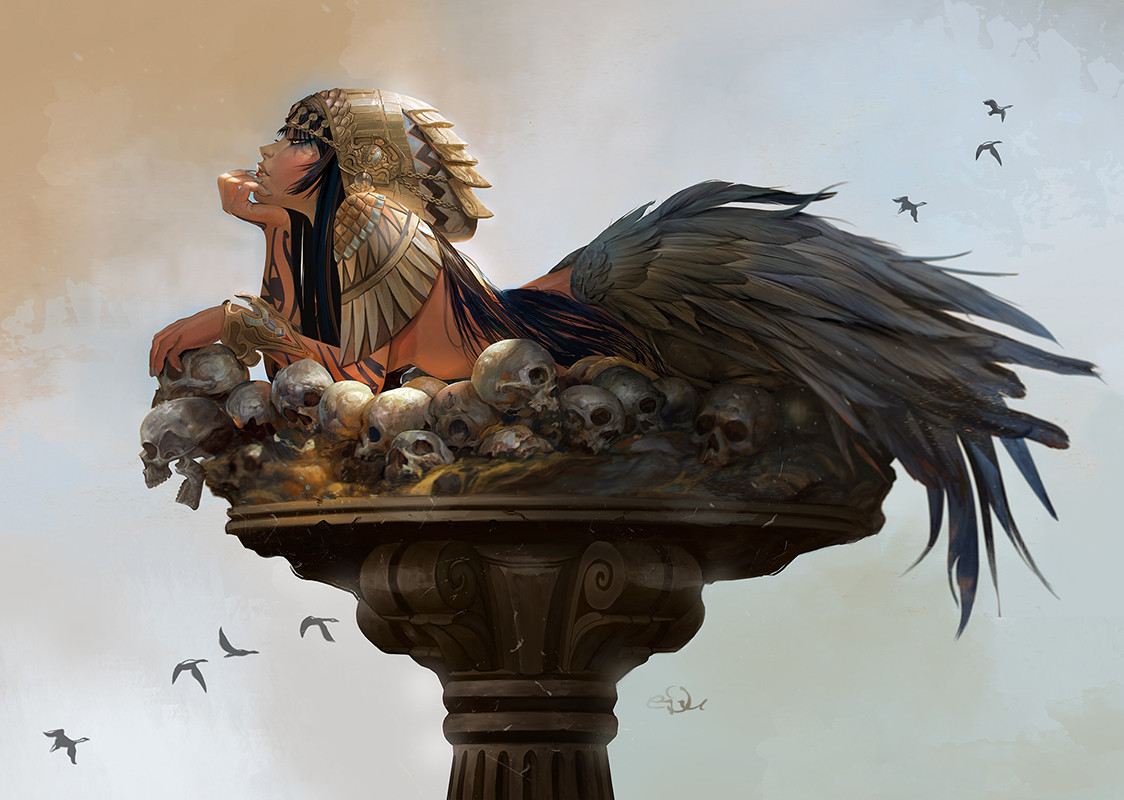
Eduardo Francisco
All Sphinx will ask riddles. They ask these riddles not because they know the answer, but because they are trying to find an answer. However, it is common wisdom that creatures will not lend the Sphinx their minds for any suitable length of time. Most get frustrated and leave. This is why so many Sphinx will threaten death, or a curse, or offer a gift in exchange for having the riddle answered. Coercion is, of course, how wise beings barter--at least, that is what many Sphinx come to believe.

Here be a riddle generator. For every game you play a Sphinx, or run with a Sphinx in it, keep it on hand; most Sphinx greetings include a riddle of some sort. In exchange for wisdom gained, the Sphinx will likely aid whoever it is answering the riddle. This is one of the many ways Sphinx adventurers come to be.

SPHINX - OD&D

Sphinxes are magic-users, and can only progress to 8th level (Warlocks). Sphinxes can use no magical items other than scrolls and potions. Sphinxes may only arm themselves with bows and slings. They have a 1-5 chance of knowing the answers to any riddles, and their wisdom allows them to hire sages at 1/10th of the price (200gp per month). After progressing to 2nd level (Seer), sphinxes can begin to research cleric spells. They cast these spells with their normal magic-user spell slots. All sphinxes can assume a monstrous shape, wherein their body takes the form of a lion, giving them two attacks with their claws. In their normal shape, they have wings, allowing them to move 2" through flight. Sphinxes are also magically-resistant, and thus save against magical effects as if 4 levels higher. Finally, a sphinx can speak any language.

Why does the Sphinx retire at 8th level? The Sphinx, by then, having learned much of this world, feels its soul pushing it to learn through other ways. 8 levels worth of adventure grounds the Sphinx; it then goes on to serve as a sage for some courtly figure, or some great rising power. In this position it will serve for a few centuries before returning to the adventurer's life, likely vastly more powerful, and more so in the form of a traveling deity then a wandering mercenary-for-hire.

I suggest using the COMMANDMENT spells for the Sphinx.

Image result for sphinx character art
Magic: the Gathering

SPHINX - 5E

Ability Score Increase. Your Wisdom score increases by 2, and your Intelligence score by 1.

Age. Sphinx are born fully mature, and have no natural age limit. 

Alignment. Sphinx tend towards neutrality in all ways. Adventuring Sphinx tend to be good, but more than a few turn evil as well.

Size. Sphinx in their humanoid form stand between 5 to 6 feet tall. Your size is medium.

Speed. Your base walking speed is 30 feet. You also have a flying speed of 15 feet.

Languages. You know a number of languages equal to your Intelligence + your Wisdom modifiers (minimum 1).

Born Wise. You have advantage on Intelligence, Wisdom, and Charisma checks that you are proficient in. 

Regalshape. As an action, you can transform into a CR 1 lion. Your Strength, Dexterity, and Constitution ability scores are replaced with that of a lion's. Your Intelligence, Wisdom, and Charisma scores remain the same. You have a human face while in this form, and can speak and cast spells with verbal components. Once you've used this feature, you cannot use it to transform back into your humanoid form until you finish a short or long rest.


SPHINX - HIRELING

A Sphinx can be hired for a cost of 4,000 GP per month. Sphinx hirelings are of 8th level. They will teach magic-users and clerics spells they know, lend their spells as aid to those that hire them, and provide wisdom, guidance, or information. The Sphinx will not leave the castle or palace alongside whoever hires it, and is unlikely to ever leave during their employer's lifetime. Yearly, the Sphinx will ask a riddle of its employer. If the riddle is not answered within 1 month's time, the Sphinx will end its contract and seek another employer.
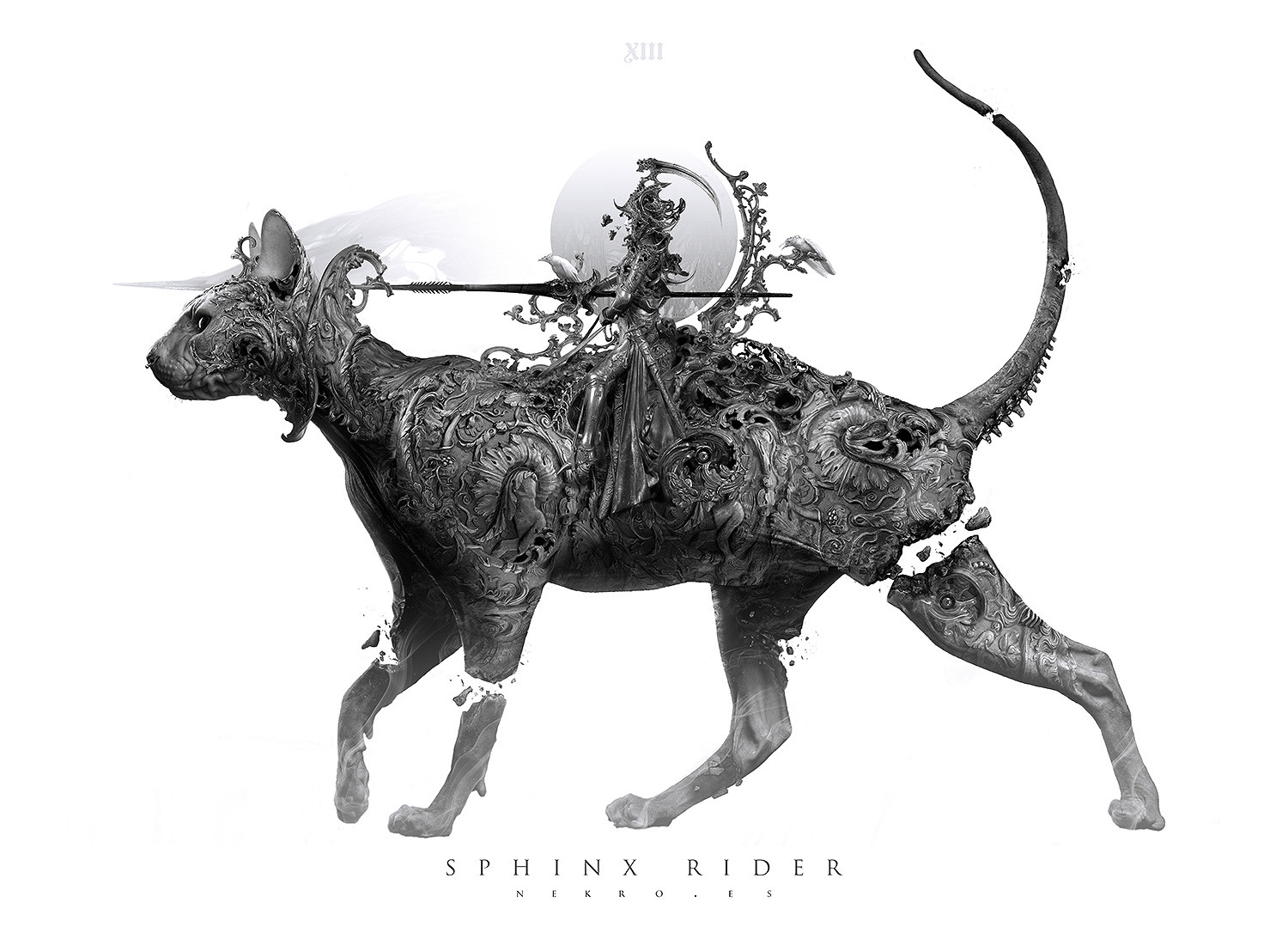
Nekro

USING THE SPHINX AS A CREATURE

Most Fantasy games have statistics for a Sphinx. I suggest the following feature to be added mechanically.

Riddle Curse/Gift. When the Sphinx meets a creature for the first time, it will ask if it would like to answer a riddle. If the creature fails to answer the riddle before it leaves the presence of the Sphinx, it shall be CURSED. This curse cannot be lifted save through a powerful exorcism, answering the riddle, or death. But, if the riddle is answered before one leaves the presence of the Sphinx, they earn a gift. Roll 1d6 below to see what this gift is.
  1. A piece of lapis lazuli, inscribed with a riddles. Acts as a spell scroll of one 6th level COMMANDMENT spell.
  2. A map that must be translated in order to find the treasure of which it leads to.
  3. Its services, for a year and a day.
  4. A curse to be placed on the head of one creature of the riddler's choice.
  5. The answer to a single question. If the Sphinx does not know the answer, another question may be asked until it does.
  6. To be sent back in time, reverted to the age of your childhood, and allowed to live your life again but with the knowledge of now.
Treat a party as players as one person, thus giving them only one gift as a whole.

Most Sphinx serve as a roleplaying/social encounter, as well as a puzzle. A Sphinx used in combat should be one that seeks violence as a means to wisdom. This is a wide umbrella. Perhaps the Sphinx is looking to hunt all humans down, as it believes that wisdom is found in a world without them. Or, maybe, the Sphinx seeks to rend and tear armor of all sorts, and will believe itself truly wise after it has damaged every piece of armor to ever be forged. These esoteric reasoning's give the Sphinx an esoteric vibe; it is a strange creature, clearly inhuman, and while not all together horrible, it is something mystifying, horrifying, and awe-inspiring to those that encounter it.

Having the Sphinx wield powerful magic, be surrounded by enchanted items, and dwelling in places of power is key to this. For Sphinx lairs, roll 1d6 or make your own:
  1. The funeral-palace of a long-dead hero or god-king.
  2. The throne-room of a demon-queen.
  3. A place where magic is so thick in the atmosphere that it changes the weather.
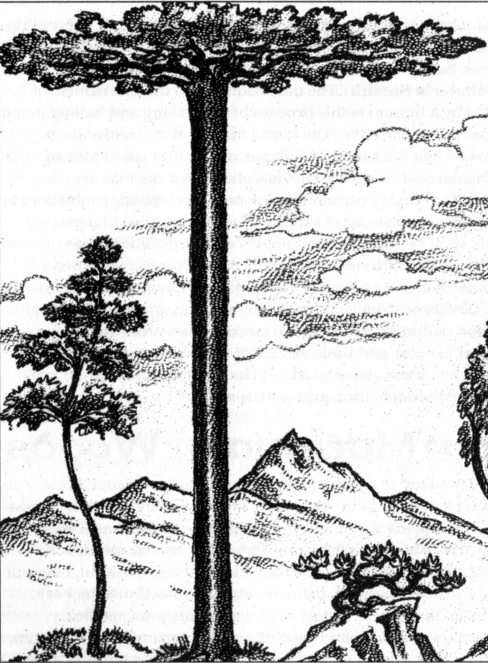
  4. Underneath the boughs of a sacred tree, one where some messianic figure once rested.
  5. In the center of an ancient battlefield, where great forces were risen and vanquished.
  6. A place where an afterlife borders the realms of the living.
When the Sphinx is met, it will ask a riddle. If the players decline to answer, roll 1d6 to see how the Sphinx responds.
  1. A curse upon all who do not answer.
  2. Unspoken and immediate hyper-violence.
  3. Offering a gift of some sort.
  4. Stating that it will kill someone the PCs love dearly if not answered.
  5. A sudden onslaught of monsters is released from a hidden space.
  6. A spell, powerful and horrid, is cast upon the PCs.
Roll on treasure tables of your choice, as if you were rolling for a dragon horde. This is the treasure that fills a Sphinx's lair, gifted to it by rulers from a thousand worlds, all of whom have sought the Sphinx's wisdom.

Sentient creatures surround a Sphinx. Dragons will come to trade riddle-answers for treasure, monks will come to study in its shadow, magic-users to learn spells and clerics prayers, adventurers seeking new vistas or long-lost ruins, monarchs and rulers and tyrants wishing to become better rulers, oracles in training to learn the secrets of the future, and, most rarely of all, another Sphinx, coming to trade pslams for just a short time. Thus, an entire dungeon or adventure site manifests around the Sphinx.

Image result for humanoid sphinx art
Hekkil


COMMANDMENT: Magic-User Spells Based Off Egyptian + Mesopotamian + Grecian Magic

Magic-Users in COMMANDMENT are different than those in classical OD&D. Their magics stems from the cultural mythologies of Mesopotamia, ancient Greece, and Egypt. They were not casting spells like light or hold portal. As useful as these may be while traversing a world Iron-plagued and rotting away, those are not the tools these magicians had.

A future post will be done for Cleric spells, as they are things dictated by omens, celestial events, and long prayers. Meanwhile, Magic-User spells are those sorceries learned by mankind from sphinx and spirit.

Below, 36 spells are offered for any game, really, if you want to add some spice to a warlock's life. Keep in mind all spells require a save vs Wands (or whatever your magic save is in your game). Research for these spells was done through a smattering of historical sources, none more valuable than Egpytian Magic by E. A. Wallis Budge. These spells are not intended to be 1 for 1 recreations of Egyptian/Mesopotamian magic, but instead spells inspired by these folklores.

Likely in the future, I'll turn a bunch of folk magic from these books, as well as key spells from the original MU spell list into enchanted items or potions. Easy treasure, really.

Note: " indicates multiply # by 10. So 1" is 10 feet

by Yeve Drovossekova

FIRST LEVEL

  1. Anointed Skull's Midnight Whispers
  2. Bare the Slave's Heart
  3. Gift Them Their Misfortune
  4. Nail to Them the Nomad's Curse
  5. Tongue that Dream-Speaks
  6. Ward the Evil Eye
SECOND LEVEL
  1. Beget the Nest of Crowns
  2. Blind the Readers of These Spells
  3. Dusk that Settles On Mud
  4. Keep Dead the Dead
  5. Move the Warlord's Statue
  6. To this Point, Bring the East
THIRD LEVEL
  1. Exorcise the Hated Evil
  2. Gather Forth All the World's Waves
  3. Loosen Soul
  4. Set Loose the Crocodiles
  5. Spreading of the Repelling Minerals
  6. Transfigure Dust to Vermin
FOURTH LEVEL
  1. Block of Slaughter
  2. From the Heaven's Eye, See Sin
  3. Mold the Waxen Sacrifice
  4. Paint a Curse Upon the Tomb
  5. Passage Through the Underworld 
  6. Ruin That which Ruins Me
FIFTH LEVEL
  1. Evil Eye
  2. Fashion the Chimera
  3. Favor
  4. Rule
  5. Upon Me I Bestow the Strength of the Dead
  6. Walk Again, Those Countless Dead
SIXTH LEVEL
  1. Chain One's Fate to a Demon's Own
  2. Destiny, Rewritten
  3. Idols of Bestial Gods
  4. In the Clay Container, Life Reborn
  5. Serve
  6. Unluck of the Doomsday

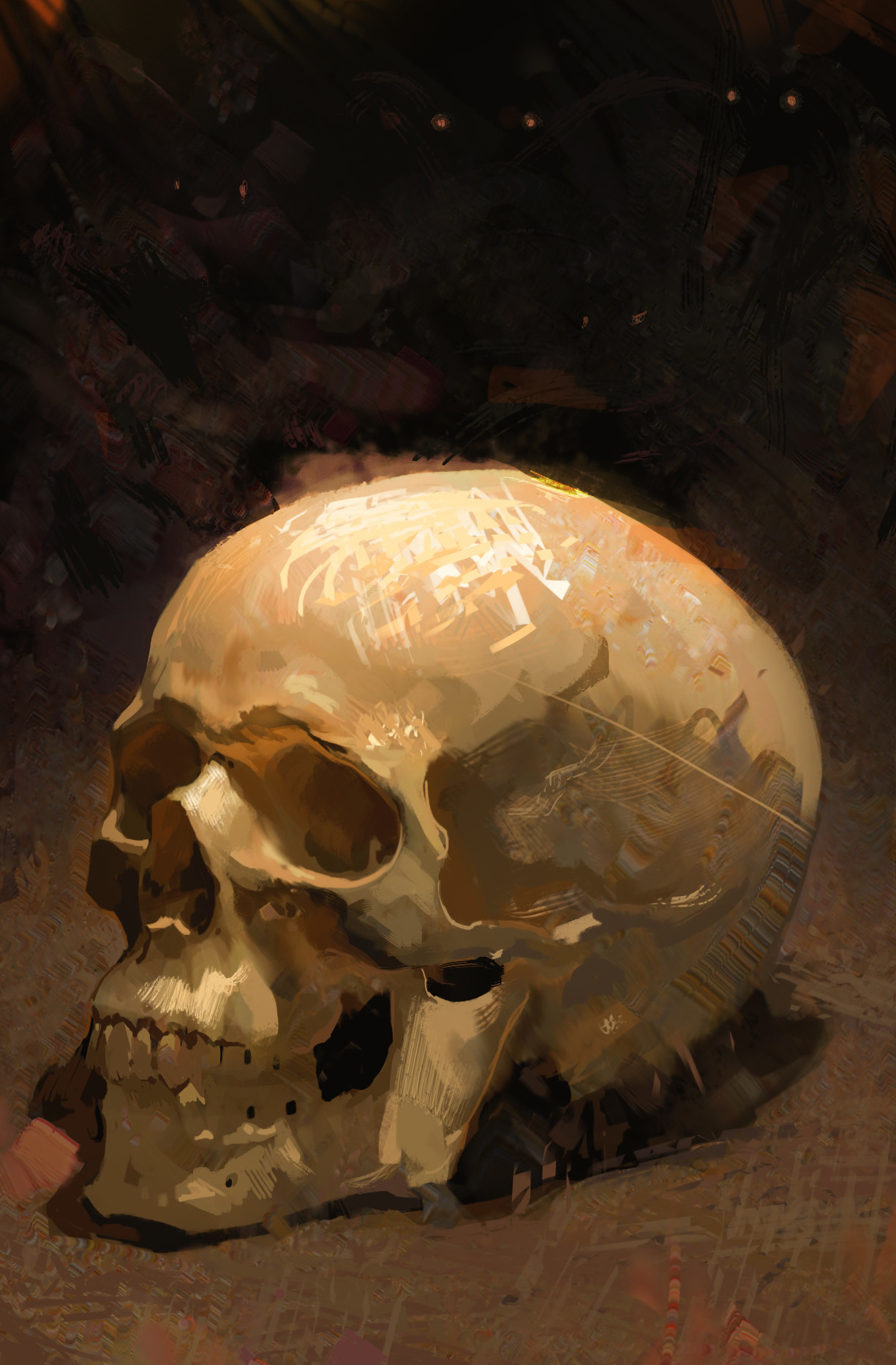
Skull  study
by Bartlomiej Gawel

Anointed Skull's Midnight Whispers (1st Level)
After anointing an undamaged skull in droplets of water from the Godsblood, hide it in a place where neither sun nor moon nor starlight will ever touch it. Upon casting this spell, the skull will begin to whisper. Said whispers ooze from you. Anything that is hostile towards you within 1" is terrorized by the whispers until they leave said radius. A creature terrorized can only commit simple acts, such as running, screaming, or untrained attacks. The morning after this spell is cast, the skull is destroyed and the spell ends.

Bare the Slave's Heart (1st Level)
Take the preserved heart of a slave and wrap it in hempen cord when you cast this spell. The next creature who touches this heart barehanded will become a slave to the spell's caster until the heart is destroyed or the magic dispelled. A slave will not do anything to harm itself or any friends it has, but will perform any manner of menial task for its master. An undead creature, or anything that is barbarous, will be immune to this enchantment.

Beget the Nest of Crowns (2nd Level)
Affix upon your brow a crown of twigs and feathers as a part of casting this spell. Birds without number will then cloud the heavens above and descend. All within 60" is considered obscured, ranged missiles will not hit their marks, no one can move more than 1" per round, and all sound is drowned by their chirping. These birds swarm until somehow killed en masse or dispelled. This spell is useless in doors.

Block of Slaughter (4th Level)
Slice your hand open with a ceremonial dagger and take 1d6 damage when you cast this spell. Point your hand towards a creature that can see it. Said creature will exert all of its efforts to kill as many creatures as it can other than you during the next 6 rounds.

Blind the Readers of These Spells (2nd Level)
Upon your spell book, light incense when you cast this spell. When someone attempts to decipher your spell book, or attempts to cast a spell that lets them do so, they will be blinded for 1d6 days time. Even a creature with no training in magick trying to read your spellbook will fall victim to this spell. After 1 creature is cursed in this manner, the spellbook is no longer protected.

Chain One's Fate to a Demon's Own (6th Level)
You must know the true name of a demon to cast this spell. You must also anoint a creature in strange oil as a part of this spell's casting. The anointed creature is possessed with a demon whose true name you announce. The demon will lie sleeping within the anointed creature. Should the creature ever die, the demon shall be released to do battle with all that is hostile towards you until it is slain or banished.

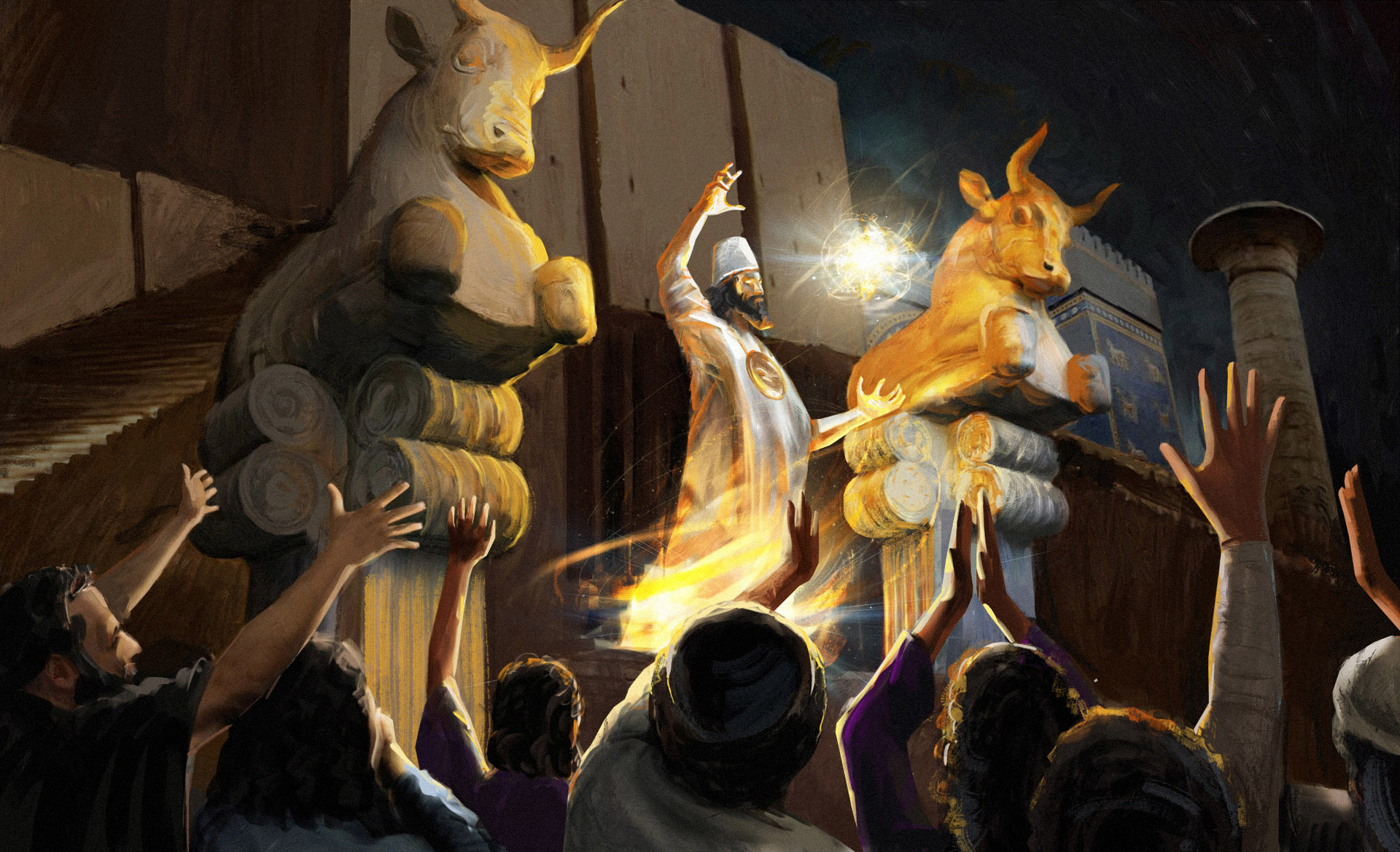
Babylonian magician
 by Eugene Medvediev
Destiny, Rewritten (6th Level)
As a part of this spell's casting you must know the birth place of a creature within 10". The creature's birth place is changed, and thus its entire life path is changed. The creature's memories are rewritten, as is their personality and alignment, and they disappear, reappearing somewhere else in the world.

Dusk that Settles On Mud (2nd Level)
Sprinkle the dust of a black ore onto clay, mud, soil, brick, limestone, or any other earthen substance. It will turn into constricting, hard, black metal and shrink slowly in size. A 1" x 1" x 1" area of earth can be enchanted in this way. After 1 round, it will have shrunken down to the size of a pebble.

Evil Eye (5th Level)
When you cast this spell, one of your eyes goes blind. A creature that you look upon when you cast this spell is cursed by the evil eye. You can see what it sees through one of its eyes, but only see, not hear, feel, or hear thoughts. At the end of every day, the creature must roll 1d20. On a 1, the die size reduces. When the die size reduces below a 1d4, the creature dies, and sight is returned to your blind eye.

Exorcise the Hated Evil (3rd Level)
Grab the throat of a barbarous or possessed creature and press a polished opal to its forehead. Pull the opal back, and all evil from the creature will exit it in the form of black, ichor-filled vomit. Afterwards, if the creature was barbarous or possessed, it is no more. Likewise, if the creature was cursed, it is cursed no more.

Fashion the Chimera (5th Level)
Take the body of a dead man and lay the corpse of an animal upon it. Only then may you cast this spell. The two bodies fuse in a way of your choosing. The new creature is risen as a chimera that will faithfully serve you. It has as many HD as you do, and has one aspect of the animal that it is fused with, such as an eagle's wings, a lion's claws, or a shark's water breath. If the chimera is ever exorcised, it dies instantly.

Favor (5th Level)
This is one of the words of power. Utter it, and one creature whose hand you hold will be able to cast any 1 spell you have memorized. Once cast, they will be compelled by fate to do you a single favor.

From the Heaven's Eye, See Sin (4th Level)
Stare into the sun when you cast this spell and do not look away until you wish it to end. While staring into the sun, you shall see anything that the sun could see, in any part of the word. You can see it as close as if you were currently 10" above ground. At night, this spell does naught, and it cannot be used in doors.

Gather Forth All the World's Waves (3rd Level)
Lift your hands and sing to all the seas you cannot sea. A 3" radius of space around you is filled with churning, crashing waves of white-crested green water. Creatures in the water begin to drown, and thus can not speak or cast spells. If they fail their save, they are picked up and moved to random locations, taking a number of damage dice equal to your levels at the end of every round. Thus, at 6th level, they will take 6d6 damage, and at 7th, they will take 7d6 damage. After 1 round, the waves dissipate, returning to their distant homes.

Gift Them Their Misfortune (1st Level)
When you are missing hit points, suffer 1 damage as you smear the wound with bewitched ointments of your own make. Then smear the blood-oil produced on another creature. It will lose twice the hit points you have lost.

Idols of Bestial Gods (6th Level)
You must have fashioned from clay an animal the size of a small hut before casting this spell. This spell is cast on this the idol. The idol turns into a flesh-and-blood version of itself, intelligent, sentient, and speaking all languages. It has HD equal to your total levels + 5. It will serve you loyally as a sage or as a warrior. It has 9 thac0 and deals 3d6 damage with its attacks. The animal has all the traits of whatever animal you sculpted it after. When it dies, is dispelled, or is exorcised, it turns into clay and shatters.

by Victoria Dame

In the Clay Container, Life Reborn (6th Level)
You must have access to the corpse of a creature with its head attached before you can cast this spell. As a part of the casting, cover the corpse in clay. The next round, the creature will be reborn, healed of all ailments and wounds. 

Keep Dead the Dead (2nd Level)
Gather the blood of a wounded creature and imbibe it when you cast this spell. The creature cannot ever be brought back from the dead, as its body will turn to sour soil upon death, unfit for the hosting of a soul.

Loosen Soul (3rd Level)
Work a short ceremony that loosens your soul from your body. It remains so for 6 rounds. While your soul is loosened, it can slip out of your body and move up to 2" away, sliding through walls or doors. You see and hear whatever is within the same area or space as your soul.

Mold the Waxen Sacrifice (4th Level)
Present a waxen figure you have made as a part of casting this spell. Affix to the figure via nail a piece of another living creature. Whatever the figure feels so too will the living creature, though it will suffer no other ill effects from the figure's defacing. 10 times may the figure be manipulated before this spell ends.

Move the Warlord's Statue (2nd Level)
A statue of animated stone constructs itself. It stands twice your height and is decorated and painted to mimic that of a famed warlord. It will follow in your footsteps indefinitely, or until you command it to take a single action. If that action is to attack, it will deal 5d6 damage to that which fails its save. If that action is to defend, it will absorb the damage from the next attack launched upon its ward. If is to lift, it will lift one thing weighing 10,000 gold coins or less. After any of these acts, it will turn into mud and disintegrate.

Related image


Nail to Them the Nomad's Curse (1st Level)
Write upon papyrus the wrongs a creature has committed and nail them to its home or lair. For every wrong written, the creature will be unable to return to its home and unable to rest anywhere else. At the dawn of every day, one of the wrong's disappears. Creatures who are unable to rest due to this curse take 1d6 damage at the dawn of every day, and they cannot rest to regain hit points.

Paint a Curse Upon the Tomb (4th Level)
As a part of this spell, drench an object in the same paints used to adorn the tombs of god-kings and god-queens. Any creature that takes the object other than you is curs'd. Said creature rolls twice on all die rolls and takes the worse result. If this would result in a failure for any reason, the creature suffers 1d6 damage. This curse persists until somehow dispelled, or if the curs'd object is destroyed by fire.

Passage Through the Underworld (4th Level)
Cover your ears and close your eyes as a part of this spell's casting. Then, walk forward. Your body will descend underground, to a place no living or undead creature may follow. The following round, appear anywhere within 36" of your original location (up or down). You know exactly where you will go. When you emerge, one ghost emerges with you, and will aggressively haunt wherever you appear.

Ruin That which Ruins Me (4th Level)
You can cast this spell only when you die. That which kills you dies for 1 round, resurrecting after that round with hit points equal to its total hit dice.

Rule (5th Level) 
This is one of the words of power. Utter it and a legion of 20 6th level fighting-men (Myrmidons) will gather to you in 1d4 days. They will be loyal to you for one battle, after which they will disperse randomly into the world.
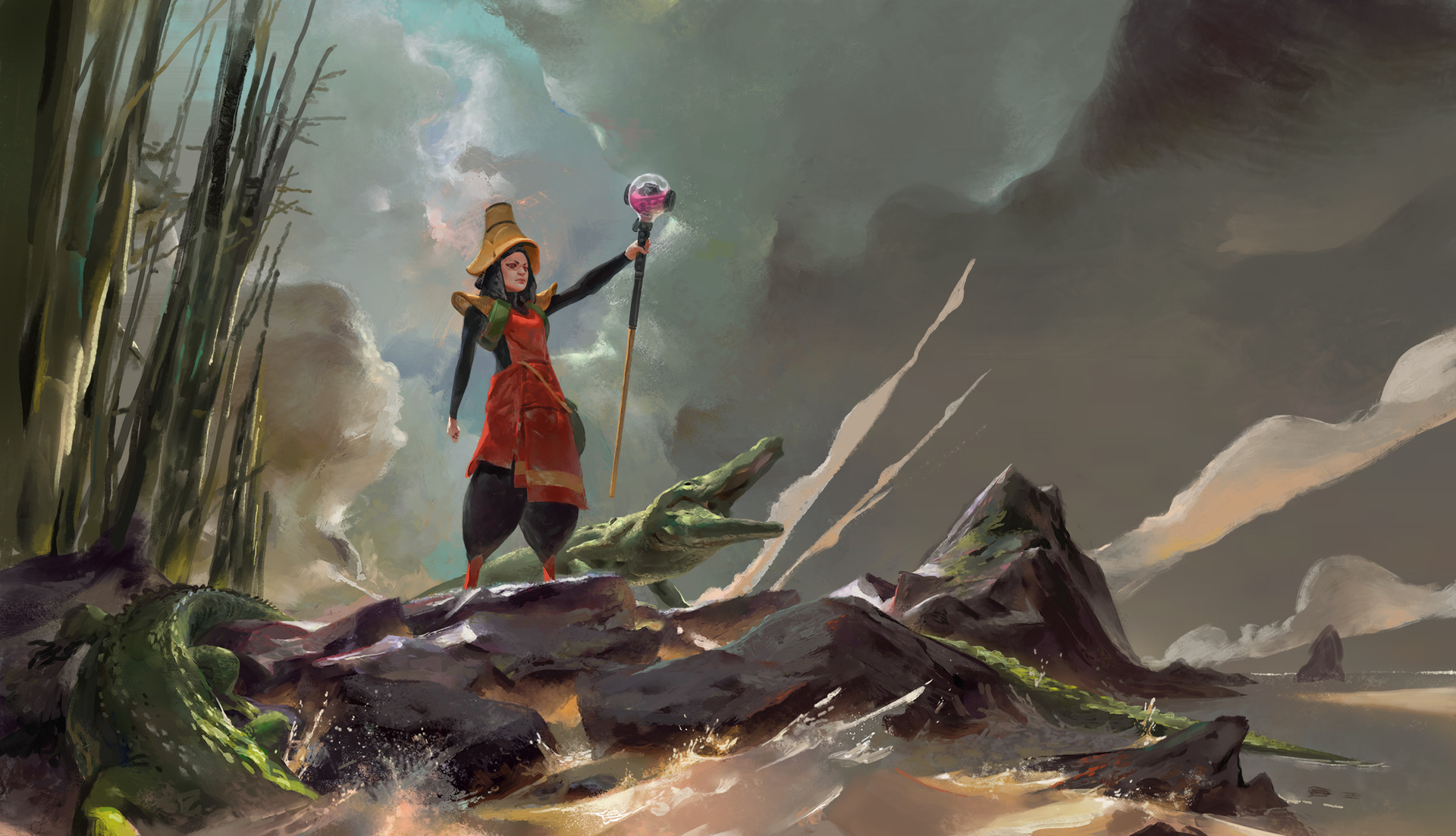
Crocodile Summoner
By Ian Barker

Serve (6th Level)
You utter a word of power. This utterance forces the world to serve you. You can use this spell to part water up to 10" deep, or lower the water level of a body of water by 50%. You can create weather of any kind, or raise up great walls 10" tall and 50" wide. Casting this spell allows only one of these feats to be achieved.

Set Loose the Crocodiles (3rd Level)
A moat 2" deep, 1" wide, and with a radius 3" away from you is suddenly carved into the earth and filled with water. If these dimensions cannot be met, then the moat tears through any non-magical obstructions to form itself. Inside of the moat, countless crocodiles. Creatures who attempt to swim or leap across must save or take 1d6 damage as they are pulled in. Creatures in the moat cannot move, and take 3d6 damage every turn until they save and can swim out. 

Spreading of the Repelling Minerals (3rd Level)
Scatter minerals strange and esoteric as a part of this spell's casting. A magical zone is created 10" by 10" by 10" in size. Any and all metal objects are thrown out of it with haste, as are weapons made of stone or bone, over the next 4 rounds.

To This Point, Bring the East! (2nd Level)
Take a stone stele and affix it into a point of your choosing when you cast this spell. The next creature that attacks you within 10" of theis stele will be drawn to destroy it instead. The stele can take 1d6 hits before it is ruined.

Tongue that Dream-Speaks (1st Level)
Split your tongue with a bronze dagger and read aloud a text before you. You need not understand it or know the language, and you have 1 round with which to read. When you are done, sleep. In your dreams you will understand all that you read and wake with a tongue healed. This spell allows you to understand even the ciphered text of other spellbooks. 

Transfigure Dust into Vermin (3rd Level)
Motes of dust are turned into lice, rats, and scorpions around you. Point to a creature. The vermin swarm them, biting and gnawing, dealing damage equal to your levels. At 6th level, this will be 6d6 damage, and at 7th, 7d6, and so on. This damage continues until the target brings fire to the vermin, or the spell is dispelled.

Scarab Plague
by Marius Bota

Unluck of the Doomsday (6th Level)
Roll 1d20 when you cast this spell, and stare at the creature whom you are cursing. On that day, the creature must succeed on its save or die. If it has less then 20 hit points, it will die no matter what.

Upon Me I Bestow the Strength of the Dead (5th Level)
You may only cast this spell while having the skull of a 4th level fighting-man (Hero) or higher in your inventory. You gain their Strength score and skill at arms, as well as the ability to use a fighting-man's magical and non-magical armors, shields, and weapons, and their thac0 for 6 rounds. 

Walk Again, Those Countless Dead (5th Level)
To cast this spell, you must have a scrap of flesh from a dead man's face. Once cast, you call forth the dead to serve you. For the number of dead animated simply roll one die for every level above the 8th the Magic-User is, thus a "Sorcerer" gets one die or from 1-6 animated dead. Note that the skeletons or dead bodies must be available in order to animate them. The spell lasts until dispelled or the animated dead are done away with.

Ward the Evil Eye (1st Level)
Cover one eye in its entirety when you cast this spell. While covered, no one may target you with a spell, but will instead target the creature nearest to you. Lasts until your eye is uncovered.

The Man in the Golden Mask
by Irina Vizhevskaya

In Realms Forgotten & Bloody: Spellcasting, Spell Levels, & Spell Slots


It's a legacy, but I don't like how mechanical "spell levels" and "spell slots" sounds. I want something for my 5E game(s) that sounds more authentic to the settings I run in (mainly a variant of the Forgotten Realms right now). Let it be known that in cannon FR, arcane magic is THE ART and divine THE POWER.
I'm thinking (in order of the above) - Spell Circles & Weave Knots.
The Sleeper
Mathematic & Arithmetic + Fantasy = Spells 
Spell Circles, of which there are 9, are circles of magic upon which a magic-user acts. The weave is organized into these circles somewhat naturally; it is a tapestry of magical force that spellcasters "witness." Once witnessed, their minds are literally rewired in such a way that allows them to perfectly perform the actions required to cast a spell even under duress. Anyone who has access to any spell circle should roll a 1d12 for a trait gained from the rewiring.
1. Anything lyrical (poems, riddles, stories, etc) becomes an obsession of yours. You seek out these things, make these things, and sometimes even speak these things frequently.
2. Fear is baptized from you. Replacing it is an "arrogance response"--whenever you would normally be afraid, you instead seek to dominate whatever is triggering the response.
3. You lose the ability to read words of any languages you know or learn. Instead, whenever you see text, you see silvery images replacing the text that communicate the same ideas. When you write, you instead draw similar images.
4. Your sense of time is lengthened to the extreme (or shortened). Days feel like either hours or years; years feel like weeks or lifetimes.
5. Decide one mundane thing that makes you happy. That thing is replaced with an esoteric version of itself. For example, if you enjoyed eating, you now only enjoy eating when the North Star is obscured by clouds or when comets streak through the heavens.
6. Whenever you see your favorite color, you instead see an incredible kaleidoscope of shades replacing it.
7. Your pain response changes so that whenever you feel pain, you instead feel the strange, indescribable sensation of a tree experiencing the change of seasons.
8. You are utterly unmoored from those you love. For these people, you no longer feel any emotion, and when you begin to feel love again it quickly evaporates.
9. Your witnessing of the Weave has left you with a tick that requires you to weave your own strange tapestries whenever you take a rest.
10. Even when confined in small rooms, or with chains and rope, or surrounded by a dense forest, you feel as if you are in a vast space too big to be filled with anything else.
11. Movements of the stars and other celestial bodies take up most of your nights in viewing.
12. Suddenly made aware of a world within and beyond your own, you cannot help but lose all sense of value for material goods.
Tapestry
Magic-users can physically see and touch the threads they knot in their minds.
Weave Knots, of which there are many, infest a spellcaster once they witness the Weave. The more a magic-user's skill grows and the more access they gain to Spell Circles, the more weave threads knot in their minds. These threads are literal; the brains of magic-users, when dissected, are filled with ethereal, glowing knots of something that unravels and dissipates. Magic-user's who are memorizing their spells, or praying for powers from deities, or otherwise practicing magic at all are literally knotting these threads in their minds. Once the spell is cast, the thread is untied.
When all mechanical spell slots--now Weave Knots--are spent (now untied), roll 1d6 to see how you change. This change is reverted the moment you regain at least one tied Weave Knot.
1. You are impossibly morose; almost anything that happens or that someone says puts you in an ill mood.
2. You can no longer see colors, instead shades of grey.
3. Your sense of smell and taste are lost, and your skin goes partially numb.
4. Suddenly, the air, your clothing, your hair, everything feels much heavier. It is a struggle to stand upright, and walking takes momentous effort.
5. Your thirst and appetite increase exponentially; no matter how much you eat and drink you do not fill full, but you do feel very ill once you've eaten too much.
6. Looking at things that are put together, like houses, suits of armor, or even books gives you sharp, stinging headaches.
Image may contain: indoor
Witnessing the Weave -- psychadelic, symbol-riddled, almost grounded but not quite.

Duskwood Tree
These ill effects are known well to any magic-user, especially wizards in their schools and cabals. Collectively, they are called the Six Punishments. While apprentices are routinely trained to untie all knots so that they can function under the effects of the Six Punishments, there are a number of ways to give a "boost" around them. Namely, drugs.
THE AURORA MUSHROOM, found across Faerun, is named for the strange colors it lets off every night. Eating it alleviates the effects of the Six Punishments for upwards of 8 hours. Additionally, it gives a sense of giddiness to the ingestor, makes it so colors they see melt into one another, and strips them of any magical knowledge for the duration. A favorite amongst sorcerers.
DUSKWOOD MILK, the name of the milky white sap of the Duskwood tree, when drank in small amounts, alleviates the Six Punishments for upwards of 14 hours. However, all sensory input is interfered with; sounds are intense, touching others is either incredibly unfun or too much fun, and staring at bright lights is very, very difficult.
BLOODLETTING, specifically from cuts made underneath the eyes, softens the effects after 10 minutes, and completely counteracts them after 1 hour. Not an enjoyable process; it requires making several cuts every 10 minutes until the Six Punishments ends. The preferred method of practiced wizards.
INCENSE using blood of the spellcaster, blood of another spellcaster, and leaves from the Golden Wand tree alleviate the Six Punishments within seconds, and continues to alleviate them so long as the incense is burning and actively breathed in, regardless of one's ability to smell. Used often by clerics and bards.
REKNOTTING the weave knots instantaneously undoes any effect of the SIx Punishments. This is difficult, however, often taking 1-8 hours to complete depending on the training of the magic-user and the spell circles involved. The most common method amongst spellcasters.

Esoteric Sorceries Pt. 1

Sorcery is the power of the soul.
When you weave a sorcery, you take its burden directly to your spirit. While it is there, you are changed. You can rebuke the supernatural and twist reality in minor ways. And, of course, you can work sorceries proper--though once you have worked them, your soul is empty and it will be a while before you can gain such power back.
Masterful sorcerers spend years increasing their spirit's burden-limits. The more sorceries they can keep inside themselves, ready to be woven, the more they can See and the more they can Do.
Should one decide to embark on the esoteric path of the sorcerer, they will find they are entering into a world where everyone knows half the rules, and the half they don't know can kill them in a heartbeat. It is dangerous. It pumps the adrenaline like no other task. And its rewards are as strange as they are grand.

SORCERY MECHANICS

(Anything with an asterisk * refers to 5E conversion stuff found at the bottom of this post)

SORCERY DIE
Pick up 1d12. This is your Sorcery Die. Any time a sorcery will do damage or otherwise require a roll, you will roll your Sorcery Die and add your total character levels to the roll.*

PERFORMING SORCERIES
Your soul can only handle performing a number of sorceries equal to your character levels + your Charisma modifier. Once you've performed your maximum number of sorceries, it costs 12 HP for each additional sorcery performed. As long as you have sorceries that you can still cast without spending hit points, you are considered HEIGHTENED.

You can return to your heightened state by performing one of the following refreshes. Roll 1d12 everytime you run out of sorceries to see which refresh must be performed.
  1. While smoking opium, confront a hallucination of yourself and cannibalize it.
  2. Shove forty needles into your thighs and drink the blood.
  3. Map the stars and convince them to align in such a way as to create disaster.
  4. Temporarily blind and deafen yourself for eight hours.
  5. Kill as many insects and small animals within an 8 hour period as you can.
  6. Steal a kiss from a mystical creature.
  7. Severe two identical fingers from your hand and swap and reattach them.
  8. Snort a powder consisting of bone ash, black lotus, and crushed queen bees.
  9. Take a selection of spiders and have them bite your tongue. Then swallow them all.
  10. Create and smell an incense or perfume mixed with your blood and a single heartstring.
  11. Consume the seeds of a plant that will blossom in your stomach.
  12. Poison yourself so that you appear dead for 8 hours.
Surely your players will ask how these things are possible. If the player has magical regents already, they can do all of these refreshes once. Beyond doing a specific refresh once, they will need to find ways to replicate that refresh again.

HEIGHTENED**
While heightened, you are different. In addition to having one of the quirks listed at the end of this section, you have numerous benefits that you can make use of.

End Magic
When a magical effect from a spell or another sorcery manifests that you are aware of, roll your sorcery die and add the number of sorceries you can still cast to the roll. If you roll a 12 or higher, that effect ends instantly. If it is a continuous effect, you must do this 3 times to end the effect. A failed roll on a continuous effect mean you cannot break it for another 24 hours.

Tear Their Spiritual Firmament
A creature that you see must save vs magic or suffer your sorcery die in damage***. You must be able to see the creature, and the damage manifests directly to the creatures soul, bypassing any defenses they may have. 

Know the Esoteria of All Things
When you see an esotery, a magical item, mystical creature, or a spell being cast, roll your sorcery die and add the number of sorceries you can still cast to the roll. On a 12 or higher, you know the exact effects, both mechanically and narratively, of whatever it is that you're trying to identify.

Shed Curses as Snakes Shed Skins
If you are the target of a curse, you can temporarily end its effects on you for 24 hours. To do this, you must sacrifice half (rounded up) of all maximum amount of sorcery performances. If you successfully do this for 30 days, the curse will be permanently broken.

Eat Sorcery to be Sorcerous
If you feast on a sorcerous or mystical creature enough to do at least 12 points of damage to it, you can perform 1 sorcery without having to mark it towards your limit. These effects stack, but you cannot eat your own flesh to do this.

Heightened Quirks
  1. Whenever you blink, your iris, pupil, and the sclera change color and sometimes develop patterns.
  2. Wherever you walk, lotuses blossom from your footsteps before dying.
  3. It is storming. Violently. Always.
  4. Everything you look at is dyed various shadows of purple and black. Others see this as well, not just you.
  5. Mammals are terrified of you but insects are attracted to you in swarms.
  6. Stars are always streaking through the sky, even during the day.
  7. Filth and dirt cannot stick to you or your garments.
  8. Whenever your arms move, afterimages of them float in the air for several seconds. Each afterimage is a different color.
  9. A crown of horns, feathers, or lotus petals bursts from your skull.
  10. Your touch sends waves of both excruciating pain and ecstasy through those that you touch.
  11. Strange tattoos of odd creatures and symbols appear on your body. They crawl across your skin.
  12. When you speak, the sounds of a chorus echo after your words.

LEARNING SORCERIES
You begin with 2 sorceries known. When you increase in level, roll your sorcery die and add your Charisma modifier. If you get a 12 or higher, you learn a new sorcery. Ignore this and replace this with spells learned if playing the 5E Sorcerer.

RECORDING SORCERIES
Sorceries cannot be recorded in spellbooks, spell scrolls, or through any other method. The only way to learn them is through exploration of the magic of the soul or being taught directly by another sorcerer. 

BEING BORN SORCEROUS 
Every PC has a 10% chance of being born sorcerous. This indicates that they have a mytstical ancestor, or that some strange force has seeped into their spirit. If playing 5E, just take the Sorcerer class instead. For NPCs, 1 out of every 1 million humans is born sorcerous. 

Related image


EXAMPLE SORCERIES

To You I Gift the Kiss of Ages
5****
Roll your sorcery die. You either age forwards or backwards the number of years you rolled. The next creature or object you touch must save vs magic or age that number of years multiplied by your total character levels. As this happens, you return to your original age. If the creature remains alive or the object is not destroyed, it moves 1 year closer to its original age for every hour that passes after they are affected by this sorcery.

Bring Out the Truth of Your Being
1
A creature that you are looking at must save vs magic or manifest a strange, supernatural trait such as horns, iridescent skin, burning eyes, multiple mouths, or something similar. Whenever the creature tells a lie, attempts to become invisible, or attempts to change their shape, this feature will force anyone within 100 feet of the afflicted creature to look directly at it. Roll your sorcerer die. The trait  disappears in a number of hours equal to the number rolled.

I Will Now Bleed Across the Visual Spectrum
2
Roll your sorcery die. You can only be seen through one of the following ways:
  1. Infrared vision.
  2. Dark vision.
  3. True sight.
  4. Blindsense.
  5. Through glasses with blackened lenses.
  6. By those who are at 1 HP.
  7. By those who are naturally blind.
  8. Witch's sight (the ability to see through illusions).
  9. Devil's sight (the ability to see through magical darkness).
  10. Through a blindfold made out of butterfly wings.
  11. Through smoke or incense.
  12. By those who are cursed.
This lasts for 1 hour.*****

Hold Not the Tale of Genesis in Thy's Heart
1
When you hear a creature speak or otherwise make an audible sound, you can force it to save vs magic. If it fails, it will begin to tell you everything of note it has done within the last few hours. The number of hours is dictated by a roll of your sorcery die. That creature will continue to speak even if dead as long as it was alive before the sorcery was performed upon it. 


For 5E Peeps
* - Add your Charisma modifier instead of your character levels.
** - Either replace the Sorcerer classes metamagic feature with this, or use these 5 features in order to form a Sorcerous Origin. If you go the metamagic route, each metamagic costs 2 sorcery points to use. Pick them as if they were normal metamagics.
*** - Save vs Magic=Con Save. Damage is force damage.
**** - The # here represents that is a 5th level spell in a Vancian system, such as 5E's own. There are no components--the sorcerer is the component.
***** - Spells that effect you and last for more than an instant effect are considered concentration.
Additionally - This replaces the spellcasting feature for the Sorcerer class, as well as their spell list. Even a Bard's magical secrets cannot learn these spells.