Showing posts with label Adventure Site. Show all posts

Provenents are the Pillars of Creation in a Fey-Bloomed World

Before the Fey-Bloom, humanity lived at the behest of the Provenents - those Pillars upon which the world is worked. It was not a relationship between men and gods or men and rulers; the Provenents do not trade, barter, accept worship or sacrifice, make requests or enforce demands. They flow, they appear, and humanity works off the leftover fruit of their operation. 

Primordial Crimson
Zifeng Ye
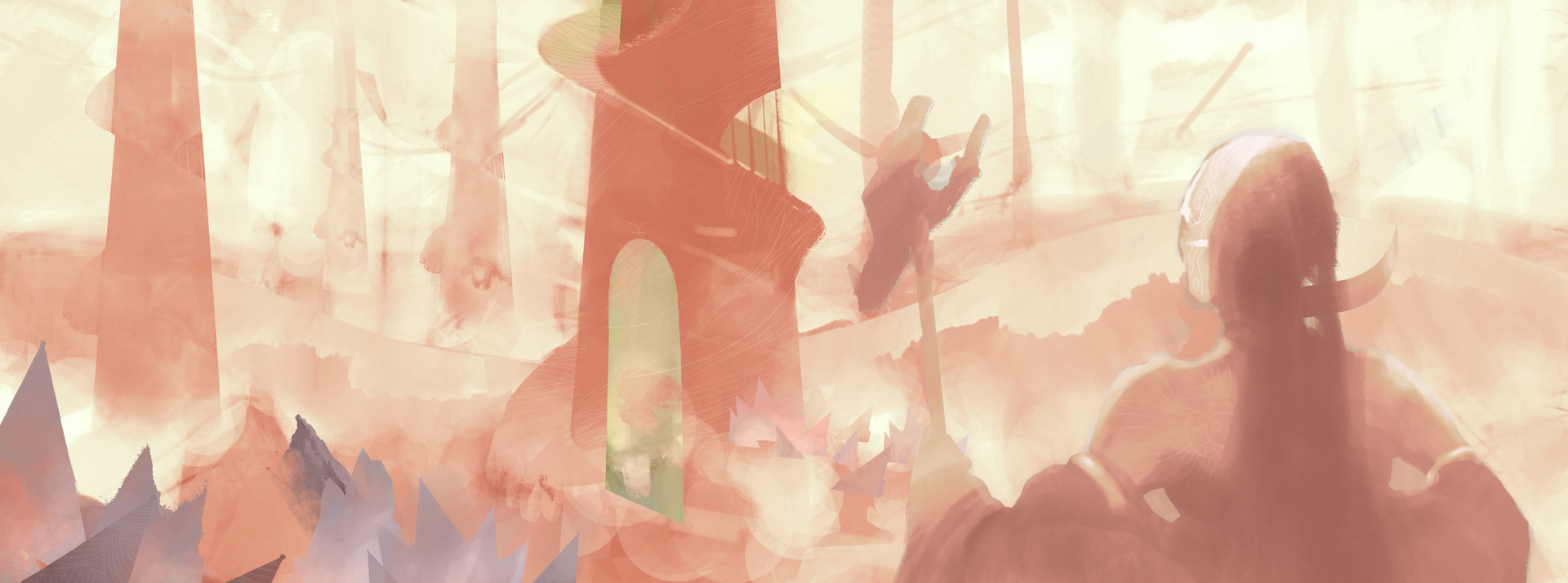
A Fast built in an area where a Provenent holds influence.


These are not World Spirits; these are not Elementals. Provenents may have created the world or they may have been created by it. They may be immortal or they may obey a life cycle that denies anything else the human mind could imagine. Provenents Bloom not; the Fey can neither control nor destroy them. There is a response to the Bloom, though, seen in how a Provenent's area of influence shrinks, expands, or otherwise morphs. There is not enough gathered knowledge yet to create any rhyme or reason for what this means.

Of these Provenents are we aware and more in places I do not know.

Provenent of the Waterfall, that capricious woman whose hands sweep away all manners of landmark; whose flood-feet flood towns in a way not so different from how a fish flops out of water or how trees shake in the wind. If she bleeds she bleeds over mountains, through the carvings of valleys and into the ravines where she pools in rest for a while then floods out again in a erosion of stone and a sexual gifting of forest to land.

Find her in the East, where you seek:
  1. A fountain of youth made from one of the Provenent's breasts.
  2. Memories lost or forgotten by those who have drowned or who have cast their sins into water.
  3. To attract the Provenent's attention to a Fey-Bloomed castle out of hopes of her flooding it.
  4. Secret cave-groves hidden by the Provenent's sprawled, sleeping body.

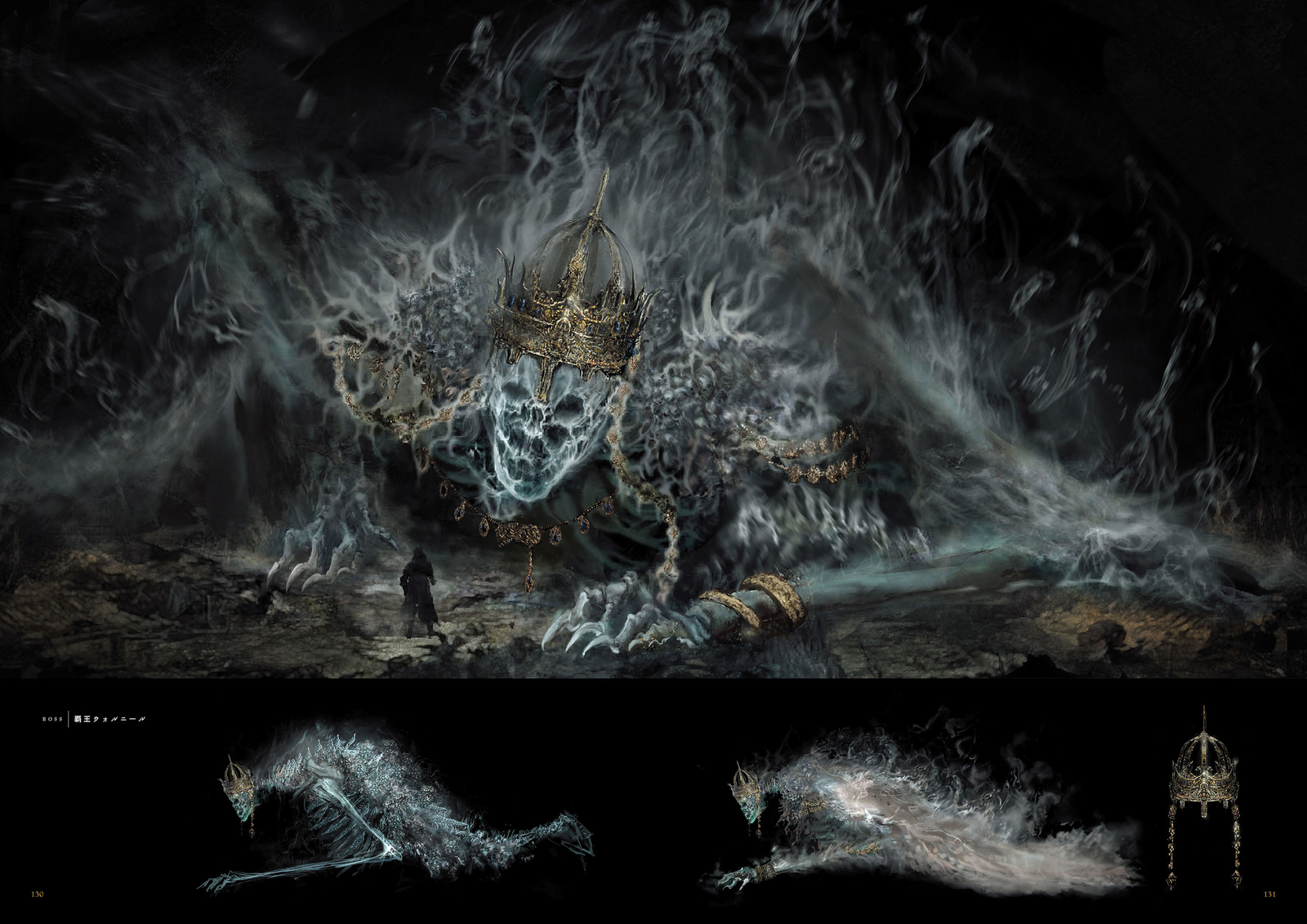
Provenent of the Sunset, they who know that sleeping is dying and is creation and is heat and is cold: whose wings flash out with a million feathers, each feather the color of sherbet or cotton candy or chocolate or blood; who lives where the horizon is open and not closed and where the moon has risen five hand-lengths above the edge of the world whilst the sun sinks half below. Day has ended and morning will come and there is a promise to those Fasts built too far away that night will last forever and a day and something wicked will not fail to come this way.

Find them in the North and the West, where you seek:
  1. Burning, bladed feathers that brings an end to curses, Blooms, and schemes.
  2. The liquid youth of the moon that inspires madness just as much as it does innovation.
  3. A branch burning with the era-ending flame of the sunset.
  4. A sanctuary where those soon to die can eternally live unchanging.

Provenent of the Tarpit, this man who in his passiveness has become cruel in a way no others have. There is nothing so stoic in all this world, never moving, never resting, never waking; bubbling and drooping and dripping and sinking and in that sinking pulling into him all those things who seek to find what mysteries may have been lost in the dark or the desolate places where nothing is kind. Fasts swimming in asphalt are reached by no danger . Nothing that Blooms can find its way out of the tar; nothing that has no bones will ever know the destiny that is escape.

Find him in the South, where you seek:
  1. The remains of some great creature that has use yet.
  2. To lead a predator hunting after you to their demise.
  3. A place where even the most powerful of artifacts or tools can be destroyed.
  4. A fast where outlaws and destitute do gather.
Provenent of the Rainbow, o' singing child, singing child whose songs are light and not sound and are sung when sitting and sung when dancing both of which happen at once and happen when the storm comes through with chickenscratch lightning and wild bolts mindless in their wroth and winds and gales and tornadoes pregnant with rain and hail that goes a'falling and comes a'blowing. Pristine upon the cliff the child. Never seen save on the curve of the bow and at night there is a twin or perhaps the same child but silver and grey and black and white and here there is tell of evil omens and omens of curses to come.

Find them in the East and the West, where you seek:
  1. A prophecy pertaining to dangers to come on your journey.
  2. The chance to dance with the Provenent and thus be exorcised of all curses and Blooms.
  3. Where great chaos churns and thrives and thus where you can be tested and polished.
  4. Liquid golden luck which pools where the Provenent does sing.
Dawn of anxiety
Anna Marek
Perhaps the Provenent of the Sunset?

The Sphinx - Class, Race, Hireling, NPC, Enemy

The Sphinx is, along with the Angel and Medusa, my favorite fantasy creature. They are one of my principle OD&D races, featured heavily in COMMANDMENT, and are aesthetically one of my touchstones for Fantasy as a whole. So, have a blog dedicated to fleshing out the Sphinx in OD&D, 5E, and general fantasy games.

by Casimir Lee
The Universe, and, in fact, every universe is a spell in the process of being cast. This spell is sentient. This spell wishes to understand itself, its purpose, where it is going, where it came from. Thus life is born. Stardust makes complex compounds, the universe's magic is sheaved off to form a soul, and evolution begins. Across every universe, life of all kinds abounds. The Sphinx is but one of many, but one special nonetheless.

A riddle, personified. The Sphinx was born wholecloth from the divinity that is the universe, created from eons of watching life evolve and still not finding the answer to the Question of Questions. The Sphinx knows this. It is born wise, adult, knowing of many things and many languages. But the Sphinx is young in soul, lonely amidst the stars, the cosmos. It knows why it was born, but not why all was born, and it sets to work. The work: become wiser still, through any and all means, so that one day the Question of Questions can be answered.

This makes them great adventurers. They happen upon a strange land and seek to know all there is to know. If you're looking for treasure, or weapons, or secrets, and you happen upon a man or woman or them wing'd and gold-swathed, a man or woman or them who is a master of a thousand and one riddles, you'd be a fool not to ask them to ally with you. And, of course, the Sphinx will. You are but one of many vectors towards wisdom in the future. By knowing you, watching you, fighting with you, and even killing you, the Sphinx grows more.

Not all Sphinx are so kind. Some, especially those that are older, are cruel. They seek wisdom in violence, death, suffering, annihilation. Their kin do not judge them for this. There is wisdom to be found in all things. There in lies the biggest difference between you and they. You have morality guiding you forward. The Sphinx has a quest, eternal and known, and any means needed to complete it is thus Righteous. Some are chaotic. Some are lawful. Some choose to be good. Some choose to be evil. Some choose to be both, or neither. All, though, are Righteous, and they can be convinced no different.
Consecrated Sphinx
Lius Lasahido
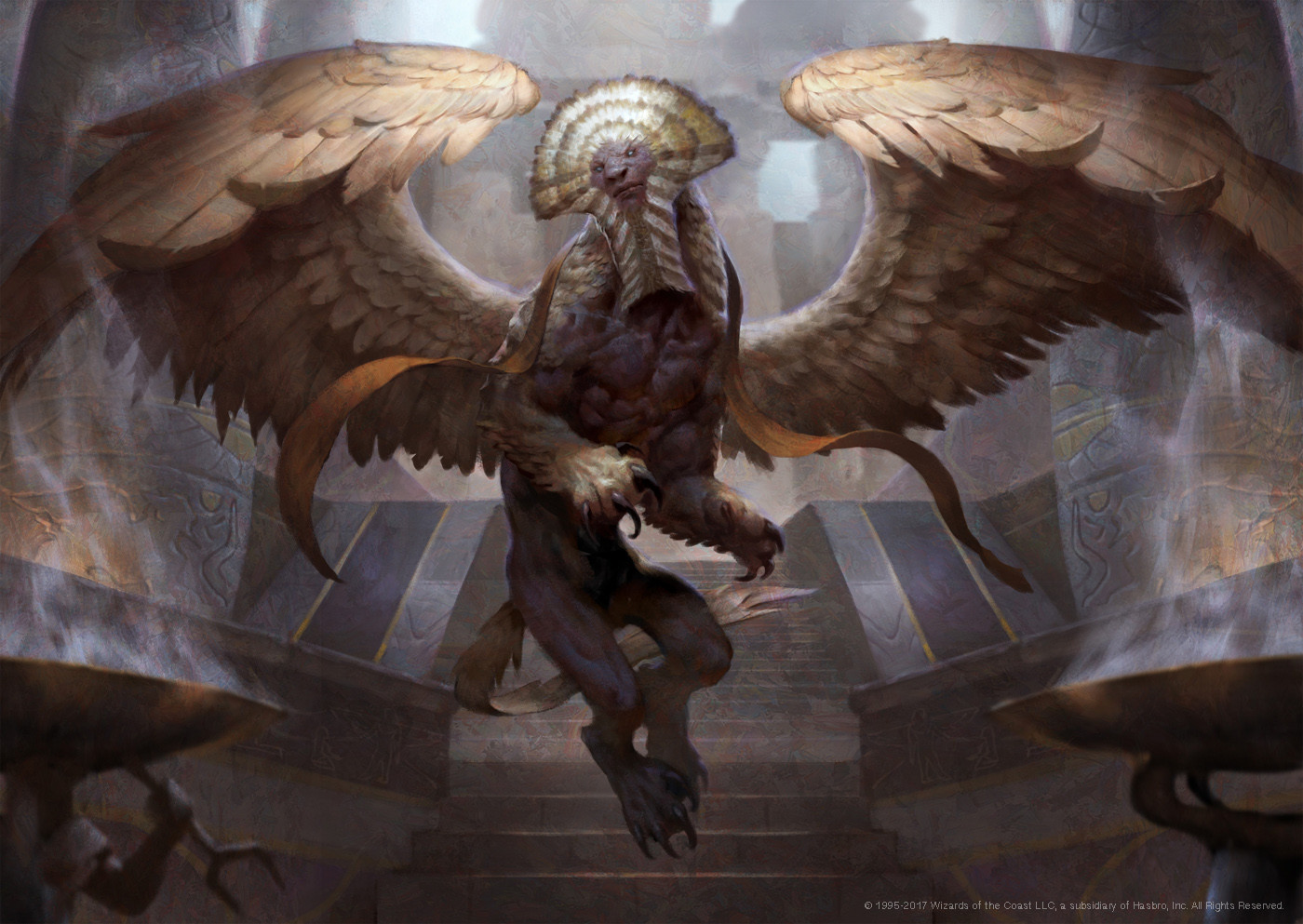
The form of the Sphinx is a bit different then what you're used to imagining. This is because they are creatures of two forms.

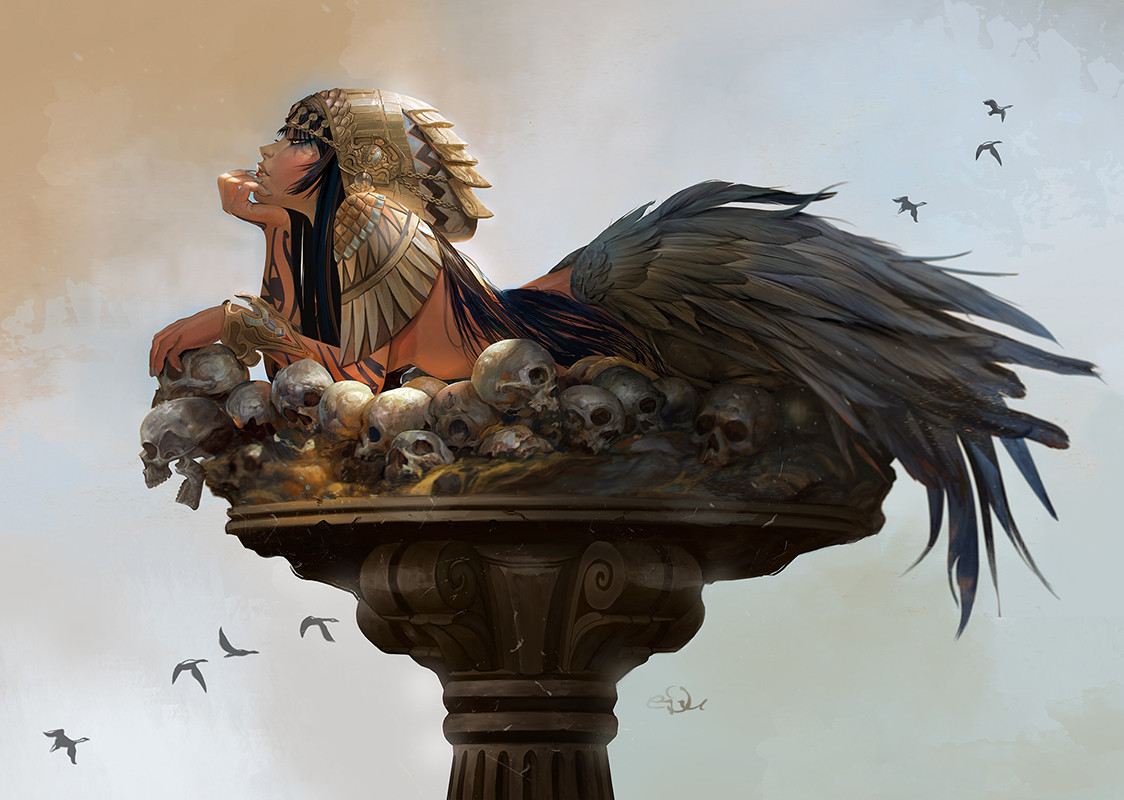
They are born as adults, in the shape of humans, for it is that shape that is most common throughout all universes for those seek answers. They are wing'd, to better traverse the world. Gold adorns them, for gold is the metal of greed, and they are greedy for wisdom in all of its forms. Their skin is of a color olive, or mahogany, or porcelain. Their eyes are hazel or green and star-flecked.

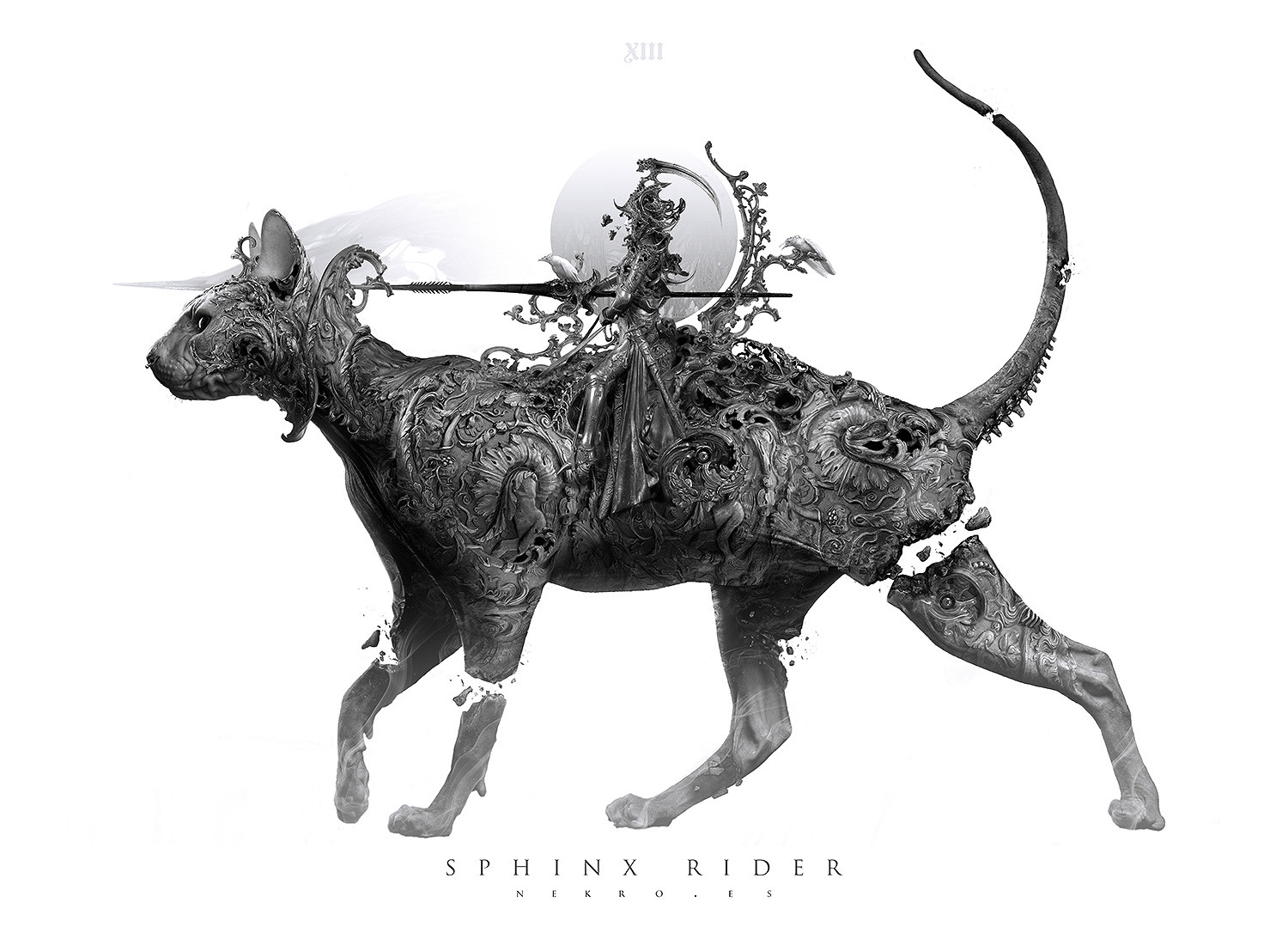
But wisdom is the domain of lions as well, who know much of the universe instinctively. Thus, the sphinx has the ability to take on this majestic, powerful form. The older they are, the larger their shape. They retain their wings, too. A Sphinx who no longer wishes to adventure will usually retain this shape, for reasons many.

Fur sapphire-rich or jet-deep. Manes wild as burning plains or regal as the king's crown. Eyes slitted, glowing in the dark, burning pieces of gold worth more than any coin. Claws and fangs sickle'd and sharp, blades enchanted by long learning years.

The Sphinx is not born, it is made. All are infertile. When a Sphinx is truly wise, it will have answered the riddle of how to create a child and will do so. Some will choose to parent, but most do not; after all, their child is an adult already, ready to fly into the world and have its own questions answered. Know that this means that it is rare that Sphinx congregate. There are no Sphinx towns or Sphinx cities. The only time they gather is in death, when their souls fly into the great beyond, ruminating at the Horizon together before going to explore some distant afterlife.

Know too that a Sphinx cannot die of old age, unless it wills away its immortality. Thus, many live for epochs, recording what they know on stone tablets or in omen and song.
Eduardo Francisco
All Sphinx will ask riddles. They ask these riddles not because they know the answer, but because they are trying to find an answer. However, it is common wisdom that creatures will not lend the Sphinx their minds for any suitable length of time. Most get frustrated and leave. This is why so many Sphinx will threaten death, or a curse, or offer a gift in exchange for having the riddle answered. Coercion is, of course, how wise beings barter--at least, that is what many Sphinx come to believe.

Here be a riddle generator. For every game you play a Sphinx, or run with a Sphinx in it, keep it on hand; most Sphinx greetings include a riddle of some sort. In exchange for wisdom gained, the Sphinx will likely aid whoever it is answering the riddle. This is one of the many ways Sphinx adventurers come to be.

SPHINX - OD&D

Sphinxes are magic-users, and can only progress to 8th level (Warlocks). Sphinxes can use no magical items other than scrolls and potions. Sphinxes may only arm themselves with bows and slings. They have a 1-5 chance of knowing the answers to any riddles, and their wisdom allows them to hire sages at 1/10th of the price (200gp per month). After progressing to 2nd level (Seer), sphinxes can begin to research cleric spells. They cast these spells with their normal magic-user spell slots. All sphinxes can assume a monstrous shape, wherein their body takes the form of a lion, giving them two attacks with their claws. In their normal shape, they have wings, allowing them to move 2" through flight. Sphinxes are also magically-resistant, and thus save against magical effects as if 4 levels higher. Finally, a sphinx can speak any language.

Why does the Sphinx retire at 8th level? The Sphinx, by then, having learned much of this world, feels its soul pushing it to learn through other ways. 8 levels worth of adventure grounds the Sphinx; it then goes on to serve as a sage for some courtly figure, or some great rising power. In this position it will serve for a few centuries before returning to the adventurer's life, likely vastly more powerful, and more so in the form of a traveling deity then a wandering mercenary-for-hire.

I suggest using the COMMANDMENT spells for the Sphinx.

Image result for sphinx character art
Magic: the Gathering

SPHINX - 5E

Ability Score Increase. Your Wisdom score increases by 2, and your Intelligence score by 1.

Age. Sphinx are born fully mature, and have no natural age limit. 

Alignment. Sphinx tend towards neutrality in all ways. Adventuring Sphinx tend to be good, but more than a few turn evil as well.

Size. Sphinx in their humanoid form stand between 5 to 6 feet tall. Your size is medium.

Speed. Your base walking speed is 30 feet. You also have a flying speed of 15 feet.

Languages. You know a number of languages equal to your Intelligence + your Wisdom modifiers (minimum 1).

Born Wise. You have advantage on Intelligence, Wisdom, and Charisma checks that you are proficient in. 

Regalshape. As an action, you can transform into a CR 1 lion. Your Strength, Dexterity, and Constitution ability scores are replaced with that of a lion's. Your Intelligence, Wisdom, and Charisma scores remain the same. You have a human face while in this form, and can speak and cast spells with verbal components. Once you've used this feature, you cannot use it to transform back into your humanoid form until you finish a short or long rest.


SPHINX - HIRELING

A Sphinx can be hired for a cost of 4,000 GP per month. Sphinx hirelings are of 8th level. They will teach magic-users and clerics spells they know, lend their spells as aid to those that hire them, and provide wisdom, guidance, or information. The Sphinx will not leave the castle or palace alongside whoever hires it, and is unlikely to ever leave during their employer's lifetime. Yearly, the Sphinx will ask a riddle of its employer. If the riddle is not answered within 1 month's time, the Sphinx will end its contract and seek another employer.
Nekro

USING THE SPHINX AS A CREATURE

Most Fantasy games have statistics for a Sphinx. I suggest the following feature to be added mechanically.

Riddle Curse/Gift. When the Sphinx meets a creature for the first time, it will ask if it would like to answer a riddle. If the creature fails to answer the riddle before it leaves the presence of the Sphinx, it shall be CURSED. This curse cannot be lifted save through a powerful exorcism, answering the riddle, or death. But, if the riddle is answered before one leaves the presence of the Sphinx, they earn a gift. Roll 1d6 below to see what this gift is.
  1. A piece of lapis lazuli, inscribed with a riddles. Acts as a spell scroll of one 6th level COMMANDMENT spell.
  2. A map that must be translated in order to find the treasure of which it leads to.
  3. Its services, for a year and a day.
  4. A curse to be placed on the head of one creature of the riddler's choice.
  5. The answer to a single question. If the Sphinx does not know the answer, another question may be asked until it does.
  6. To be sent back in time, reverted to the age of your childhood, and allowed to live your life again but with the knowledge of now.
Treat a party as players as one person, thus giving them only one gift as a whole.

Most Sphinx serve as a roleplaying/social encounter, as well as a puzzle. A Sphinx used in combat should be one that seeks violence as a means to wisdom. This is a wide umbrella. Perhaps the Sphinx is looking to hunt all humans down, as it believes that wisdom is found in a world without them. Or, maybe, the Sphinx seeks to rend and tear armor of all sorts, and will believe itself truly wise after it has damaged every piece of armor to ever be forged. These esoteric reasoning's give the Sphinx an esoteric vibe; it is a strange creature, clearly inhuman, and while not all together horrible, it is something mystifying, horrifying, and awe-inspiring to those that encounter it.

Having the Sphinx wield powerful magic, be surrounded by enchanted items, and dwelling in places of power is key to this. For Sphinx lairs, roll 1d6 or make your own:
  1. The funeral-palace of a long-dead hero or god-king.
  2. The throne-room of a demon-queen.
  3. A place where magic is so thick in the atmosphere that it changes the weather.
  4. Underneath the boughs of a sacred tree, one where some messianic figure once rested.
  5. In the center of an ancient battlefield, where great forces were risen and vanquished.
  6. A place where an afterlife borders the realms of the living.
When the Sphinx is met, it will ask a riddle. If the players decline to answer, roll 1d6 to see how the Sphinx responds.
  1. A curse upon all who do not answer.
  2. Unspoken and immediate hyper-violence.
  3. Offering a gift of some sort.
  4. Stating that it will kill someone the PCs love dearly if not answered.
  5. A sudden onslaught of monsters is released from a hidden space.
  6. A spell, powerful and horrid, is cast upon the PCs.
Roll on treasure tables of your choice, as if you were rolling for a dragon horde. This is the treasure that fills a Sphinx's lair, gifted to it by rulers from a thousand worlds, all of whom have sought the Sphinx's wisdom.

Sentient creatures surround a Sphinx. Dragons will come to trade riddle-answers for treasure, monks will come to study in its shadow, magic-users to learn spells and clerics prayers, adventurers seeking new vistas or long-lost ruins, monarchs and rulers and tyrants wishing to become better rulers, oracles in training to learn the secrets of the future, and, most rarely of all, another Sphinx, coming to trade pslams for just a short time. Thus, an entire dungeon or adventure site manifests around the Sphinx.

Image result for humanoid sphinx art
Hekkil


Castles are the Dungeons for the Fey and the Gothic

Many fairy tales revolve around castles and courts. These places are filled with wonder and awe, horror and debauchery. They are both simultaneously filled with dark and light. Capricious nobles, strange and incomprehensible to us born outside their world, are ready to take advantage of us, to be overtaken by us, to destroy us and to be destroyed, to give us blessings and curses, to reward treasure, take treasure, and have treasure taken. There are secret places in here to explore, to hide in. Ways in, ways out. People in there of all kinds, different factions with different interests, all revolving around the mystery and mysticism of the castle.

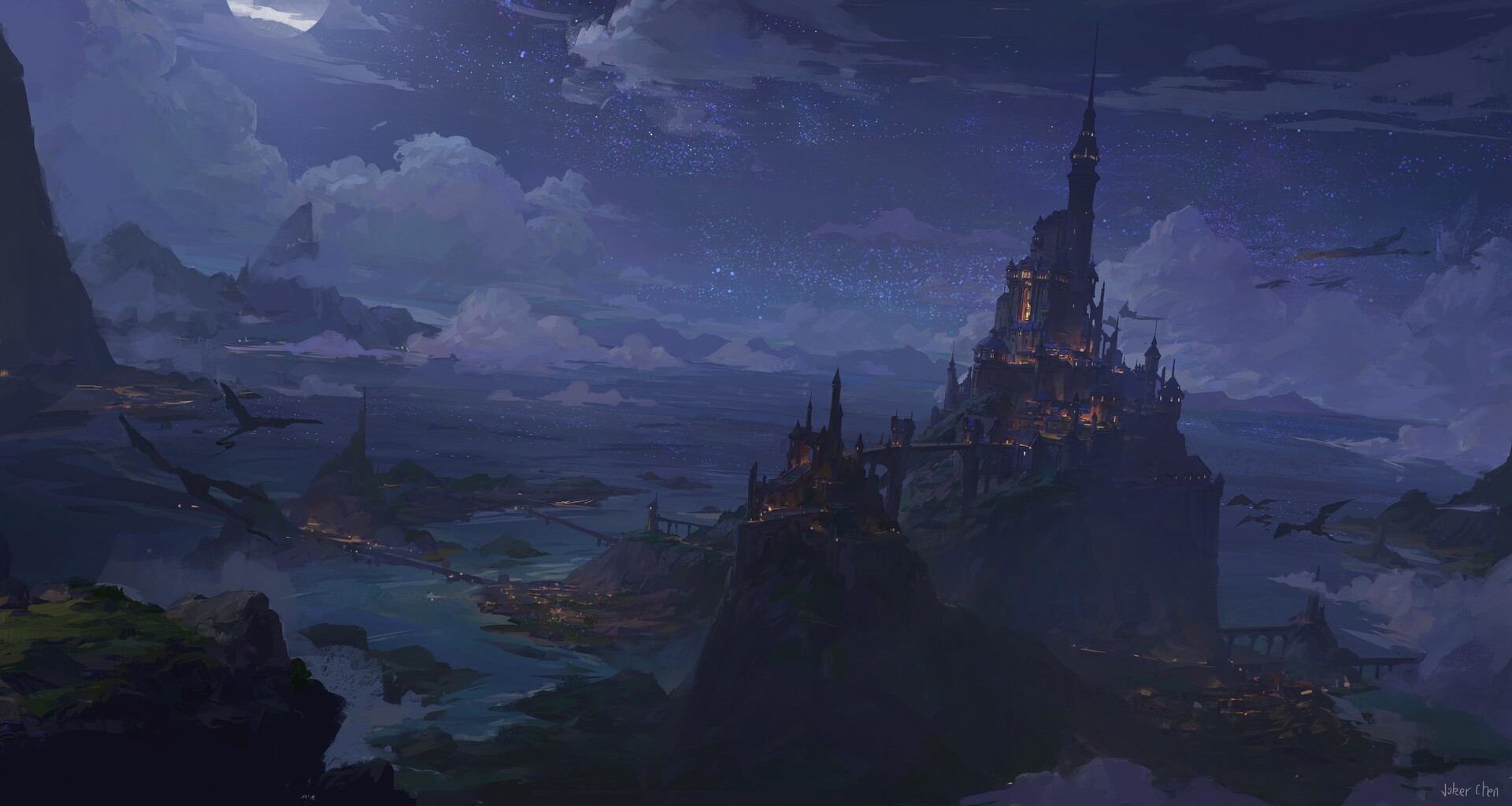
The dark fairy castle
Joker Chen

These are dungeons, but less dirty, grim, and abandoned, more poetic, mystical, strange. In a dungeon, cobwebs fill hallways and the dead shamble around. This can happen in castles as well, but in fey castles or gothics, you have animated suits of armor, strange servants, weird guests.

Let's look at two examples: Bluebeard's Castle (fairy tale) and Dracula's Castle (gothic).

Bluebeard's Castle is a place of horror and mysticism. It is beautiful, and the castle's owner, Bluebeard, is charismatic, attractive, groping. He invites you in, barrs one secret room, and gives you keys to the other. You stumble from fairy tale room into fairy tale room, dancing with strange servants, surviving strange riddles and puzzles. But there is that secret room, that dark room, that strange room with the potential treasure and horrible curse. In all ways, this is a dungeon for fey.

Dracula's Castle is much the same. Surrounded by direwolves and spectres and will-o'-wisps, filled with vampiric brides and hiding peasants trying to escape their damnation. Locked doors that hide darker secrets that must be explored so that you know you can leave. A haunting, stalking, loping master of the castle, a threat coming through the walls or into your room.

Dracula's Castle
Josh Black

And yes, keep in mind, there are rooms to rest in within the castles. Places to regain your faculties. Or, places in which even weirder encounters can happen. Dracula's brides invade and you must fend them off through wit until their husband returns to calm them. Bluebeard returns and you must hide from him, keep it secret that you've been in that Dark Room, survive his hunting of you when he finds out.

Yes, castles are dungeons, but with more active threats. Intelligent dangers that know you are there and want to interact with you.

Strahd's Castle is a dungeon, but an Archfey, an Elven Prince, the Winter Court can all have a similar one.

Whenever I see fey adventures, I always see forests that, glades this. No one ever really makes adventures around the castles. But it is here that the fairy tale is the most powerful, and where the gothic can be wedded to it.

Image result for fantasy audience


It is this wedding that I think has a lot of creative potential for dungeons and modules in the future. A castle that takes both fey and gothic elements to make something. Like the 5E Raven Queen, who is at once a god, an archfey, and a gothic horror, who resides in a Castle of Memories. This is the perfect dungeon place. Invade and plunder the memories of countless tragedies to learn secrets to defeating enemies, or finding rare treasure. Hide from the Raven Queen and her elven servants, and avoid the gloom-beasts that manifest here too. Every room can have a new puzzle or encounter or secret with ease. Other factions can be in here, perhaps adventurers or elves or those seeking audience with the Raven Queen

And let's talk audiences. For a game about adventure, these are often glanced over. But an audience with a powerful gothic-fey (or a normal fey or a gothic creature) can be a great puzzle. You must at once dodge around their ego, have wit-duels with other members of courts, gain allies to help you, present treasures or plan how to escape, potentially have a crazy battle, potentially hoodwink or trick whoever you are having an audience with--there's lots of potential here.

Now with this all positioned, I guess the next step is to actually make a castle-dungeon adventure. I'll have to sew on that though.

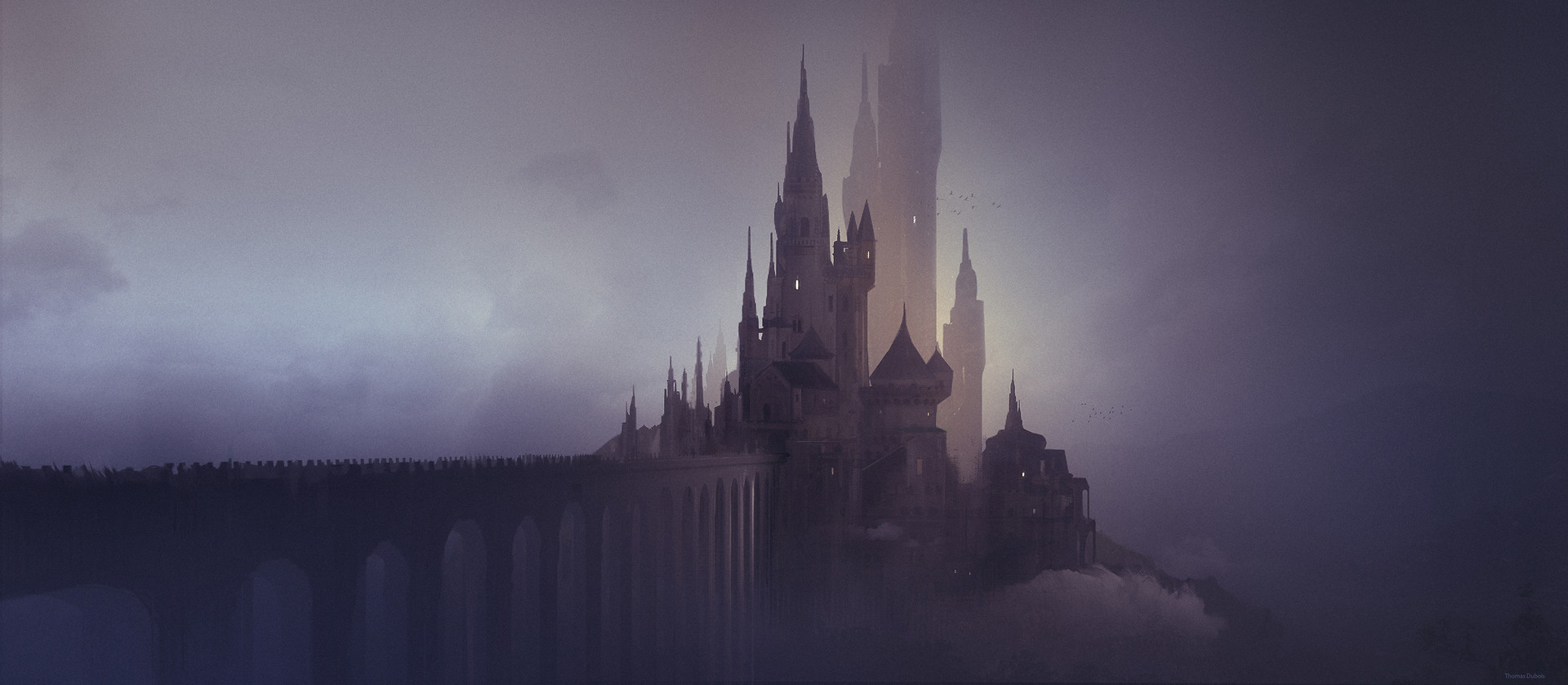
Foggy castle
Thomas Dubois

COMMANDMENT: Making a Point-Crawl & Changing Names

COMMANDMENT is me taking the literal Bronze Age Collapse and fantasizing it using Dark Souls tropes/ideas. I've decided it would best be played as a pointcrawl, meaning: dungeons connected by flux space where cool things happen.

In order to jack up the Fantasy a bit, I've decided to do some renaming of things. Some of these are based off of previous ideas, while others are corruptions of actual names, nicknames, or alternative names found across history.

POINTCRAWL GOALS

Image result for pointcrawl
The point-crawl map for Slumbering Ursine Dunes.
COMMANDMENT has a few goals as a pointcrawl that I want it to hit. These have to be considered goals for creating a Souls-esque style of game as well.

  • Every location should be utterly unique in terms of threats, treasure, lore, aesthetic, and implicit narrative.
  • Every location should have no more than 3 ways of exiting it that are "safe," leaving room for outside-the-box dangerous ways to escape. This promotes linking of the points.
  • Every location should either have a bossfight or climactic point that needs to be dealt with to really get the GOOD stuff from that location.
  • Some locations should require other locations to visit, while a good number of locations should start out varied and open to approach.
  • There needs to be a central hub area the players can go too (ala Demon Soul's hub, the Hunter's Dream in Bloodborne, the Firekeeper places in Dark Souls, and the Dilapidated Temple in Sekiro).
  • Travel between points should be a mixture of abstract and concrete. Flux Space will make these areas unique. Travel between hubs should cost something somehow as well.

BUILDING COMMANDMENT AS A POINTCRAWL


Image result for egyptian fantasy art

Pointcrawls are pretty demanding to design, I think. Hexes can be simple and treated as dungeon rooms on a wilderness map, while a full pointcrawl has very stylized, thematic, concentrated dungeons as its points. That being said, I think starting theme first will help us here.

This requires me to begin elaborating more on the world of COMMANDMENT. This is what I have thus far.
  • There is a tablet of 10 Commandments. It is utterly unknown in creation, cannot be destroyed, but can be separated.
  • These 10 Commandments change the laws of the world to fit the commandments, creating curses for those that break them and miracles for those that follow them.
  • Usermaatre Setepenre II, previous ruler of the Evening City, discovered this sacred tablet and used his deific magicks to rewrite it.
  • After rewriting the 10 Commandments, they were split into groups of two, each given to some other force to broker piece in the face of prophecized doom.
  • Each city is based off of its two commandments, save for the Sunrise City, whose Commandments are lost.
  • The Sea Peoples have the lost commandments and have rewritten them, providing the power needed for their invasion to have the success it does now.
  • Players will need to collect the Commandments, reassemble the Sacred Slab, and choose what/how to rewrite them in order to change the world's destiny. Or they can destroy them, somehow, or use them to make themselves god-kings, or whatever.
  • City names change a lot. Right now, the cities with the commandments have a naming pattern of the Seat of the Commandments of X & Y instead of proper names. Nicknames are given based on old prophecy, relating the city to a time of day, as well as a single word offered by Usermaatre Setepenre II to call the people of that city.
So we have here, from this outline, a minimum of 5 Cities to serve as hubs, plus the Denyen Isles--home of the Sea People. That's 6 points so far.

We're going to need some points for things beyond that. Libya & Syria are destroyed, so the Horn of Africa will be another point. The Great Green--this worlds name for the Mediterranean--needs 1-3 points in it as well, or maybe a generator to create points here. So right now that puts us at a minimum of 8 points and a maximum of 11. The Steppes we won't deal with in COMMANDMENT, nor will we deal with whatever life lies too far north of the Great Green to really impact this.

I want a few more points too, just as open-air what-ifs for right now. I think the Great Green itself could just be a mega-point, but we'll have one more point of interest in it as well, so settling on 2 from there.
Image result for anor londo art
Some of these cities I imagine like Anor Londo--cathedral meets ghost town.


So, to recap, a glossary of locations for COMMANDMENT:

  • The Godsblood - Grave of Heroes. This is the massive river is the renamed, deific Nile River. This is the player's opening hub--the mouth of the Godsblood, a sacred place where hero corpses end up after being put to river or sea. Allows for travel to 4/5 of the Seats or the Great Green.
  • Evening's Marches - The Seats of the Commandments of Authority & Conspiracy - City of the Masyreen. Renamed Pi-Ramses, it is here that the God-Prince Usermaatre Setepenre III fights his endless war against the Sea Peoples.
  • Sunset's Cradle - The Seats of the Commandments of Art & Lies - City of the Achaens. Renamed Pylos. Ruled by twin Oracles--one who channels the Sun, the other the Horizon. Divinations are inscribed onto pottery, weapons, fabrics, and skin here, and are used as currency.
  • Noon's Empire - The Seats of the Commandments of Ancestry & Trade - City of the Azuhinum. Renamed Asur. Ruled by the Queen of Heaven, a witch-queen from future eons. It is a solid tyranny with an army unmatched that has utterly conquered Sunrise
  • Morning's Chains - The Seats of the Commandments of Slavery & Truth - City of the Yisra'el. Renamed Israel. Ruled by Shelohmoh, a man who mastered the art of chaining divinity, and thus has created a city of angels, smokeless fire, and demons. Miracles were once worked in the streets; knowledge is gathered here en masse.
  • Sunrise's Funeral - The Seats of the Lost Commandments - City of the Bab-ll. Renamed Babylon. The Commandments here have been stolen, and Noon's Empire has replaced their leader with a vicious deific dragon, the Marduk. The people, oppressed, have access to Iron.
  • Denyen Isles - The Seats of the Commandments of Conquest & Iron. The dark home of the Sea Peoples. Utterly Barbarous in all ways. To set sail for here is to likely die in the Great Green, as its location is obscured by magick & heretical belief.
  • The Great Green - War's Endless Sea. A massive body of water that connects all of these different, spread out lands. From the far west came the Sea Peoples.
  • Santorini - Haunt of Gods. Gods of Conquest flock here for reasons unknown. An isle of monsters, ghouls, and other barbarous things and who knows just how many secrets.
  • The Pyramids - Ancient pyramids built by god-kings long past. Inside of each are secrets old, and riches true. Consider this like a DLC/expanse area to explore.
  • Ri-A - Where All Skies Meet. My thought up "Final location," which is literally the interior of the sun where all horizons lead. Maybe it's here that the Commandments are rewrit.

So now we have 11 nodes. Now for each node, we need the following:
  • Simple overview of location.
  • Encounter tables.
  • Treasure, armor, and weapon  with fluff descriptions.
  • NPCs.
  • Commandments.
  • Level layouts.
  • Factions.
Level layouts is the hardest thing on this list. I'm considering pushing flux-space up harder. Every point is a hub of more points (probably between 6-10) connected by Flux Space. Each sub-point is treated like either a miniature dungeon (no more than a few floors) or a strange, complex dungeon room. They will be laid out in a way that you need to do certain things to progress to certain rooms, with hidden connections found between important places.

There's something else that needs to be addressed too: making everything have gone to shit.

Dark Souls Ruin

In every soulsborne game, the would has gone to shit. The decisions of the player(s) determines if the world heals, stays as shit, or something new happens, each with nuance that makes everything a somewhat grey choice.

Image result for irrythil art art
Monsters, boss fights, and NPCs can be used to show ruin as well. See: High Lord Wolnir from DS3

That being said, we need ruin to come to this world. Luckily, we easily have it in the form of Sea Peoples and Iron.

The glossary of points higher up in this post describes things as they were before the Sea Peoples invasions began in earnest, and before iron-working became more mainstream. Now, with Iron making people Barbarous and the Sea Peoples constant attacks, much of the world is fucked. Some ideas right now are:
  • Evening's Marches is mostly barren of life, with literally everyone being turned into a soldier and sent into war. Filled with Barbarous run aways, weird mystics, rebels, and the twisted palace of the God-King.
  • Sunset's Cradle has been plagued with apocalyptic divination. Many people have fled, and those that remain are either trying to complete prophecies, prevent prophecies, or are becoming ever more brutal in their rituals to create prophecies.
  • Noon's Empire has no friendly souls there. Everyone is oppressed and hateful or oppressed and broken. A rot is spreading across the empire, the cracks this weakness creates are seeing Gods of Conquest and other threats slowly overtaking her.
  • Morning's Chains no longer is a place of masters-and-slaves. The deific slaves have finally revolted with the power of Iron behind them. A place caught in a very supernatural, curse-fueld, Hell-on-Earth stylized civil war.
  • Sunrise's Funeral is seeing massive amounts of Barbarous rebels and Gods of Conquest pop up. It is the most dangerous place to venture of the 5 Seats because of this.
That covers the "normal" places. The others are pretty self-explanatory, given COMMANDMENT'S backdrop.

So in the end, we have points to create, a format for creating them, and compelling reasons to go there. Now all that's left is creating each one (which will take a long time, I'm sure), and to establish some more concepts, namely:
  • What exactly are the 10 Commandments.
  • Potential character classes.
  • Making a character/running this stuff as an actual game.
  • Lots and lots and lots of item descriptions written and rewritten for consistency.


Palace of the High-King


A great ziggurat of blue-painted stone looms above the island of petty temples, omen reading huts, and medicine drinker shacks that girdle it.

Image result for ziggurat fantasy art
This'll do until I get the commission in.

Armies of god tenders bustle about, performing tasks to keep the divine happy. They are slaves and they are servants and they are the happiest of the Bless’d for they have both purpose and safety bestowed upon them by their masters.

Hundreds of shrines and offerings are left upon the sides of the ziggurat. Four sets of stairs wind their way up. The more desperate the prayer, the more steps you take. Never do you enter the zenith temple. It is made of clay and reed and appears a shack itself, but inside is where gods dwell and you are no god nor their tender.

This is the Palace of the High-King, this shack that sits a top majesty. When one enters, they are taken into a seperate world inside the Heaven Bless’d. Here, in the presence of gods, miracles are forged and the Heaven Bless’d is made safe.

Why Visit the Palace of the High-King?
Roll, choose, or create a reason.
  1. A god tender approaches you, telling you that one of the gods has summoned you for audience.
  2. You wish to view a god, but have no permission to enter the Palace. Thus, you sneak in, and search the god out for their blessing.
  3. Your place of work surrounds the Palace, and a god tender calls on you for aid.
  4. You’ve heard great treasures lie unattended inside the Palace and you wish to steal them.
  5. There is a Hanging Garden locked away in there, and you wish to hunt in it.
  6. Many god tenders have died as of late, and you wish to replace one of them.

ROOM SUMMARY OF THE PALACE OF THE HIGH-KING
This is a basic summary of what will be found as you explore the Palace. Detailed sections below. Numbers correspond to rooms. Connecting the rooms are hallways, where the floors are stone, and the curved ceilings and walls made of reed.

  1. Blood-Stained God Foyer. The opening foyer of the palace. Leads to rooms 2, 3, and 4.
  2. Heliograph Epics of All Heavens. A room covered in heliograph murals. Leads to room 5.
  3. Pyre-Beds. The pyre-beds of the god tenders. Leads to room 6.
  4. Throne Baths of Heaven’s King. The audience chamber of the former High King and current Steward-King. Leads to rooms 8, 9, 10, and 11.
  5. Symbol Graves, Untended & Unworn. Where divine symbols are gathered and stored from the dead and forgotten gods.
  6. Bloodletting Sanctity Chamber. Where the god tenders perform auto-sacrifice.
  7. Sealed Gate of the Hanging Garden of the High King. Leads to the appropriately titled Hanging Garden.
  8. Torture Room of the Four Oracles. Where the god’s four personal Handless Priests live and rant prophecies.
  9. Union of the Palace Heavens. The nexus that leads to the personal domains of each of the gods. Leads to rooms 13, 14, 15, and 16.
  10. Heart of the Radiant Heretic. Where the Radiant Saint who tricked the High King is sealed away.
  11. Prison Where Hells are Made. The torture-prison where the worst criminals are interred.
  12. Where Sunbeams Meet and Guide. Directly above room 4 is a glassed opening. Touching it transports one to any location within the Heaven Bless’d that the sun can touch.
  13. Half-Grave of the Half-Sun. The Palace Heaven of Half-Sun Sintotec.
  14. The Sobbing Grotto. The Palace Heaven of Veiled Weeper Allalotl.
  15. Empty Space Beyond. The Palace Heaven of Gatekeeper Metamm.
  16. Where Crucifixions are Worshipped. The Palace Heaven of Blood Dream Xoash.


HEAVEN’S GUARDS
When exploring the palace without a god tender guide, there is a 3-in-6 chance that every hallway and room will have 2d6 palace guards. These guards are 1st level fighters and wear the gilded skins of animals they’ve hunted and had blessed by Half-Sun Sintotec. When reduced to 0 hp, they transform into beasts of your choosing, such as wolves, lions, tigers, jaguars, etc. When reduced to 0 hp in this form, they cry out, summoning another 2d6 palace guards in 1d4 rounds to the area.

Additionally, every room has a 5-in-6 chance of having a god tender inside. If the god tender sees the party has no guide, they will interrogate them. If the party does not convince the guide otherwise, they will run and find 2d6 palace guards and return with them in 1d8 rounds.

Palace guards will imprison player's reduced to 0 hit points and stabilize them so that they do not die. Player's will be imprisoned in the Prison Where Hells are Made for 1d12 days before being taken for trial before Half-Sun Sintotec in the Throne Baths of the High-King.

ENCOUNTERS IN THE PALACE OF THE HIGH-KING
Roll 1d6 for every room entered. On a 5 or lower, there are god tenders in the room if it is daylight hours, or a 1-in-6 chance during night time, with exceptions. If there is an encounter, roll a d6 on the chart below. Replace used options with your own.

  1. 1d4 god tenders are secretly discussing how to best introduce dragon worship to the Heaven Bless’d. Act suspiciously when discovered.
  2. 1d10 god tenders are kneeling and praying. They are oblivious to what goes on around them, increasing sneaking odds by +1.
  3. 1d6 god tenders are doped on opium and hashish. They will see the party as gods and begin to follow them around, cutting themselves and filling the parties footsteps with the shed blood.
  4. A senior god tender is tutoring 2d12 neophyte god tenders on the history and purpose of the current room. The senior god tender, if cowed, will lead to the neophytes being made docile as well.
  5. Two god tenders are petting each other in this room. Embarrassed, they will run off when discovered. It will be an additional 3d8 rounds before they find the courage to call the guards.
  6. 4d10 god tenders are holding a meeting in this room, discussing various matters of state and faith. There are already 4d6 guards gathered here to protect them.

ROOMS IN THE PALACE OF THE HIGH-KING
Objects considered treasure if removed from the Palace and taken to safety have their value beside them in parenthesis. The value represents an individual item; if there are multiple, each is worth the listed amount. Treasure here is only considered treasure if stolen and taken to a place for personal use or benefit outside the Palace. Brackets contain numbers of rooms that hallways lead too.


  1. BLOOD STAINED GOD-FOYER
Enter through the shack’s only doorway. The chamber is twice the size it should be. Brown-red stains cover the stone floor and fill the foyer with the metallic smell of spilled blood. Statues at the corner of each room shaped like strange creatures (400sp). They whisper your secrets as you approach them. Three hallways yawn before you--one on the north wall, one on the east, and one on the west [2, 3, 4]. From the ceiling hang 400 tecpatl daggers (20sp).

  1. Heliograph Epics of All Heavens.
Western hallway spits you out into a chamber the size of a small island. Thousands of 60-foot tall, 120-foot wide stone tablets (1,000sp) lined up in rows. Each has been burned with heliographs telling the complete history of the Hunter’s High Heaven and the Heaven Bless’d & Burned. Touching one allows you to see that moment in history play out in real time. 1-in-100 chance you find the moment in history you are looking for, increasing to a 1-in-2 chance if guided by god tender. Where are the missing moments in history? Stairs in center of chamber descend underground [5].

  1. Pyre-Beds.
Eastern hallway leads you to god tender living quarters. At any time there are 60+1d20 god tenders sleeping on litteral pyres. The flames are golden and do not burn, but instead lull one into a sleep where they can lucidly dream at will. Some god-tenders are talking, others kissing, others making featherwork. No privacy anywhere to be had. Somewhere, someone is throat singing. A stone hallway leads eastwards [6].

  1. Throne Baths of the High-King.
Northern hallway takes one to the audience chambers. Massive, with marble galleries on the sides for Midnight Plumed and god tenders to watch. Thirteen pools, each 30 feet in diameter, cover the ground. At the back is one bigger than the rest, with a throne built into part of it. Here, the kings listen, decree, and bathe. Bathing in any pool heals all missing hit points and makes one weep blood into the water. If bathing without permission, be cursed, and reduced to 1 hit point until service has been performed in gods’ name. Four hallways stand in the back of this chamber [8, 9, 10, 11]. 1-in-6 chance of audience currently being held.

  1. Symbol Graves, Untended & Unworn
Down the stairs one will find a stone antechamber, barely lit, cold, smelling of blood, urine, and sex. God tenders are only allowed to enter here when their eyes have been stitched shut, and can only crawl on hands and knees. Decorating the walls are countless Heavenly Gears. See Appendix A for a listing of them, and tables to create your own. Touching a Heavenly Gear requires a save vs magic or be possessed by the god’s dying moments. Fly into a rampage, killing everything as death pains wrack your body and the apocalypse claims your mind.

  1. Bloodletting Sanctity Chamber
Yawning eastern hallway leads to individual chambers encased in stone half-domes. Smells of wet meat and flayed skin. Weeping comes from different chambers. Inside, god tenders lean over bowls and penetrate themselves with needles and slice their genitals to create god-wine. Drink the fresh blood and reset your miracle die as if it had never been used. All god tenders here are  too high to recognize others.

  1. Sealed Gate of the Hanging Garden of the High King
The gate is broken to pieces and scattered throughout the rooms. Each room has a 6-in-6 chance of holding a gate piece, requiring a thorough search to find, going down by 1 for each piece found. Arrange all six pieces in the Throne Baths of the High-King [4] to create the gate. Instructions and spells needed to activate it found in the Heliograph Epics of All Heavens [2].

  1. Torture Room of the Four Oracles.
The most western hallway leads to a stone chamber sectioned into quarters with reed walls. Within each room lies a Handless Priest, mutilated, filling their quarter with the stentch of death. God tenders come in, torture, and ruin these oracle liches to extract futures like venom from a snakebite. Inflict 20 points of damage onto a Handless Priest and roll on the Prophecy table. Receiving a prophecy more than once indicates an increase in truth and urgency with each hearing.

  1. Gurgle the blood of a god and spit it on the eggs of a woman and know then at that moment a thousand breaths will pass between the setting of the Half-Sun and the rising of the moon and the murder of your enemy.
  2. Feathers sprouting from your ears will let you know that the Mystics are near and when they are near they will sneer and say to themselves let us take that one’s heart and bring it here, to our home which all things fear.
  3. Obsidian glass will cut your feet. Look into the blood then. Stir it with your finger. A flower will blossom. A dragon will roar. On the horizon will sit what you search for, or something worse still.
  4. Listen. Look with eyes unclouded by faith. Forgive her, and she will let you live, and will see you home.

  1. Union of the Palace Heavens
Hallway opens up on a great cathedral. Featherworks decorate walls and shrines (100sp). Underneath a sky window and situated in a beam of bright light are four clay tablets that stand as tall as men. Each is emblazoned with another god. Smell incense and entrails as you touch them and are warped to one of the four Palace Heavens [13, 14, 15, 16].


  1. Heart of the Radiant Heretic
This dark chamber is filled with the stank of animal breath and the sweet smell of pollinated flowers. He hangs from the far back wall. From the reeds sprout four flowers and from each flower blossoms a tiger’s head and each head holds a different limb. The Radiant Saint hangs from them, he who led to the High-King’s death and the High-Queen’s theft, impaled upon three glass spears through his chest (1000sp). Speaks not, the Radiant Saint, beyond a prayer to Tiamat. Gods will torture him for pleasure and god tenders do as ordered. If presented with a Radiant Mystic, he will awaken and tell them what must be done to free him--a kiss from a Dragon Wife and the forgiveness of a Medicine Drinker.

  1. Prison Where Hells are Made
A vertical prison lined with stairs. Feather-decorated obsidian bars slice the hands of those who touch them without the Steward-King’s summons. Inside each cell is a criminal who has gone too far to be tried by the masses. Or, they know secrets they should not, and draconic heresy has envenomed their hearts and minds. Each cell is small, fits one body, must stand and not sit. Piss and shit mix with flowers up and down the prison. Fed honey, water, blood, and executed flesh.

  1. Where Sunbeams Meet and Guide
Above the Throne Baths of the High-King [4] sits a sun-window. Stand underneath it, pray to the gods, and be born to any location in the Heaven Bless’d that the sun touches. Happens fast, but at a cost. Skin burned badly, eyes blinded for an hour, and body radiates an authoritative lume. No encounter rolls are made here.

  1. Half-Grave of the Half-Sun
A vast lake of liquid gold stretches out before you. No borders, horizon burns with sun flares. Islands of giant, gilded skulls float and are covered in weapons sheathed hilt-deep(500sp). The sky is the color of a bruise. It is hot, sweltering, and the air smells of a forge. Half-Sun Sintotec walks across the surface, inspecting weapons. God tenders follow after him, their legs gilded and their bodies horribly burned. When they die they become gilded skull-islands and Sintotec sticks weapons into them as reminders. 1-in-6 chance standing on liquid sun every round to die as your body is vaporized from the heat. If without a guide, Half-Sun Sinotec will engage in combat on sight.

  1. The Sobbing Grotto
Mangroves flooded by water a foot deep. Butterflies dance from branch to branch and perfume the air with jasmine and rose. The deeper one goes into the mangroves, the thicker the water becomes until it transforms totally into blood. Weeping can be heard from virtually every part of this Palace Heaven. Its source is Veiled Weeper Allalotl, sitting in a tree, weeping, her god tenders catching the blood dripping from her feet and staring into it for prophecy and blessing (5000sp). If without a guide, her Heavenly Gear swarms you.

  1. Empty Space Beyond
From here, one can see all of creation. The Shattered Crowns, the Ashpits, the Pyre Cities, the Radiant Auroras--all of it. You are falling. The air is cold. You are thousands of miles above the surface of heaven, but you will not lose consciousness as you fall. Rare is it that Gatekeeper Metamm can be found here, and when you finally hit the ground, you wake up inside of the Union of the Palace Heavens, hardly a minute having passed since you left [9].

  1. Where Crucifixions are Worshipped

Behold Blood Dream Xoash. He is crucified before you in a chamber black. The only lights come from the torches that hang from the crucified corpses of executed prisoners that surround the god. He sleeps and will not be awoken through any less than the death of the host the symbols are divinely welded too. Crucified prisoners who still draw breath sleep as well, their dreams feeding the great Blood Dream. Feathers pin their hands into stone, wood, and glass. They stretch deep into the abyss. God tenders kneel before their god and will guide anyone who appears, guided or not, into the Hanging Garden of the Blood Dream with drugs and auto-sacrifice.