Showing posts with label We Mortal Legends. Show all posts

The Plane of Lightning & Thoughts - Fulmens - Spells of the Storm-Wracked Noosphere

In conjunction with a good friend of mine I'm helping start the Planescape challenge. For those too lazy to click the link just now, its essentially a re-imagining of various planes, but instead of directly waxing poetic about them, they are informed via the various kinds of magic that stem from them. My choice of plane was the Plane of Lightning.

Note: I'm considering one day maybe publishing these spellbooks, or making some kind of game around them. Is that something readers of this blog would be interested in?

MIGTHY THOR
Eric Tualle
First, some context.

The Noosphere is the term given to that untouchable, unknowable plane of existence where all ideas, thoughts, dreams, and impulses are drawn from. As a place, it is alive. It crackles with synaptic static, leaves the skin tingling with the electric flash of ideas both good and bad. This is why the Plane of Lightning is so oft called the Noosphere, as they are, in truth, both one and the same. After all, how does the brain communicate if not through electricity?

Thus, the Plane of Lightning, the Noosphere - think of it as the ever-dreaming mind of the universe itself. 

Neurons
Glen Johnson
A closer idea to how the Plane of Lightning might look
Drawing on the Plane of Lightning for your magic is a dangerous affair. In order to be properly initiated into these esoteries, one must perform a certain ritual.

Take a small nail of silver, pure silver, silver newly fashioned into this shape and cleansed in water purified utterly. Take this nail and insert it into the roof of your mouth, slowly. It will hurt. You will bleed. Reduce your hit points by 2 permanently. Find a storm and there, meditate. Think. Do nothing but think. Think as it rages and ensure no rain is falling, lest you call the attention of a different, more diluted plane. Ensure that Jupiter, or your settings equivalent, is bright in the sky just beyond the clouds. Think on things you do not know. Wonder. Muse.

Eventually, the lightning shall strike. Drawn by your thoughts and the silver in your mouth is this bolt slung from a dimension beyond our own and when it falls it stakes its way into you forever and always. Your mind will be overwhelmed. Your thoughts will be wiped from your brain, alongside your fears, your hopes, your ideals; this state is fleeting, of course, no longer than a second's sliver, but in that second your brain will become the host of the Plane of Lightning.

As it is a plane, it can exist in many places at once. While it is there, you will feel it. You will know it. Roll on the Fulmen's Omen table below to see how exactly your ascendancy into a Fulmen (as those so enlightened call themselves).

Fulmen's Omen
  1. The air around you smells of charged ozone, and animals scurry as your anger rises.
  2. When you speak, others hear peals of thunder far off in the distance, as if a storm neared.
  3. When others look at you, their thoughts are mixed with the thoughts of peoples and creatures somewhere far away.
  4. People close to you feel an electric shock whenever they touch someone else.
  5. When you are injured, the sound of buzzing, crackling, or hissing fills the ears of those around you, growing louder the more you are hurt.
  6. Metal objects within 30" feet of you let off a soft, pale blue-white glow - St. Elmo's Fire.
  7. When your eyes fall on someone, the hairs along their arms and neck stand up on end.
  8. When you see someone you intend to hurt, the hair on their head begins to raise.
  9. Intrusive thoughts bloom in the minds of everyone who touches you.
  10. Those talking with you feel as if they are experiencing a constant stream of new ideas.
  11. When you feel threatened, whoever is threatening you feels as if their teeth were vibrating.
  12. Those who you hurt feel as if they can speak a new language, know a new skill, or do a task they never had the knowledge to do so before. This is fleeting; it disappears after a moment's notice.
When you become a Fulmen, you learn a single Fulmen's Secret. You learn an additional Fulmen's Secret every 15 Fame, if you repeat the meditation process of the ritual 1 month after the first, or (if your system of choice has it) you gain 2 levels. You can learn a Fulmen's Secret of a higher level if you know 1 secret of the level immediately lower.

If you repeat the meditation ritual, your hit points are reduced by 1 each time. Getting struck by lightning repeatedly, even if magic, does little for one's health.

There are other ways to learn Fulmen Secrets. Traveling to the Plane of Lightning (& Thoughts), though dangerous to the extreme, is something that Master Fulmens oft do in the later years of their lives. Likewise, by stealing the silver nail from a Fulmen's mouth and performing the entire ritual over with that nail, you can learn all the secrets they knew. Doing so, however, means that you lose whatever secrets you both did not know.
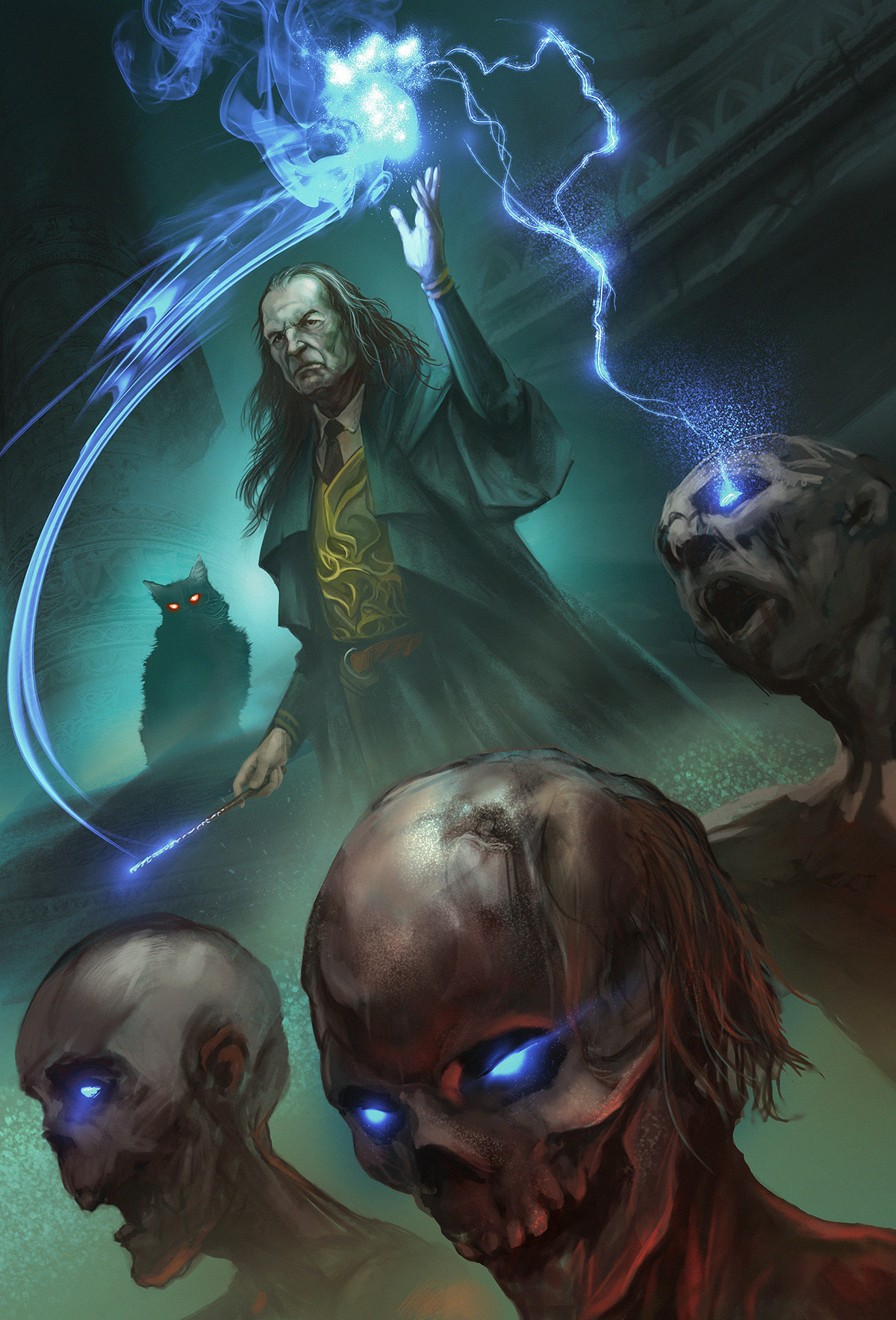
"Argus Filch, the shadow Necromancer"
Nicolas Camiade
A Fulmen who has dabbled in other magics too.

THE FULMEN'S SECRETS

Names & Levels (using standard B/X spell levels to determine what kinds of slots to use)
Roll 1d3 when learning a Fulmen's Secret to see which you grasp from the Plane of Lightning

First Level
  1. How to Become Wise as All the World's Sages
  2. St. Elmo's Fire Turned Upon Those Who Dare to Know What They Do Not
  3. The Painful Art of Forking Thoughts Into the Unenlightened
Second Level
  1. Attract Those Crackling Thoughts that Evade You Still
  2. Dim the Stars that Fork Into Endless Logics
  3. Enrage Those Mindless Mortal Heavens
Third Level
  1. Cast the Storm Across Mountains & Memories
  2. The Secret to Erasing All Knowledge of the Sageless Heretics
  3. Turn Thy Muscles Into Countless Thoughts

DESCRIPTIONS - FIRST LEVEL

How to Become Wise as All the World's Sages
Close your eyes and see naught but the roiling storm behind them. See flashes of lightning - of brilliance - and call one to you. Your hair stands up on end. Your eyes, still closed, glow so brightly they shine from behind your eyelids. All who see you see a bolt of lightning fork its way down from the heavens and into your body. Your veins burn blue through your skin; open your eyes then, and you will have a sage-like understanding of one academic, magical, or practical topic of your choice. You cannot speak to share this knowledge. If you do, the lightning escapes from your mouth and you lose your blessings. Lasts for as long as your mouth is kept shut. Some Fulmens even stitch their mouths to ensure they never lose their wisdoms.

St. Elmo's Fire Turned Upon Those Who Dare to Know What They Do Not
Lift your left palm skywards, for the left is that which masters the occult. See before you creatures that have blood, or else have iron or copper or some other metal inside of them, no matter how trace the amounts. Whisper. Whisper and close your eyes and see the storm and see them inside the storm. You do not know what you are whispering; only that there is sound coming from your mouth, and to others it sounds as if faint, distant, echoing peals of thunder are slipping past your lips. Open your eyes and see that everyone you just envisioned is glowing a faint, pale, cobalt blue. They do not know this, nor does any other non-Fulmen. Whenever you sleep, you shall enter into their mind; you will know all that they know for as long as you do, and if you wish, you can grant them knowledge that you yourself have. If you grant them knowledge, there is a 70% chance that portions of their brain are overloaded by the introduced static, making them forget 1d6 important details or memories that they know. If both Fulmen and victim are sleeping, their dreams are yours to control.

The Painful Art of Forking Thoughts Into the Unenlightened
Hold out your hand, aimed as it is towards the source of your ire. Let your emotions cascade into brilliant strikes of lightning inside of your head. Hear the echoing, pealing, roaring, angry thunders. Draw on the noosphere; hunt for information on how to kill, how to butcher, how to murder. In a flash of brilliance it comes to you; a lightning bolt drops into your hands, screaming, screeching, and in that moment you must fork it into that creature that you hate. When it strikes, the creature knows all the knowledge you just hunted for. It fixates on one method of murder. Then, that method happens. Perhaps their throat opens up just the perfect way to make a Glasglow smile. Maybe their bones suddenly break as they learn the appropriate number of hammer strikes that it takes. There is a  70% chance that they survive. And if they do, the knowledge remains with them, forever; a way to make assassins, if one has ample bodies for the coinflip.

ACHILLES
Marta Nael.
What I imagine to be a Fulmen, enhanced with some crystal, preparing to create their assassins.

DESCRIPTIONS - SECOND LEVEL

Attract Those Cackling Thoughts that Evade You Still
Lift your left hand skywards, occult wand that it is. You know so little about the reality around you. But someone must. Think on what you do not know and create the cackling display. Every living creature within 1 mile and with an open roof above their heads will emit from their crowns a bolt of lightning that slings and slithers through the air to be gathered into an orb held in the palm of your hand. It burns away the skin there, singes the flesh; these are wounds that will heal supernaturally within 1d4 days time, but until they do you can hold nothing else with this limb. Now, with the lightning gathered, watch as it turns into a bolt of lightning that strikes you thusly. You will learn, from the minds of those you have sought:
  • Their location.
  • How to perform the skills they know best.
  • Who they love the most.
  • Who they hate the most.
Your personality is destroyed. You can learn nothing else, lest your brain be turned to ash. Memories will not take while this knowledge is held inside of you, but you can repeat the information freely, perhaps to a scribe to record it, or another Fulmen to learn it. Lasts for 8 seconds for every lightning bolt you have consumed through the casting of this spell. 

Dim the Stars that Fork Into Endless Logics
Choose an individual that you can clearly see. Point to them with your left hand, palm facing the ground. Lower it. Slowly. Steadily. Your arm aches. The individual will turn their attention towards you entirely but will not move. The star that is their mind dims. Intelligence spills out of them; the ozone smells, their hair rises on end, metal objects begin to glow with St. Elmo's fire that they hold. Once your hand is flat by your hip, the spell is done. 30% chance of success and if so, they are a catatonic mess, totally incapable, drooling, tongue lolling out of their mouth, unresponsive to any and all stimuli. But the moment you move your hand more than 5 degrees in any direction, their star flares and intelligence returns to them. Useful for the binding of immortals; many a Fulmen has an apprentice bind their arm to their sides so that djinn or angels or demons work not their terrible works upon the world.

Enrage Those Mindless Mortal Heavens
All lightning that is not inside the Plane of Lightning is mortal lightning. It is mindless, stupid. Easily enraged. Close your eyes. Feel the storm beating against the inside of your skull. For just the briefest of moments, let it out. A wave of skin-tingling and invisible electricity will race from your body, felt for ten miles out. In the heavens above does the storm come suddenly. Bolts of lightning will fall to the ground haphazardly and non-stop for as long as your eyes are kept closed. For every minute there is a 2% chance of someone beyond yourself being struck by a bolt of lightning, doubling for every additional minute that passes. If struck by a bolt of lightning, a creature's mind is scrambled; they will become enraged and mindlessly run about attacking everything and everyone but the Fulmen until the caster's eyes are opened. Objects struck by lightning are sundered; if wooden, they ignite.
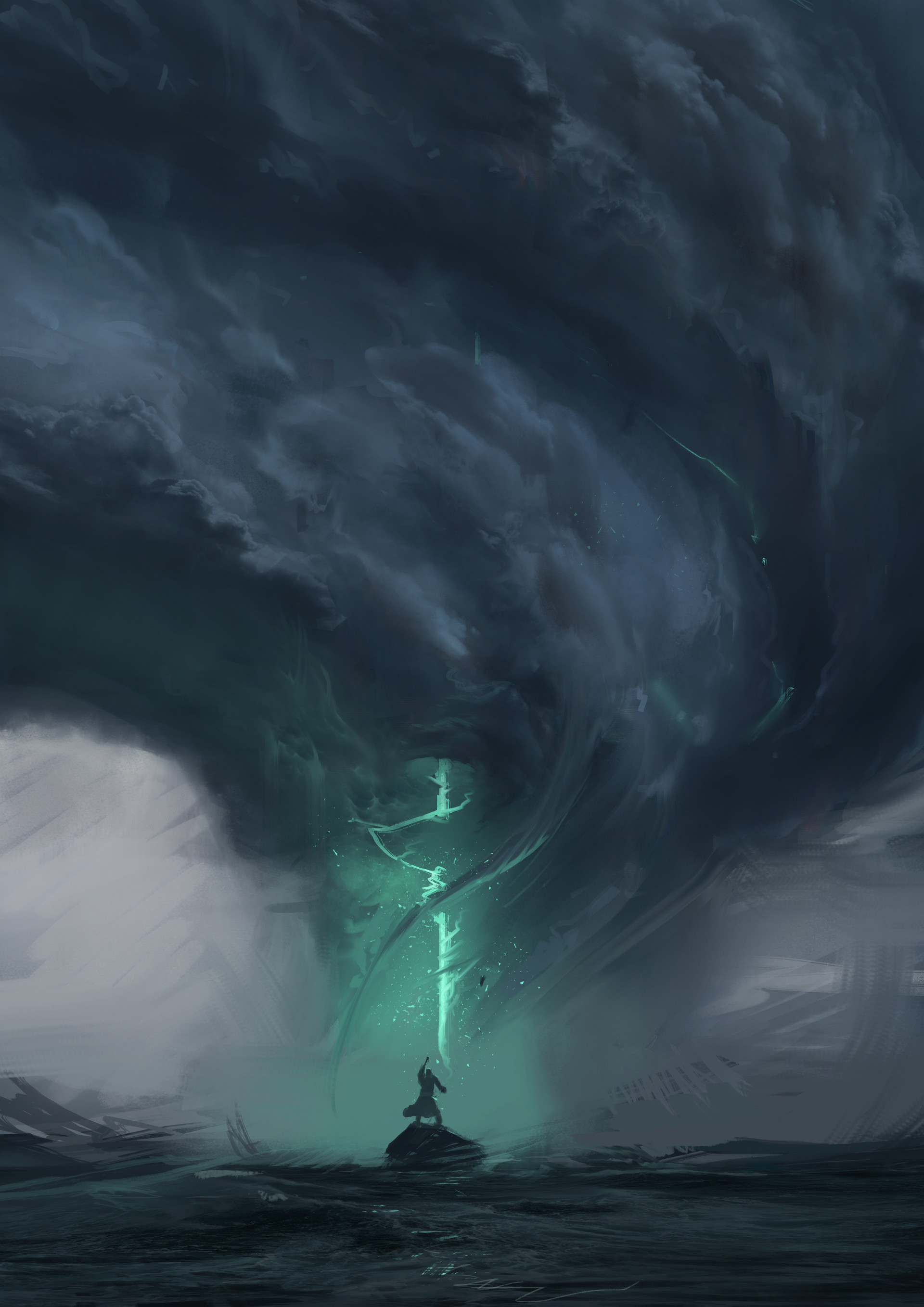

Oliver Mootoo
A Fulmen gathering knowledge, for better or for worse.

DESCRIPTIONS - THIRD LEVEL

Cast the Storm Across Mountains & Memories
See your victim. Inhale. Deeply. More deeply still. Your victim will feel then as if they have been struck by lightning. They will know your thoughts. They will know your intent. As they try to stop you, exhale. The storm inside your skull sends a budding piece of it across time and thought directly into the mind of your chosen servant. They may mentally fight back. As they struggle, repeat this ritual - simple as it is - and finish what you have started. 10% chance of failure. When you succeed, their brains have been utterly replaced with a sliver of the Plane of Lightning - your Plane of Lightning. In all ways are they now a mental clone of you. They know they are a budded thoughtform inhabiting a body of your choice and that they come from you. Your mind-clone will serve you in all ways. The original mind is gone, set adrift in the Plane of Lightning. Only by traveling there and capturing their lightning in a bottle can you restore them.

The Secret to Erasing All Knowledge of the Sageless Heretics
Grab your victim. Kiss them. As you do so, you create a bridge between your Plane of Lightning and their brain. In that moment, every single neuron they have is attuned to the infinite inside you. Choose which to kill. You are erasing vital information from their mind. Burning those neurons to cinders so that it literally can never be used again. Steal their ability to keep their heart beating, or their lungs filling with oxygen, and so on. A perfect assassination tool, used as such throughout Fulmen history. If used on another Fulmen, begins a tug-of-war between them; the two must say a word back and forth to each other, each taking a turn. The first to finish a sentence obliterates a chosen bit of knowledge in the other's mind that has less letters then the sentence does. A complicated affair - one oft avoided by Fulmens against each other to avoid the hassle.

Turn Thy Muscles Into Countless Thoughts
Be obliterated by your own Plane of Lightning. Let loose mental blocks you did not even know were there. It will flood your body. Your muscles will be destroyed, your skeleton too, every fiber of who you are. In a flash you are gone. And in a flash, you return. The lightning created assembles the perfect form. You levitate inches off of the ground. You are androgynous. You glow with sacred genius lightning. When you move, you move as fast as a lightning bolt does - or perhaps as fast as thought. You cannot be hurt save by silver or another's lightning. You need not eat, drink, nor sleep. Never again will you wear armor or wield a weapon or tool or touch another. In your mouth, your silver stake is still there. If it is ever removed, your form dissipates; you become one with the Plane of Lightning and disappear from all other worlds forever more. A method of ascension used by Fulmens to enter the Plane of Lightning and learn secrets that cannot be contained by mortal bodies - the secrets of the 4th level.

Dr.Manhattan - Garry Galler
Gary Galler
What else, but an Ascended Fulmen?
Apotheosis of Lightning & of Thought

FULMEN ARTIFACTS

Argentate Wand
Rod made of bones from the left hands of spellcasters. Covered in pure silver. Attracts lightning and Fulmen's Secrets and redirects them to someone else around the wielder. Created in the East, where all Fulmens were hunted and killed.

Deliberation Coil
A coil of plastic, wood, and silver. Hand held. Attracts a single bolt of lightning and then forks it into 8 or less people within 10 feet of it. Each person struck is continuously struck; while continuously struck, all gathered can communicate with each other in ideas, visions, and thoughts- a method far faster than verbal communication.

Fulmen's Stake
Silver stake, covered in blood-rust. Belonged to a now dead or now powerless spellcaster. Insert into your mouth and learn 1 random Fulmen's Secret.

Ideation Cloak
This cloak of wool has the static thoughts of dead Fulmens contained within it. Any who touch it are shocked. If worn, an hour later, one's body is in tune with this, and no longer shocked. Increases the efficiency of one's brain, making them more apt to learn new ideas, skills, and other talents.

Knowledge Stake
Long silver stakes inserted into the hands, eyes, feet, and sternum. For each stake inserted, increase the % chance of success for your Fulmen's Secrets by 10% and become unable to use that part of your body save for spellcasting. If inserted in the sternum, suffer from a heart attack and die within 10d100 days instead. Inserted by Fulmens who know their time is short or that a great obstacle looms before them.

Looking Mask
A cloth mask covered in a reflective substance. When worn, Fulmen Secrets cannot effect you. The mask is reflective of the outside world. Worn whenever Fulmens schedule meetings with one another, and taken off to show respect and comfortably. 

Noo Quartz
Crystals that grow naturally when a lightning strike occurs. The lightning is not mortal; it is, somehow, from the Plane of Lightning. Grows into organic matter. Increases success rates of spells by 1% for every crystal growing on a Fulmen.

Potion Catatonia
Potion made from a Fulmen's blood, captured lightning, and air from the Plane of Lightning. Once mixed, forms a moving, shifting helix in its bottle - a liquid that feels like a gas and moves like a crawling solid. When consumed, reduces brain activity to a minimum, putting the consumer into a coma for 1d4 days. Fulmens have made many tools to destroy their would-be killers. A hint to what happens to mortals who visit the Plane of Lightning unprepared.

Speculation Censer
A censer of black glass. Melt pure silver in it. Breathe in the fumes. Allows you to communicate with a Fulmen who has ascended to the Plane of Lightning. Ask them questions for as long as you remain conscious, though the silver fumes will surely knock you out in 10d10 seconds. Used to make pacts with the Thought Lords, the Neural Gods, and the Genius Fulmens of ages long past.

Storm Razors
A pair of argentate wands with a bolt of lightning cackling between them, trapped. Wield both as a melee weapon. Swing them and anything they touch is electrocuted. Catch something between them and watch as the lightning obliterates them. 1d12 damage per turn touched or trapped. Used as an execution tool by Fulmens on those who broke pacts with the Thought Lords.

Tablet Cerebrations
A silver tablet. When in the presence of electricity, St. Elmo's fire radiates on it, revealing a map or words and instructions. Used by Fulmens to hide their now extinct orders from their hunters & destroyers.

Wisdom Bottle
Glass bottle made with traces of silver from Fulmen Stakes. Attracts lightning when uncorked. Can a single bolt of lightning, mortal or not. When uncorked, lashes out against whoever the bottle is pointed at and fades.
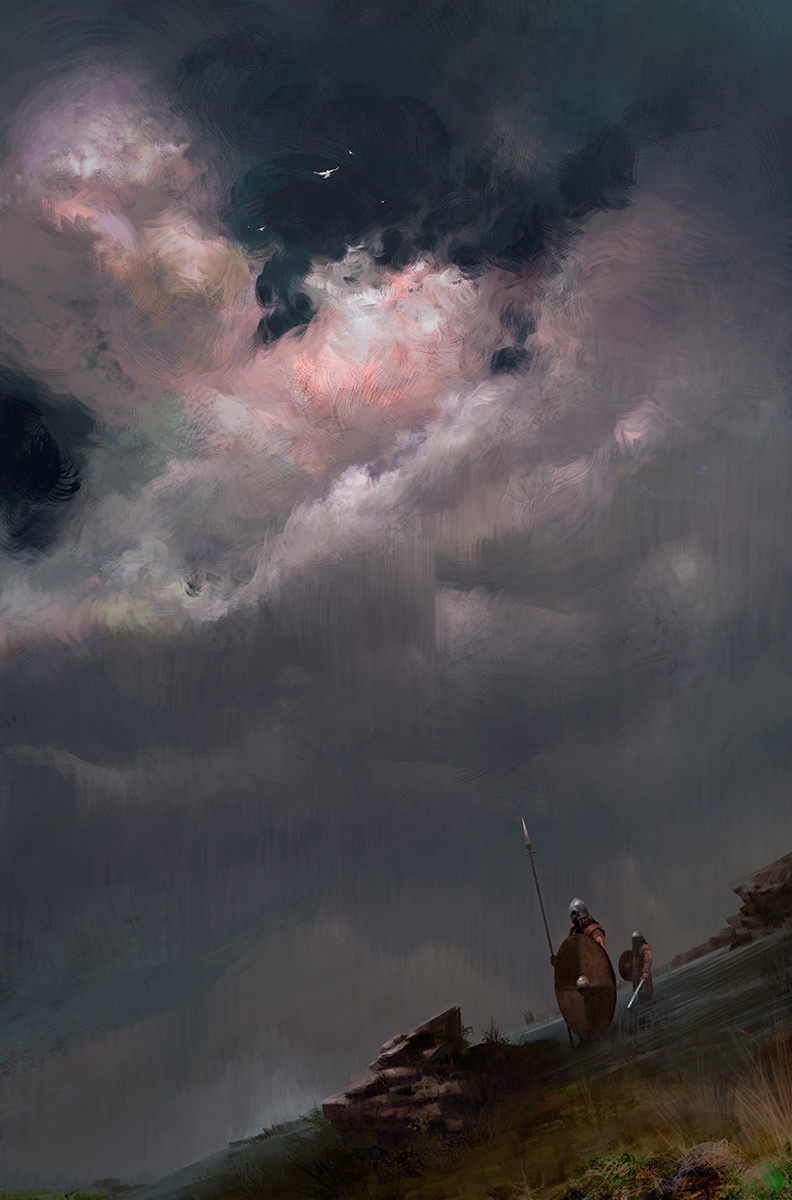
Storm is coming
Piotr Foksowicz
Follow the storm to follow the Fulmen.

Spell Slots as Hit Point Abstractions

Spell slots are limited. This is primarily for game reasons; the wizard cannot cast fireball more than X times a day, because if they could, people with swords would cease to matter, and that's not good for the game. But let's pretend that isn't the main reason and come up with a narrative reason, and thus maybe a new mechanic, for why Spell Slots exist.

By Seb McKinnon.

The Force of Magic

What laymen call magic - that is, the casting of spells, the working of rituals, and other such supernatural powers - is a deeply personal thing. Not just on the mental level, but on the physical as well. To cast a spell is to turn one's body into a channel for something utterly paranormal; to let something leave you and rearrange the world before you. This is an idea that many have discussed in a philosophy called the River & the Rain. 

The River is the actual force flowing through the spellcaster. It is that eldritch momentum that ignites a fireball in a perfect vacuum or that polymorphs a griffon's body into a comatose mouse.

The Rain is the greater force that the spellcaster is calling on. It is a metaphysical concept, an energy that permeates everything, the stuff that keeps the universe expanding, the noosphere too, and that ideas generate when conjured forth.

Together, the River & the Rain make up the force of magic. The more of the rain you can call upon to flow into your river, the more force the river has, or in other words, the spell you are casting becomes all the more powerful. This is a tangible thing. It can and has been measured by cabals of arcane workers, by congregations of divine priests, by circles of druids hidden in the hill and mist. This is, mechanically, what a spell level is. Call it a Spell of the 1st Circle if you want, or a Miracle of the 1st Order, or whatever name you can conjure forth. It all means the same thing: spell level.

And if a spell's level is tangible to the amount of force that the spell produces, and if this force is a river flowing through the spellcaster, then it is only natural that there are many limitations to spells - as many as their are limitations of the physical form.

For example, a human's max recorded jump height is 63.5 inches - a little over 5 ft or 161 cm. It stands to reason that, with little variation, a human cannot possibly jump higher than that; their biology will not allow it. So then is it true that a human can only cast spells so strong due to their own biological limit. It is a limit that can be raised with training, yes, but it is a limit nonetheless. And just as a human cannot jump their max height an infinite number of times, neither can the spellcaster cast their spells an infinite number either. Thus, spell slots.

Let's first translate this to some more interesting narrative concepts, and then see what it leads too mechanically.

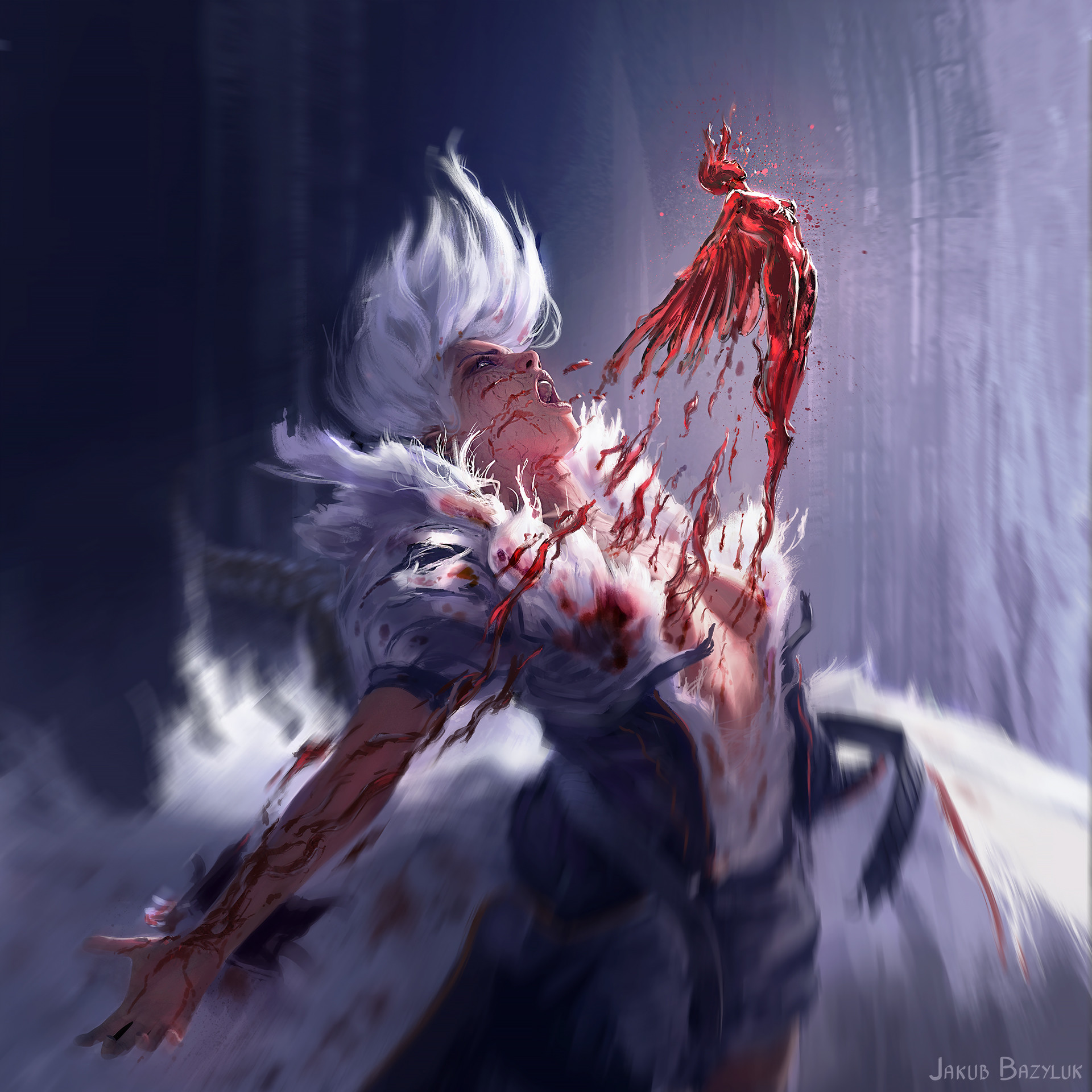
Machina Arcana - Sabina illustration
By Jakub Bazyluk. A spellcaster violently letting the River flow for a spell.

Magical Exhaustion

As the River flows so too does the spellcaster's body suffer wear and tear. Their neurons, during the casting of a spell, are firing on every possible cylinder. The complex network of bacteria, fungi, and cells that makes up a living being are all, for that moment, uniting their potential to one specific purpose. Such effort does not go unpunished. Eventually, a spell caster will expend all of their spell slots and be left with just their own, natural, mortal selves.

What does this look like? It is different, yet always the same. A feeling that one's heart is beating slower - that their blood is thinner than it was before - that their stomach cannot digest food or liquid. Thinking is done through a haze as memories are rebuilt and personality traits reestablished by the previously overloaded mind. It will feel like your nails are loose in their cuticles; like your bones are only barely attached to their joints.

In other words, it is not a pleasant feeling. Not like being exhausted, but similar, thus its simple term of being magically exhausted. No spellcaster likes it. Many avoid casting their last spell so that they can avoid this state. In games where they only get one or two spells a day at early levels, it is a state frequent. In exchange for being able to blow a door open or warp someone's perception of you, you just feel like abject shit.

Below, a d12 table. Roll on it when you spend your last spell slot. This effect is lost when you regain any spell slots. These effects are in addition to the above description.
  1. Your eyes are weakened; you see low detail versions of everything around you.
  2. You lose all sense of temperature except for a spreading, extreme heat inside of you.
  3. You vomit immediately, and can keep no food or liquid down for long.
  4. Memories of specific things, such as people's names, your favorite color, or the name of where you are disappear.
  5. Your personality is eroded, leaving you bland, neutral, and unimpressed with things around you.
  6. Natural instincts like fear, pain, and anger are gone, significantly mellowing your reactions.
  7. When others look at you, they forget what you look like, sound like, or act like the moment they look away.
  8. Your name is damaged; others can only remember and refer to you as either the first or last letter of your name.
  9. Non-magical things that you touch sometimes slip through your fingers as if they were never there.
  10. Your thoughts leak out of your head and into others around you.
  11. A magical, aurora-glowing sweat drips off of you and rises as steam too. Whatever it touches - clothing, grass, other's skin - it steals away its color.
  12. You continuously cry, though these tears you shed are more akin to blood than anything else.
A night's rest, a week's rest, whatever your rest is allows your body to heal, and thus the magical exhaustion ends.

Exhaustion serves as a way to note that you are growing stronger. Magical exhaustion is no different. Eventually, your ability to let flow greater rivers for longer duration will mean that magical exhaustion is harder and harder to come by. And just as muscles grow visibly larger, a spellcaster grows a greater presence the more powerful they become.

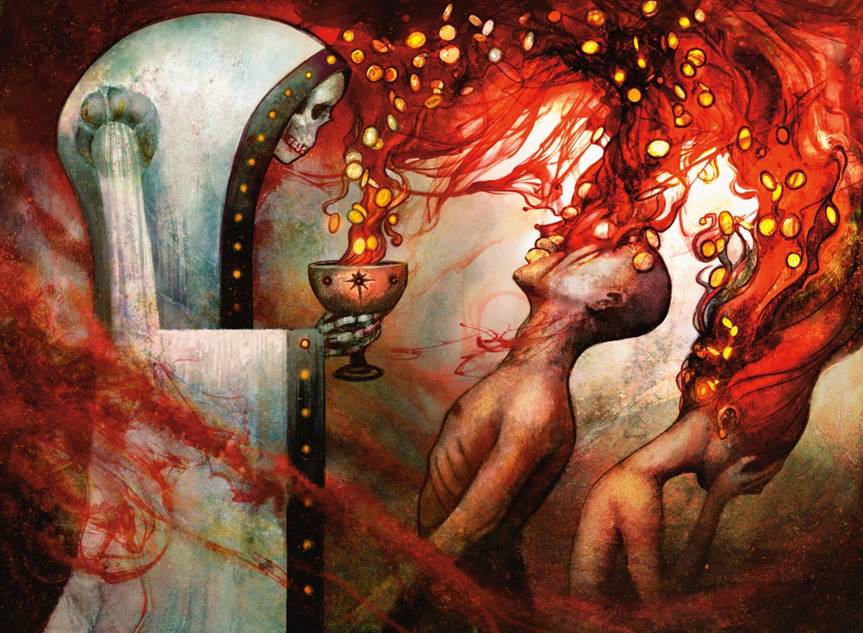
By Seb McKinnon.
Magical Exhaustion is similar to feeling as if you are fading away, mist in the sun.

Eldritch Presence

Eldritch Presence is the concept coined that shows how powerful a spellcaster is. It is an aura about them - a non-visible force that is felt in the minds of those close. The higher the spell level that the caster can cast, the more powerful their Eldritch Presence is.

It feels like looking at a sky where stormclouds are just creeping on the horizon. Like looking around and seeing a gentle wind pick at the trees and grass as the grey above grows ever darker. A gravity that does not pull you inwards,and a force that does not push you away but that threatens almost innocently. It sets your hairs on fire, waves of goosebumps racing from shoulder to hand. Cats will bristle if this force is malignant. Your hair will stick to your head, as if you are sweating. Glass fogs, blades become sharper, colors more vivid. Most noticeably of all, your thoughts will race. Faster and faster will you think as if something was empowering your mind in ways never before felt. Like an adderall drop, a hit of speed.

These effects are slight for neophytes. Even for those well-versed, able to cast magics entering into the third, fourth, fifth levels can they be written off by the ignorants who know not what Eldritch Presence is. But beyond that, it is tangible. It is a pressure. It makes the commons bow to the wizard, the king sit more rightly in their throne, the guards ever more guarded.

Hard it is to put a range on such an effect. The range is your sight. If you can see a powerful spellcaster, you can feel their Eldritch Presence. If they are close enough to you that you can hear their voice then you are close enough to feel their strength.

This is why dragons, demons, angels, and all other manner of superior creatures can confidently stare down a battalion of soldiers and not be harmed. So great is their Eldritch Presence that it halves the force of sword swings, makes arrows miss wide. Force field of Rain. Armor of Power.

And if this is how it feels to hold magic, and if magic protects you from certain death, then so too can magic be seen similar at hit points - abstraction of life as it is.

Guild Wars concept art.
Strong Eldritch Presence can even make others perceive you as something beyond mortal.

Spell Slots as HP

Spellcasting characters no longer have hit points. They instead have spell slots. If they are a half-caster (ranger, paladin) they are uniquely equipped, as now they have their starting hit points and their spell slots to protect them.

When a creature/character (hereafter referred too just as a creature) would suffer damage while having at least 1 unspent spell slot, they instead take no damage unless the damage die rolls either its max number or is above 6 + the amount of spell slots unspent, whichever is higher.

Example: if a 1d8 longsword attack is made against a wizard with 1 spell slot, the longsword needs a 7 (6 + 1) or 8 (max number) to hit. If the wizard has 2 spell slots, only an 8 will hit. If a 3, only a 9, thus requiring a modifier of some sort to deal damage.

If the damage meets one of these two criteria, the spell slot is lost.

If a creature is Magically Exhausted (no spell slots), any damage die rolled against it knocks the spellcaster out and either kills them or leaves them dying, depending on your exact ruleset. If they have hit points, then those instead are effected until the same situation occurs.

This makes magic-users more difficult to kill if they are completely fresh, but essentially makes them nothing better than dead meat if they are out of spell slots. Resource management is all the more difficult now, as you are spending hit points. It will become important for a spellcaster to find a way to regain spell slots more quickly, if not at least temporarily, in order to stave off death for just a while longer. But it also empowers spellcasters when fresh to take on big risks. They can match the great warrior in a duel so long as they allow the River to flow free and to flow hard.

By Seb McKinnon.
Even a little girl, enriched with magic, is mighty as the armored soldier.

Temporary Spell Slots

The following methods can be used to regain temporary spell slots; that is, spell slots that disappear when your normal spell slots are regained. You cannot have more temporary spell slots then you have maximum spell slots.

Places of Power, such as shrines, altars, magical lairs, old arcane battlefields, moonless nights with the right constellations, etc etc, can be meditated in for 10 minutes, regaining 1d4 spell slots. 

Rituals & Sacrifices if you are a divine/miracle caster can be done in the name of your Power/Divinity, allowing you to regain 1 temporary spell slot per miracle you know.

Eldritch Cannibalism can be done on a creature with Eldritch Presence. Drinking a dragon's blood or eating a captured pixie will give you 1 temporary spell slot per HD the creature has.

Contracts & Pacts & Deals can be made with a creature with Eldritch Presence. In exchange for a favor, they lose 1 spell slot and you gain 1 temporary spell slot. They cannot regain their spell slot until you lose your temporary one. Temporary spell slots gained this way are added on top of your maximum spell slots and do not disappear when you regain spell slots, instead only disappearing when the favor is completed or you die.

Various esoteries, like blue goldstones, opals with polished fire, or the tears of a heartbroken siren can be used similar to health potions, granting 1 temporary spell slot.

Related image
By Seb McKinnon.
The River can flow from one to another in pacts and rituals.

Cantrips & Other Outliers

In some games and traditions, spellcasters have access to cantrips - low level magicks that require little effort to use. If you can cast cantrips, you are using your Eldritch Presence to shape reality in a minor way around you. Even when Magically Exhausted does a spellcaster have at least a little presence, and thus can cast cantrips. Cantrips have no bearing on a spellcaster's hit point abstractions.

In some games and traditions, spellcasters eventually can learn to cast a low level spell as if it were a cantrip. This is a feat of great power. If you can only cast a single spell like this, treat it as if it were a cantrip. But, if you are, say, a demon with multiple at will spells, your Eldritch Presence is never truly diminished. The only thing that can kill you is a magical weapon of some sort or a spell being used to destroy you when your limited spell slots are spent. Mortal forces cannot.

By Seb McKinnon.
No steel nor arrow will kill that with Presence Eldritch as This.

Rising Legends - The Core Rules

Here's my umpteenth crack at a rulesbrew for me to use at home. I've designed it in a way that I think will make it easy for non-gamers to run, has clear depth, and remains out of the way for most people. BTW, I AM taking name suggestions.

Suke

Rising Legends is a game where you play as characters with nothing who try desperately to become something by putting their lives on the line.

To play, you need a d20 and a d6.

First, create your character. In order to do so, you follow three simple steps:

  • Roll for 2 keywords that describe your character, or choose them.
  • Write down your three attributes (Savvy, Athletics, and Weird), and assign each one of the following numbers: 12, 9, and 6.
  • Choose your starting supplies.
The referee of the game runs the world and obstacles. They will also provide the lists of keywords and starting supplies. Future blogposts/supplements will provide pre-made worlds and sagas, complete with their own lists of keywords, starting supplies, obstacles, adventure locations, additional rules, and other useful materials for running a game.

The referee describes the game world, and the players describe what they want to do. If they are doing something dangerous or difficult, the referee may ask you to roll under one of your attributes with a d20. If you roll equal to or lower than your attribute, you succeed. If you roll 10 under your attribute, you succeed with style, and the referee describes a bonus you get in the situation.

Keywords are words or phrases that represent your character. If your keyword applies to a roll, you can roll 2d20 instead of one and take the better result. If both keywords apply, you still only roll 1d20. 

As a character goes on adventures, they will find gear, magic, and helpers that will aid them. These should be notated by a player who receives such a bonus. Additionally, when a character finishes an adventure, they gain fame.

Fame is a number that represents how well known the character is in the wider world. At every increment of 10, your character will find themselves rewarded with something special . This can range from someone wishing to apprentice under them, to potentially gaining ownership of beautiful palaces, or even training which increases your attributes. Additionally, after every adventure, your character gains a new keyword. This keyword will either come from the earliest list, or be tailor made to fit your character.

If your character successfully rises to 100 fame, they become a Legend. At this point, they somehow leave the world, perhaps in a tragic twist of fate, or by being whisked away by holy powers, or even retiring to become the ruler of the land for a time after. 

Karl Sisson

During an adventure, your characters will come face to face with obstacles. An obstacle comes in one of three categories: Monsters (anything that the party encounters, including mundane things like bandits or lions), Hazards (which range from deadly traps to dangerous poisons), and Weirdness (such as horrible curses or strange powers). Every obstacle has a number associated with it, the Obstacle's Danger, which ranges from 1 to 10. When the referee says that a player must make a roll forced by an obstacle, they add the obstacle's danger to their roll.

Occasionally, an obstacle will somehow harm a player. This damage, represented by a 1d6 + the obstacle's danger, is dealt to one of the player's attributes. For example, a bandit's serrated dagger will deal 1d6 + 1 damage to Athletics, while a warlock's wicked hex will deal 1d6 + 3 damage to your Weird. If a number falls to 0, the players character is taken out until the obstacle has been overcome, the party flees, or everyone loses. Damage to an attribute can be healed with medicine (or similar means), or through rest. Every day of rest restores 1 point of damage to an attribute. Some gear, magic, or specially made tools can reduce damage taken.

While taken out, your character cannot do anything and is effectively unconscious on the ground (or in the case of Weird being reduced to 0, is rendered immobile by some strangeness). Once the obstacle is no longer present, the player rolls 1d6 for their character and consults the following table for their character's fate.
  1. Scarred! The character bears a distinctive scar from their encounter, but is otherwise fine.
  2. Traumatized! The character has been traumatized by the obstacle. For the next 2 game sessions, the player adds 3 to any rolls they make.
  3. Crippled! The character has been crippled in some way by the obstacle. The referee chooses a relevant attribute to be reduced by 3 permanently.
  4. In debt! Your character should have died, but has made a deal with Death itself in order to live. The referee comes up with a condition (such as "You must pay respects to me through blood sacrifice at midnight every night!") If the condition is not fulfilled at any point during the rest of the character's life, they die.
  5. Spiritless! The character has lost their spirit for adventure. They wander off, seeking a quiet place where they can retire.
  6. Dead! The character succumbs to their wounds and dies.
When trying to overcome an obstacle, you must reduce its danger to 0. This can be done through a number of ways, such as subduing it, killing it, banishing it, disarming it, and so forth. To overcome the obstacle, the referee will ask how you do so, and then tell you which attribute to roll under. The amount you rolled under is how much the obstacle is reduced by. Always use popcorn initiative--or the person whose turn it is deciding who goes next--to decide turn order. After everyone has went, the last person to go now goes first.

Beware! Many obstacles cannot be reduced through conventional means; a dragon cannot be killed with simple sword strikes, no more than a spear will scare away a ghost. If your described plan doesn't work, the referee will tell you that you automatically fail and describe how. 

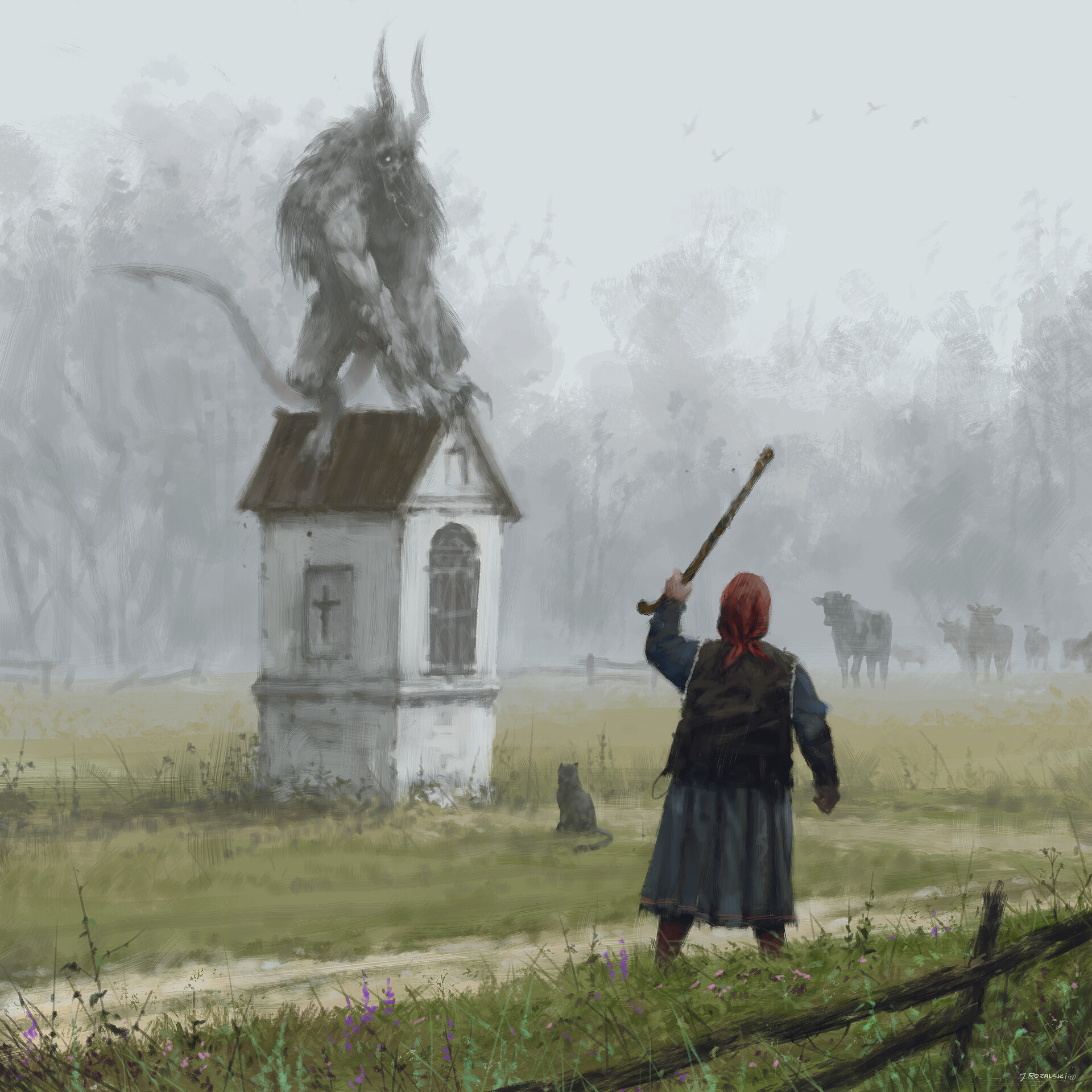
Jakub Rozalski

Draft 1 of the Rogue Game: A mini-game for running Stealth Encounters

Talking in the OSR discord about new ways to do stealth has led me to want to make stealth into a mini-game, much like combat. So, this is my attempt at what is the Rogue Game.

Image result for thief  fantasy art


WHAT IS THE ROGUE GAME

The Rogue Game is similar to combat--it is a separate mini-game within the greater game itself. If played with We Mortal Legends, just bust these rules out in the middle of gameplay. Otherwise, this will begin a series of actions much like running a combative encounter.

Stealth is the Rogue Game. In the Rogue Game, players will navigate traps, shadows, and guards all looking to catch the players.

Rogue Game Goal: There is a goal at the end of the Rogue Game: to reach an area where stealth is no longer required to progress forward. This can be a treasury, escaping a dungeon, or reaching the apartments of some target of assassination. There can be additional goals as well, such as:
  • Recovering treasure.
  • Recovering information.
  • Killing a target.
  • Planting evidence.
  • Sabotage.

Failing the Rogue Game: The Rogue Game fails if players die, if Guards alert the entire Complex to the players presence, party SD falls to 0, or if the players are somehow captured or incapacitated during the Rogue Game.

The Rogue Game vs Stealth: The Rogue Game is initiated whenever the players need to move stealthily throughout a large space (such as dungeon halls, a large treasury with a dragon in it, or across a field to a castle wall). Normal stealth can and should be used for your appropriate system when doing short-term stealth traveling.

Image result for sneaking fantasy art


ANATOMY OF THE ROGUE GAME

The following terms are the lingua franca of the Rogue Game. They will be explained in practical terms further below.

Round & Turn: As per combat. Each round is equal to a minute of time if you need to measure time. It can easily be considered as ten minutes or so as well.

Zones: The tunnels, maps, and rooms where the Rogue Game takes place. Each zone has its own guards, Light Dice dedicated to it, and obstacles. The more zones a Rogue Game includes, the more difficult it is.

Shadow Dice (SD): The entire party has a pool of shadow dice. This is a die whose size can change throughout the Rogue Game, depending on certain conditions. This also decides turn order, as discussed in the next section.

Light Dice (LD): These are used by the Gamemaster, who has either a 1, 3, or 5 light dice. They function the same as Shadow Dice, and are used to set DC's for checks, saving throws, or contested checks between Guards/traps against the PCs. The more you have, the more difficult the Rogue Game. They start at d20 and can vary in size like Shadow Dice. Each zone has the maximum number of LD in it--once all LD are used in a zone, no more can be used. LD can be triggered during any player's turn.

Skulduggery: These are actions a PC can take on their turn. It can be anything from moving forward (at half their normal movement rate), undoing a trap, scanning the area, or setting an ambush. As a default, these things have no roll associated with them. The players, being cautious, simply do them. However, the GM can choose to spend Light Dice to force the player to spend Shadow Dice to impose difficulty on the roll. EX: John wants to peek around the corner and scope out the tunnel. Normally, he does so just fine. The GM rolls one of their 3 Light Dice. John must spend a SD and roll above the LD to see what's down there. In these situations, the GM should always explain what is imposing difficulty on this.

Guards: Guards are anything that can detect a player. How many guards, what kind, their movement patterns--all of this should be thought up in vague terms by the GM. If you need a simple statblock for guards, use this:

Name:
Number: How many Guards are in this specific patrol.
Reaction: A d6 table for the Guards reaction to the players or a single reaction they will try to take.
Movement Pattern: What parts of the zone they frequent.
Special Qualities: Unique stuff.

Obstacles: Obstacles are traps, environmental hazards, area-based spells/curses, and treacherous territory. When encountered by the PCs, these obstacles must somehow be overcome. If the PCs method of overcoming the obstacle is not full proof (such as flying over a pit or using rope to climb a cliff), the GM can spend an LD for free to set a DC for the obstacle.

Image result for sneaking fantasy art

PLAYING THE ROGUE GAME

Below is offered a listed procedure. Specifics will be below that.
  1. The PC's enter into an area dangerous that they want to stealth through. The Rogue Game begins.
  2. Take the total Wisdom, Intelligence, and Charisma modifiers (or the combination of the Savvy+Athletics 10's digits in We Mortal Legends) of the party and add them together. This will give the party their entire pool of d20 Shadow Dice. If using 5E, take the Proficiency bonus of the party and add the highest Dexterity modifier found in the party. Having these numbers on hand before a session begins makes things faster.
  3. GM decides how many Light Dice they have, and how many zones there are, and what is inside the zones. This is best to have prepared before the game.
  4. The following factors are considered for lowering the die size of the SD.
    • More than half the party is wearing medium or heavier armor.
    • The players are in open daylight.
    • There is nothing to hide the players.
    • Guards are already alerted to the player's presence.
    • A PC is dead, unconscious, or otherwise incapacitated.
    • Something is actively chasing the PCs.
  5. If all of the above conditions are met, the Rogue Game ends in instantaneous failure.
  6. Compare LD and SD pools to see who goes first.
  7. Each PC can take a turn. Use popcorn intiative or a marching order to decide this.
PCs will encounter obstacles and Guards throughout the Rogue Game. They must use Skulduggery to overcome these obstacles. 

Lowering SD: Shadow Dice decrease by pool size and die size. A single die must be spent in order to succeed against the GM's LD. When an SD is spent, the rest of the party can elect to help, allowing the SD to be rolled twice and the higher number to be taken. If the SD is lower than the LD, the entire pool of dice decreases in size by 1 die step and the obstacle is still overcome. If this occurs when the SD are 1d4's, the Rogue Game is lost. NOTE: Just because failure is mitigated in a way doesn't mean there are no consequences. Losing the SD vs LD showdown can trigger Guard features, call more Guards to an area, or cost hit points, as per GM's discretion.

Recovering SD: If the PCs take a 10 minute breather to regain their composure in between zones, they can choose to either regain all missing SD, or to boost their SD by 1 die step if below a d20.

Lowering LD: If all LD in a zone are overcome, the LD in the next zone are all decreased by 1 die step.

Raising LD: If SD are decreased by 1 step, LD are increased by 1 step in the next zone.

Combat in the Rogue Game: There isn't true combat in the Rogue Game. If an ambush or assassination works, with or without roll, it just works. This can create new obstacles however: all the guards are dead, but now the bodies have to be hidden lest they be discovered. At the GM's discretion, a 2nd LD can be rolled and spent when an ambush or short combat happens, subtracting that many hit points from each PC's maximum hit points.

Changing Zones: Zones are easily changed. Once the PCs reach the end of one zone and enter into another, they are given a chance to take a breather. This does not mean they are safe: guards and other dangers can find them.

Image result for sneaking fantasy art

EXAMPLE SCENARIO FOR THE ROGUE GAME:


Stronghold of the Witchmother
Time of Day: Night
Zone #: 3 (fields, castle wall + courtyard, interior stronghold)
LD #: 5

Fields
Guards:
  • 5 patrols of Castle Guardsmen watch with arrows, burning oil, treacherous, and bells.
  • Blink dogs in the fields hunt slowly, seeking anything they can find hidden.
  • Ravens bewitched to flock around discovered invaders.
Obstacles:
  • Pitfalls dug and hidden underneath the field soil. Spikes are underneath.
  • 20 foot wide moat around castle wall.
  • Random moving spotlights on castle wall.

Castle Wall + Courtyard
Guards: 
  • 5 patrols of Castle Guardsmen, same as those watching over the fields.
  • 4 Gargoyles positioned in the 4 cardinal directions.
  • 5 more patrols of Castle Guardsmen who walk around the perimeter of the courtyard.
Obstacles
  • Gravel pathways and dry leaves in the grass to make footsteps noticeable.
  • Statues that, if approached, will sing.

Interior Stronghold
Guards:
  • 10 patrols of Castle Guardsmen, 6 of which are currently sleeping in barracks.
  • 5 Sentient Paintings whom can move from one painting or mirror to the next.
  • The Mother's Daemon, a demon conjured by the Witchmother of the Stronghold. Haunts the doorway between her bedchambers and the rest of the stronghold.
Obstacles:
  • Stairways that, if the railing is not touched when going up or down, rumble and move.
  • Doors enchanted to look false to look like walls behind the doors.
  • Rats that swarm those traveling the Stronghold at night without a charm from the Witchmother.
  • Lamps and scones that shed white light on hallways, making classical shadow-stealth impossible.

Guard Stats

Name: Castle Guardsmen
Number: 3
Reaction: Scream intruder and engage in melee combat.
Movement Pattern: Castle walls; watch over fields; courtyards; interior strongholds.
Special Qualities: Wear a breastplate (medium armor), and have crossbows, long swords, daggers, and spears. 1 HD per guard.

Name: Blinkdogs
Number: 2
Reaction: Scream the scream of a woman being gutted before disappearing and attacking.
Movement Pattern: Fields
Special Qualities: Can teleport a distance of 30 feet and make attacks with claws and fangs afterwards.

Name: Gargoyles
Number: 1
Reaction: Sing the Witchmother's anthem, fly into the air, then swoop in to attack.
Movement Pattern: Courtyard
Special Qualities: Immune to bladed weapons, can fly, and strike with fists that do damage as if boulders.

Name: Sentient Paintings
Number: 1
Reaction: Will jump from painting to painting searching for Guardsmen to alert.
Movement Pattern: Interior Stronghold
Special Qualities: Move from painting to painting at a rate of 3 paintings a turn. Each room or hallway has 1d8 paintings in it. If painting is destroyed with Sentient Painting inside, the Sentient Painting is killed.

Name: The Mother's Daemon
Number: 1
Reaction

1-2: Bargain with the players, offering them assistance if they kill the Witchmother and offer them a blood sacrifice.
3-4: Will engage the players in combat.
5-6: Will wake the Witchmother.

Movement Pattern: Interior Stronghold - Witchmother's bedchambers only.
Special Qualities: Cannot be hurt save through spell or magic weapons. Invisible but has a shadow. Attempts to possess players (free use of an LD). If successful, will only be exorcised through magic or rendering possessed player incapacitated. If struck with Holy Water, hears prayers, or if the doorway is destroyed, it is dismissed.

Creating a We Mortal Legends Starting Kit pt. 1: Bastards and Warlords

There are 2 main legends (a different take on classes) in We Mortal Legends: Bastards and Warlords.

Image result for swords and deviltry [book]
Fafhrd & the Grey Mouser are good to ape here.

Bastards are characters who have an X factor: thief skills, maybe, or flashbacks to set things up with, or a danger sense for when the going gets tough.

Warlords are characters who can force their way through things, lead men to the brink of death and back again, or characters that are just too damn tough to knock over.

I thought for a long time about a third "core" magic legend, one that can fit in any genre of game like these two. But in a game with 8 magic systems and that is meant to run Cyberpuk too and where you only pick a couple for a campaign, it didn't make sense to me. Certainly for each magic system you can make a legend, and I'll make one as an example in the future (when I revisit the Saint project). You can also make all kinds of weird legends for different reasons (the Runner for when I get my Cyberpunk post finished or the Medusa as an example race-as-legend).

But these things aren't ubiquitous enough for me. Having just a "Magic-User" didn't cut it for me either. I actually am not the biggest fan of magic-user/wizard classes or clerics/druids. These classes have X-per-day features when the other two cores have always on abilities. I've never had fun playing a level 1 Magic-User whose used their 1 spell for the day; I can't do cool thief/specialist stuff after, and I can't really fight anything, so I feel like a random NPC. For some tables, that's good, and I don't look down on that. And while I don't want to go to the opposite extreme of Superhero stuff (ala 5E), there has to be a sweet spot in the middle for me.

So, these two legends are my sweetspot. These are the default "If you make a legend for this system, it should be something like this." My biggest litmus test for these 2 legends was: would I enjoy playing both of these for an extended period of time and if someone else was playing the same legend. From a read, my answer is yes. We'll see how that holds up through playtesting.

Note: The bastard has appeared in an earlier blogpost. I'm putting it back here just for the purpose of solidarity, and to do some minor updates to it. Ctrl+f "LEGEND: WARLORD" to skip down to that.

PLAYING WITH LEGENDS IN OTHER OSR GAMES

It's simple. If you want to play a Bastard or Warlord in another OSR game, follow these steps.
  1. Choose one of the abilities from options 51-70. This is the classe's starting ability.
  2. Bastards have HD/saves as a Thief; warlords as a fighter.
  3. Choose an ability 71-90. This ability is gained at level 5.
  4. Choose an ability 91-00. This ability is gained at level 9.
Simple.

If you play 5E and want to convert these, it won't be very balanced, but you can still do it. Just choose a feature between each bracket above 50 (so 5 features in total), and assign them to each of the 5 levels a sub-class gains a new feature. Bastards are Rogue Archetypes, and Warlord's Martial Archetypes.

LEGEND: BASTARD

You're not a good person. You might be compassionate, you might be kind, you might be gentle, but deep down, you will lie, cheat, and steal whenever you have to if it means getting what you want. Some bastards are thieves, and they do well. Other bastards are assassins, or wilderness guides, or snake oil salesmen all. But wise men the world round understand that bastards can be as useful as they are dangerous.

Image result for Harrison Ford art
If Harrison Ford has played it, that character has been a Bastard.

Roll 1d6 on the following tables.

What's Your Game?
Each roll on this table will give you a Legend Feature from your Character Advancement Table (CAT). Reference the table with the appropriate # received. If no options fit, make up your own and choose a Legend Feature from CAT numbers 51-70
  1. Thievery can make a man rich if he knows how to flip his wares fast enough. Start with 57-58.
  2. Lead someone through the dark parts of a city, or some dank forest, and let fortune line my pockets. Start with 55-56.
  3. This here vial, see how purple it is? A sign of God, surely. Drink it, it'll take all your ills away. Start with 61-63.
  4. Fickle, life. Easy to take. Never cheap, though. Never cheap at all. Start with 68-70. 
  5. No games, just good fuckin' times! I go in, see what I can shake up, and dip out. Start with 64-67.
  6. Daredevils like me live for the thrill. I don't care what gets in the way 'long as the adrenaline pumps. Start with 59-60.
Who Wants Revenge?
The NPC rolled on this table is hot on your trail and wants nothing more than to even the score.
  1. I loved them, and I loved a few others too, and now those few others all want a knife in my back.
  2. A whole town in an uproar, all over me? Best believe I'll never go back there.
  3. No, I didn't know they were the child of that crimelord. But I know now, and don't plan on ever seeing them again.
  4. It was a memento, but their lover was dead and I had a debt I needed to pay off. What's the harm of helping the living?
  5. Yeah, I killed them. Was a mistake--wrong target and all that.
  6. It was a lot of money, but there were two of us, and two shares is always better than one. They knew it was all business in the end.
Name Your Contact
Name the NPC you roll on the following table. This NPC is a contact you know will always help you with something specific.
  1. They trade in exotic insects from some strange place. Runs a whole den dedicated to getting bit and tripping out. Says you can see the future, for the right price.
  2. Not quite sure if they're human or not. Blue-green skin, black eyes all around. But they know ways I don't, ways into places and ways out too.
  3. Farmer turned warlord turned fucking city watch. Not the most illustrious career, but when muscle is needed, good hell do they raise it.
  4. Not sure if I'd call them a priest, a cultist, or a monk. Something different, I'm sure. But ask them three questions and give a special tithe, and they'll ask a god those questions and give you back three answers.
  5. I've betrayed this one catspaw more times then I can count. Each time, they help me still. Got a dirty favor and I'll pass it on.
  6. Top to bottom the whole organization is screwed. They owe me two more favors, so long as they involve a prized painting or a ring made out of saint bone.

Starting Equipment
You start with 10d10x5 currency, all of it a loan from someone who wants it paid back sooner rather than later. Additionally, you start with the following:
  • (a) a false identity and supporting documents or (b) 3 vials of poison, one of which robs sight, another speech, and another their memories of a loved one
  • (a) a pair of gloves that make it so your touch can't be felt or (b) a pair of boots that make no sound
  • a dagger (which you have at all times, even if you have been stripped of all weapons), and 2 tools of your choice from any type
  • traveling gear containing the basics for your world, though missing (a) a pillow (b) something to sleep in or (c) an additional set of clothing

THE BASTARD CAT
Below is your Character Advancement Table (CAT) for the Bastard Legend. Spend 1 XP to roll on it randomly, or XP equal to the 10's digit/2 (rounded up) for a specific roll. If the option has more numerous slots on the table, choose the 10s digit of the highest number.


1-20: HD increases by 1. Roll again and add 20 to the roll unless you choose this option from #50.
21-30: Add +1 to all saving throws.
31-40: 1+your level of hirelings are attracted to you by reputation alone.
41-49: When you roll for a keyword, roll an additional 1d20.
50: Choose any of the options between 1-49, then roll again, adding +50 to your roll if it's 50 or below.
51-52: Secret Smeller - You got a nose for secretive and hidden things. When you enter a room, you spot a hidden door, secret chest or safe, or a trap of the Referee's choice. On reroll, you can spot 1 additional thing.
53-54: Contacts on Every Continent - You gain an additional contact of your choice every time you roll this option.
55-56: Dangerphobia - When something hostile or dangerous happens, you can escape it's attention so long as you have a reasonable way to do so and until it starts looking for you specifically. On reroll, you can choose another person to also benefit from this feature.
57-58: Second-Story Work - When you see something you want to steal in a building, ruin, or otherwise guarded area, roll 1d10. If you spend that many days studying the thing's security, you learn both all the details about it and a single potential way to get around them. On reroll, subtract -1 from your 1d10 roll.
59-60: Danger Sense - Whenever you enter into a room, street, or otherwise new area, you know one of the following details: if something is watching you specifically, if something is following you, or if something is dangerous is waiting for you. On reroll, choose an additional option.
61-63: Counterfeit Tongue - When talking to a specific person or an audience, as long as no one in that audience contradicts you, you can convince them that any one thing you have has one of the following properties: is worth a king's crown, was sanctified by a major religious figure, can cure any ill, or can bring good fortune to the buyer. This works 1d6 times on an audience and anyone in it, afterwards they no longer believe you. On reroll, this works +1 additional times.
64-67: An Eye for Debauchery - When you meet someone new and talk to them for at least 10 minutes, you learn one of the following details about this: which of the seven deadly sins they most frequently commit, one vice they are addicted too, or one dangerous act they are willing to indulge in. On reroll, you learn an additional detail.
68-70: Throat-Slitter - When someone or something is completely unaware of you and you know how to kill it, roll a Savvy Check. On a success, you kill that thing. On reroll, roll again on your Bastard CAT.
71-72: Bad Luck Bares Baby - Whenever someone rolls a 13 or a total of 13 on any check, you cause that person to fail their check. On reroll, you can choose one of the following numbers instead: 0, 3, 7, 20, 66, or 100.
72-76: Weird Stealer - You've stolen a single estoery of your choice. On reroll, steal another esotery.
76-80: Archthief - You gain one of the following benefits: you can scale walls or cliffs without rope or handhelds, you can hide inside of shadows as if they were utter darkness, you can open any lock, you can pick any pocket, or you can leave no trace of your passing. On reroll, choose an additional option.
81-82: The Bastard with a Thousand Faces - Create a new identity, complete with 2 keywords. When you adopt this identity, replace up to 2 of your keywords with these additional keywords. It requires at least an hour of makeup and focus to change identities. On reroll, gain another identity with another 2 keywords attached to it.
83-84: Lucky Flashback - Roll 1d4 at the start of a game session. During that session, you can have a flashback that number of times, explaining why you are prepared for whatever situation you are in. The flashback has to include screwing someone over. On reroll, increase the die step by 1.
85-86: Trap God - You can construct any trap of your choosing as long as you have 30 minutes and the materials on hand. Additionally, any trap you come across, you know how to disable it if given at least a single minute of uninterrupted work. On reroll, reduce the number of minutes needed to make a trap by 5.
87-90: 9 Lives Jack - You've got 9 lives, and you've used 1d4 of them. When you would normally die, you can instead fake your death and reenter any following scene in any manner that you choose. On reroll, roll again on the Bastard CAT.
91: The Trick to Every Trick - Roll 1d4 at the start of your game session. You succeed on that many Savvy checks that you would otherwise fail during that session. On reroll, increase the die size by 1 step.
92: One Heist Under my Belt - You have already stolen a veritable fortune. Whoever wants revenge on you knows this, but no one else does. Roll a Savvy check whenever you spend from this endless well of money. On a failure, whoever wants revenge against you has gained 1d6 allies that know about your fortune. On reroll, roll again on the Bastard Cat.
93: Deal With a Devil - You've made a deal with something, not someone, very, very bad. Work out the details of the deal with the Referee. The deal must involve somehow involving the entire party. The thing will always uphold their end of the deal. On reroll, work out another deal with the GM. 
94: They Shot First - When you attack, kill, or otherwise hurt someone or something, you can shift all the blame onto them if less than 1d10 witnesses saw you. If you reroll this, decrease the die size by 1 step.
95: Copycat - Choose another Class Ability from a different classes CAT that is 70 or lower every time you roll this ability.
96: A Twist of Fate - Whenever you die, you can twist the skeins of fate. As a result of your death, all other PCs at the table will critically succeed on their next roll. On reroll, they gain an additional critical success.
97: Death Stealer - When you see a someone or something do damage, you can steal that method of doing damage for yourself. You can use this method, dealing the same number of damage dealt, 1d4 times. On reroll, increase the die step by 1.
98: A Set of Royal Pardons - You have a set of pardons from a regional ruler that is well-respected. You can use these to commit 1d4+1 crimes without receiving punishment. On reroll, you get another 1d4 pardons.
99: Prayer From Their Lips - You've stolen a prayer from someone. When you recite this prayer, roll a d100. If you roll under your total number of HD + Keywords + Spent XP, that prayer comes true. On reroll, you get another prayer.
00: The Bastard's Bastards - You've established a syndicate, mafia, black network, or cabal of followers. You have 1d10+7 followers and a secret headquarters at a place of your choosing. For each follower, roll on the Bastard CAT twice and assign a single keyword. They will remain loyal to you until someone makes them a better offer. On reroll, you gain an additional 1d6 followers.

LEGEND: WARLORD

Violence is your closest of kin and you know that'll never change. Since you were born you've found that your physical strength and your sixth sense for handling others has been your most bless'd weapon. This has given you a unique charisma, one that anyone can fall for so long as it promises hot-blooded action and the chance to leave something broken. Thus, you are a warlord. People will follow you into hell and back. Your hands, blood-stained, mold the world into a vision only your sharpened eye can see.

Related image
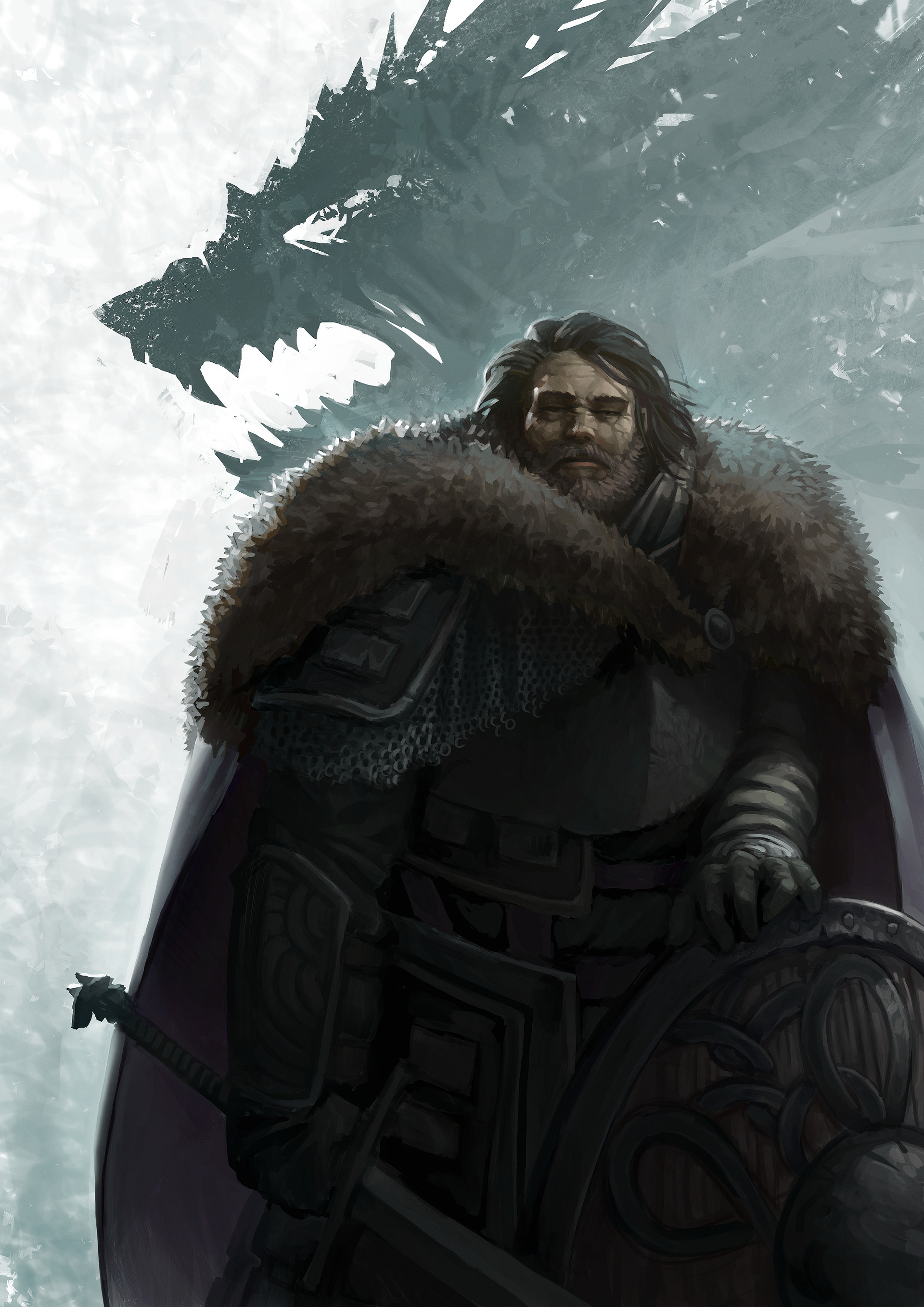
Ned Stark, Odysseus, Joan d'Arc, and even Conan are all Warlords to me.

What's Your Strategy?
Each roll on this table will give you a Legend Feature from your Character Advancement Table (CAT). Reference the table with the appropriate # received. If no options fit, make up your own and choose a Legend Feature from CAT numbers 51-70.
  1. Divide and conquer. It sows confusion, discord, and makes my soldiers realize that even the greatest walls are but brick. Start with 51-52.
  2. Brute force. An avalanche cannot be stopped, nor can I. Start with 57-58.
  3. The riskiest play always pays off. I put everything on the line and let the Fortunes guide me from there. Start with 59-60.
  4. Slow and steady slits the throat. I am cautious, gamble nothing, and exploit every mistake I see. Start with 53-54.
  5. Fast and loose, like the wind. We will raid them and run and do it again and again until our belllies are full. Start with 55-56.
  6. War by proxy is the easiest war of all. I use hired help, indirect tactics, and manipulation to pave the way forward. Start with 61-63.
Who Have You Bested?
The NPC on this table has been defeated by you and what you've taken from them has given you a hell of a reputation. It doesn't have to be a single NPC; it can be a warband, a corporation, a pantheon, or something else that you've battled with.
  1. We grew up as family, fought together as family, and won together as family. But in the end, only one could go further, and that one was me.
  2. They took from me everything. I took it all back, and then made sure they'd never have anything sacred again.
  3. It was business. Route them here, break them there. I did what I had to do. I won't say I'm proud of what I've done, but I'm proud at how well I did it.
  4. They were legends and I was not. Hard fought, bloody--but in the end, I was standing and those gods were not.
  5. Peasants, the poor, the sick. Culling them cleansed the streets but left the soul sicker than they ever were.
  6. They hated us and we hated them. Both sides were just. Both sides had fair claims to revenge. And I made sure only one side was left when everything was said and done.
What Are You Now?
The table below tells you what kind of force you're gathering right now. 
  1. Mercenaries. Fighting for a cause is best left to politicians and idealists. I just need to find a way to survive.
  2. Crusaders. There's something beautiful that we want to defend, spread, and empower. Obstacles in the way will be broken.
  3. Raiders. We have to survive, no matter what it costs us. They may need what they have, but we need it more--always.
  4. Heroes. Some say I'm drunk on fables and myth. I say that I'm special, and that those that fight with me will be special too.
  5. Purpose. There's something I need, and I know I'll need others to help me get it.
  6. Militia. We have to protect what we have at any cost, at all times.
Starting Equipment
You start with 6d12x10 currency, gained as a result of a recent battle that you've engaged in. If the number is odd, you lost the battle; if even, you won.
  • (a) the names of 10 violent souls who, if found, will die for you in battle or (b) a small band of 1d4 violent souls that serve you now and are as loyal as your payments are large.
  • (a) a scar that, when revealed to another creature, makes them hesitant to fight you or (b) a medal for your violent efforts that earns the respect of any authority that sees it.
  • any armor of your choice from your current Aesthetic's list and two weapons of your choice from your current Aesthetic's list, one of which has recently been used.
  • traveling gear containing the basics for your Aesthetic, though missing (a) rations (b) something to carry your gear in or (c) a set of undamaged clothing.
THE WARLORD CAT
Below is your Character Advancement Table (CAT) for the Warlord Legend. Spend 1 XP to roll on it randomly, or XP equal to the 10's digit/2 (rounded up) for a specific roll. If the option has more numerous slots on the table, choose the 10s digit of the highest number.

1-20: HD increases by 1. Roll again and add 20 to the roll unless you choose this option from #50.
21-30: Add +1 to all saving throws.
31-40: 1+your level of hirelings are attracted to you by reputation alone.
41-49: When you roll for a keyword, roll an additional 1d20.
50: Choose any of the options between 1-49, then roll again, adding +50 to your roll if it's 50 or below.
51-52: Divide & Conquer - When you and your allies have a creature separated from anything that can help it, or have it otherwise surrounded, you can act twice before it can act once. On reroll, choose an ally: they can act twice as well.
53-54: War Caution - When it is your turn to act, you can choose to instead learn one of the following pieces of information: any places around you that could be used for ambushes or hiding traps, a detail about a threat you're currently facing, if you can possibly kill a potential threat you can see, or a defense that a building, wall, or room has built into it. On reroll, you learn an additional piece of information.
55-56: Death by Wind - After succeeding on an Athletics check, you or any allies can immediately move 15 feet away from their current location. On reroll, you or your allies can move an additional +10 feet.
57-58: Overwhelming, like the Juggernaut - You can perform feats of almost supernatural strength, such as choking bears to death or knocking over large stone pillars. If you are under duress of any sort (combat, trap being triggered, pressure to perform), an Athletics check is required for these feats. On reroll, treat this as a +1 to your Athletics attribute.
59-60: The Dead Fool's Gambit - When you would take damage or fail a saving throw, you can choose to either deal 2d6 damage or to subdue your attacker if it is a creature. On reroll, you can choose to take -1 damage as a result of this, increasing by +1 on every reroll.
61-63: Great War Shout - Your orders, commands, and shouts motivate soldiers far beyond their abilities. On your turn to act, you issue some form of command to 3 of your comrades. These comrades gain 1d6 temporary AC. This temporary AC cannot stack or be refreshed and lasts only until you act again. On reroll, increase the number of allies inspired this way by +1.
64-67: The Rescuer - When someone you consider an ally and that you can see fails a saving throw, takes damage, or is otherwise targeted by an effect, you can move to their location instantly and make an Athletics check. If you succeed, neither you nor your ally suffer any consequences. If you fail, only you suffer the consequences. You can do this 1 time before your next turn. On reroll, you can do this an additional +1 times.
68-70: War-Trainer - Any allies of yours, up to 4 at game start, have been trained by you and increase their Athletics attributes by +1. You can train additional allies over the span 1d4 days to increase their scores by +1. On reroll, you can train men you've already trained an additional time, providing an additional +1 to their Athletics.
71-72: Trophy-Taker - Pick a number under your Athletics attribute. When you roll that number on an attack roll, you can sever a non-vital appendage of your choice from your target. On reroll, choose another number to trigger this off of.
72-76: Weird Warrior - You've learned how to fight with a new esotery of your choice. On reroll, gain another one.
76-80: One-Man Army - After making an attack, you can immediately make a 2nd attack. On reroll, you can take yet another attack.
81-82: Commander of Commanders - You have learned to give orders even in the most stressful of situations through music, banners, or just a damn loud voice. On your turn, you can give up to 3 allies of yours an order to complete right then and there. These allies are then given a bonus turn that they take immediately after your orders are given. On reroll, +1d6 more allied creatures can be given orders.
83-84: All Apart of the Plan - If you spend at least 8 hours planning for encounters in-game, the next encounter that you participate in ends the moment you take your turn, so long as violence is a possible solution. Describe what your planned strategy was and how you executed it. Then, roll 1d4; you and your allies suffer that many points of damage. On reroll, you can end +1 additional encounters this way.
85-86: Viscera Spread - You create grizzly trophies from the viscera of your enemies. These remains rot beyond recognition within 1d6 days unless properly embalmed with tools. You can brandish these remains at any time. Any non-ally that sees them is either shocked, appalled, amazed, or terrified, and will go silent for  make no checks unless defending themselves for 1d4 minutes. Targets can only see the same viscera once; new viscera is required to achieve this effect on them again. On reroll, increase the die size by +1 steps. 
87-90: Take Them All With Me! - When something kills you, you kill or break it in return as long as you could feasibly kill or break it. On reroll, you take +1 creatures or obstacles with you to the grave.
91: He Does Not Fall - When you would normally die, you can an additional turn before actually dying. On reroll, you can take +1 additional turns.
92: Wielder of Legend & Myth - With the GM's aid, create a legendary weapon with 1d4 special attributes to it. This weapon is sentient and can communicate through a single means of your choosing. Whenever a session begins, make a Weird check. On a failure, you are challenged by a warrior with 1d4 HD more than you, and an Athletics skill +1d6 above yours. If anyone aids you with this fight, your weapon instantly is taken by the warrior. If you die or lose, the warrior likewise gains the weapon. On reroll, roll again on your Warlord CAT.
93: Lives Are But Another Tool to be Used - When one of your orders results in the death of your ally, you can choose for their death to either do 4d6 damage to the target, or to subdue them. On reroll, roll again on your Warlord CAT.
94: Might Makes Right - Anyone who sees you physically best or kill another will not only keep the action a secret, they will become loyal to you. If multiple witnesses see you, roll 1d4 and gain that many hirelings. On reroll, increase the die step by +1.
95: Experience of A Thousand Wars - Roll 1d6 and record it. Any encounter you face, the number you rolled is always a viable means of overcoming that encounter in regards to the encounter's Overcome Table. On reroll, you can choose a different number.
96: Dipped in Immortality - The GM chooses a wrist, heel, or ear of your PC in secret. You can take damage no where else except that location. Damage taken to that location is multipled by 1d10. On reroll, decrease the die by 1 step.
97: Hands Deadlier Than Any Weapon - Choose a weapon category of your choice. Your unarmed attacks now have that weapon category's special feature. On reroll, choose an additional weapon category.
98: Avenger - When an ally of yours dies, you can use their weapon to banish, destroy, or kill whatever ended their life. If used against the killer, this weapon deals 1d10 damage against targets with hit points. Upon touching an obstacle that has no hit points, the weapon instead breaks their will and sends them fleeing. The moment the ally is avenged, the weapon loses all magical properties.
99: Standing One Against One Thousand - If you and your allies enter into an encounter against an enemy force that more than doubles your numbers, you and all of your allies gain one of the following benefits: +4 HD rolled immediately and added to your hit points, +3 to your Athletics attribute, or +1 additional turns that you can all take immediately after taking your normal turn. After the encounter has ended, the additional benefit(s) wear off. On reroll, choose another benefit to gain.
00: Vorpal - When you roll damage against something you know you can kill and the damage is 10 or higher, you instead kill your target. On reroll, lower the damage required by -1.